
Willow flat-body moth
Agonopterix conterminella
Description
How to identify
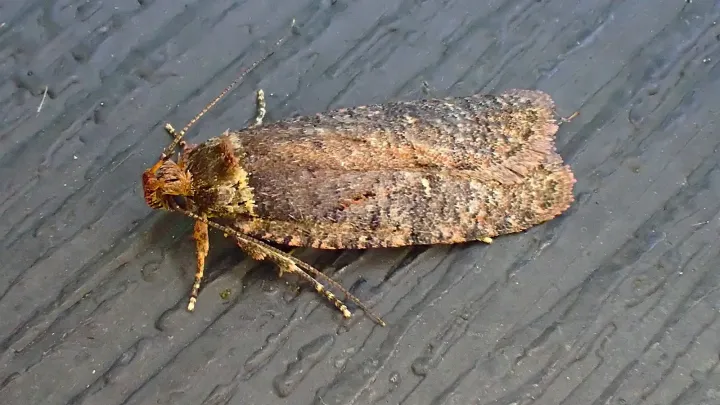
The Willow flat-body moth (Agonopterix conterminella) is a member of the Depressariidae family within the Lepidoptera order. These moths typically have a wingspan of 18–22 mm.
Adult moths are characterized by greyish-brown forewings with distinct dark markings, providing excellent camouflage when resting on the bark of willow trees.
The larvae are approximately 15 mm long, with a yellowish-green or grey body, a dark head, and dark spots along the sides of each body segment.
The species follows a complete metamorphosis life cycle. Typically, there is one generation per year, with adults generally overwintering in sheltered locations.
They are primarily associated with riparian zones and wetlands where various willow species thrive, often causing localized outbreaks in nursery environments.
What it damages
The primary host plants are species of the Salix genus. Young saplings and ornamental willow varieties are particularly susceptible to larval feeding.
Larvae feed on the leaves, concentrating their activity on the succulent new growth and terminal buds of the branches.
Severe infestations lead to extensive defoliation, which hampers the tree's photosynthesis and reduces its overall vigor and growth rate.
Feeding damage to terminal buds causes twisted, irregular growth patterns, significantly reducing the aesthetic and commercial value of ornamental willows.
In cases of high pest density, the cumulative loss of leaf surface area can weaken the trees, making them more vulnerable to secondary infections or environmental stress.
When it appears
Adult moths emerge in late summer and autumn, after which they seek hibernation sites beneath loose bark or within plant debris.
Activity resumes in early spring, as rising temperatures trigger the emergence of overwintered adults to begin egg-laying on new foliage.
Larvae appear in the spring, timed to coincide with the flush of new, nutrient-rich leaves which they require for optimal development.
The period of most intensive larval feeding occurs between late spring and early summer, leading to rapid maturation before pupation.
Pupation takes place within silk-lined leaf rolls or in protected crevices, with the new generation of adults emerging later in the season.
Signs of infestation
The most diagnostic sign is the presence of leaves that have been folded or rolled together and secured with silk webbing to form larval retreats.
Within these hidden chambers, one can find the larvae themselves or their frass, which confirms the active presence of the pest.
Damaged leaves often turn chlorotic (yellow), wither prematurely, and fall off, leaving visible patches of bare branches on the plant.
Upon closer inspection, the margins of the leaves will show irregular feeding notches where the larvae have consumed the leaf tissue.
Silken webbing connecting adjacent leaves or bridging the gap between leaves and stems is a reliable indicator of infestation by this species.
Control measures
Cultural control involves regular monitoring and manual removal of infested leaf clusters, which is highly effective on a smaller scale.
Sanitary pruning of affected branches during the growing season helps to reduce the local population of the moth and limits its spread.
If chemical intervention is required, systemic or contact insecticides registered for ornamental plants should be applied during the larval emergence phase.
Strategic timing is crucial; applications are most successful when the larvae are young and actively feeding before they have caused significant damage.
- Use of microbial insecticides containing Bacillus thuringiensis.
- Monitoring adult population levels using light or pheromone traps.
- Maintaining healthy plant vigor to enhance natural resistance to pest attack.
Taxonomy
- Latin name
- Agonopterix conterminella
- Order
- Lepidoptera (butterflies)
- Family
- Depressariidae
- EPPO code
- AGOXCO
Discussion
No discussions yet — be the first.