
Parsnip moth
Agonopterix heracliana
Description
How to identify
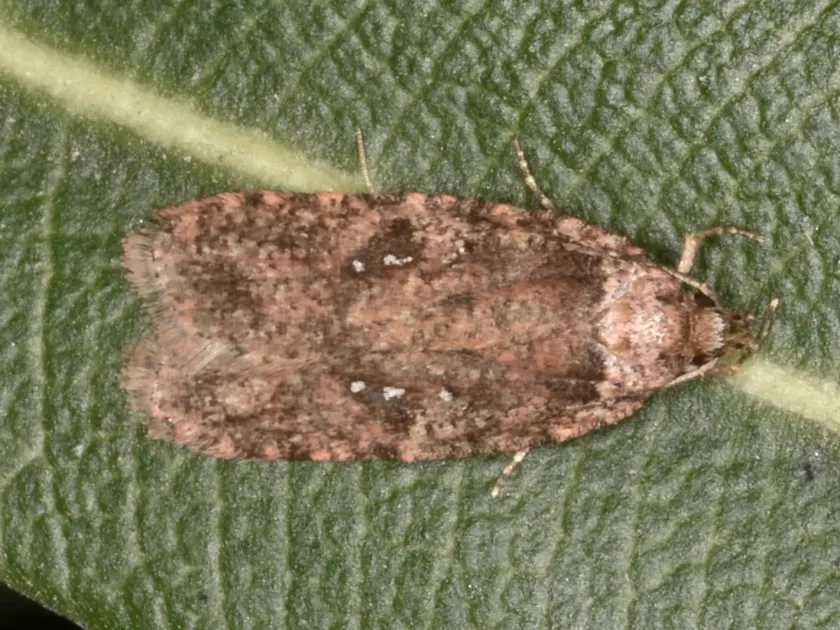
The parsnip moth (Latin Agonopterix heracliana) belongs to the Depressariidae family. The adult moth is a small insect with a wingspan of approximately 20–25 mm.
Its forewings are mottled with shades of brown and grey, providing excellent camouflage against the stems and foliage of its host plants while at rest.
The hindwings are paler with distinct fringes. When settled, the moth holds its wings tightly against its body, resulting in a narrow, streamlined appearance.
The larvae (caterpillars) are about 15–18 mm long, characterized by a yellowish-green color, a dark head, and noticeable dark spots near the base of their bristles.
Pupae are deep brown in color, measuring about 10 mm, and are typically found within silken shelters constructed by the larvae among the leaves or flower heads.
What it damages
This pest primarily attacks plants within the Apiaceae (umbelliferous) family, including parsnips, carrots, parsley, dill, fennel, and wild hemlock.
The larvae are the most destructive stage, as they feed on leaves, flower stalks, and developing seeds, which can severely impact yield in seed-producing crops.
By consuming floral parts, the larvae prevent proper seed formation, leading to significant economic losses for growers of aromatic herbs and vegetable seeds.
In root vegetable crops, infestation can weaken the plants, leading to stunted growth of the roots and reducing the overall quality of the final produce.
Severe infestations can result in total destruction of the plant's terminal growth and flowering umbels, often causing the entire plant to wilt and die prematurely.
When it appears
Adult moths overwinter in protected sites such as leaf litter, bark crevices, or garden sheds, emerging as soon as temperatures rise in the early spring.
The mating period and egg-laying coincide with the early vegetative stage of host plants, providing larvae with immediate access to the most succulent plant tissues.
The life cycle from egg to adult takes approximately 40–50 days, allowing for one or two generations per season depending on regional climate conditions.
Larval activity peaks between June and July, when the caterpillars are at their most aggressive stage, rapidly consuming plant material and preparing for pupation.
Overwintering adults are resilient and can survive cold temperatures, making the control of overwintering sites a key strategy in reducing population density.
Signs of infestation
The most diagnostic sign is the presence of silk webbing on the terminal shoots, which the larvae use to tie leaves together into protective feeding shelters.
Infected umbels (flower heads) appear distorted or "gnawed," with missing flower buds and poor development, often covered by visible frass (larval excrement).
Leaves exhibit small, window-like feeding patterns or irregular holes, eventually leading to skeletonized foliage as the caterpillars grow larger and increase consumption.
The presence of dark, granular droppings trapped within the webbing is a sure sign of active larval feeding and infestation on the plant.
If the webbing is gently opened, the caterpillars are easily visible; they often react to disturbance by wriggling backwards and dropping off the plant to the ground.
Control measures
Managing the parsnip moth requires an integrated approach focusing on early detection and the reduction of suitable habitats for both larvae and overwintering adults.
- Practice strict crop rotation to avoid planting Apiaceae crops in the same soil, which helps disrupt the localized lifecycle of the moth.
- Remove and destroy any wild Apiaceae weeds near the crop field, as these serve as alternative hosts and reservoirs for the pest population.
- Hand-picking larvae from infested flower heads is an effective strategy for small-scale garden plots where chemical usage is undesirable.
- Apply targeted biological insecticides containing Bacillus thuringiensis when young larvae are detected to minimize harm to beneficial insects.
- Perform deep tillage in the autumn to bury and kill overwintering pupae and larvae, reducing the overwintering survival rate for the next season.
Taxonomy
- Latin name
- Agonopterix heracliana
- Order
- Lepidoptera (butterflies)
- Family
- Depressariidae
- EPPO code
- AGOXHE
Discussion
No discussions yet — be the first.