
Parsnip moth
Agonopterix nervosa
Description
How to identify
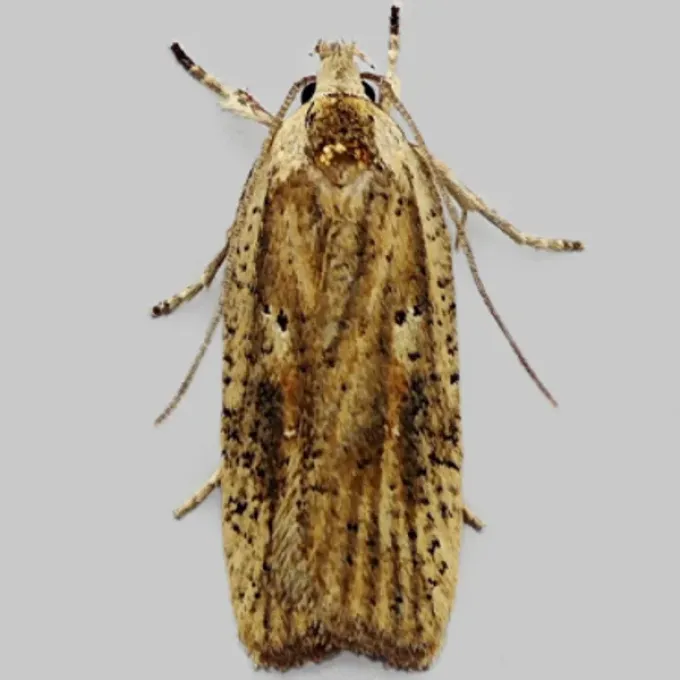
The parsnip moth (Agonopterix nervosa) is a member of the Depressariidae family within the Lepidoptera order. Adult moths have a wingspan of approximately 15–20 mm and exhibit a cryptic grey-brown coloration, which helps them blend into plant debris.
The larvae are highly active caterpillars, typically yellowish-green or green in color with a darker head capsule. As they progress through their larval stages, they grow in size and show more distinct pigmentation patterns.
The life cycle encompasses four distinct stages: egg, larva, pupa, and adult. The insect typically overwinters in the adult stage, seeking shelter under loose bark, in plant litter, or within structural crevices.
Adult moths emerge in the spring as temperatures rise, beginning their active flight phase. They mate and deposit eggs onto the host plants, ensuring that the emerging larvae have an immediate food source.
The duration of the life cycle varies depending on ambient temperature and humidity, with the potential for multiple generations per year in warmer climates, making it a persistent agricultural challenge.
What it damages
Larvae primarily feed on plants belonging to the Apiaceae family. This includes a wide range of economically significant crops such as carrots, parsnips, dill, parsley, and celery.
Beyond cultivated crops, the parsnip moth frequently inhabits wild relatives, such as hemlock and cow parsley, which act as reservoirs and facilitate the spread of the pest to commercial fields.
The primary damage is caused by the caterpillars, which feed on flower buds, blooms, and immature seeds. They utilize silk webbing to pull together the florets, creating protected feeding structures.
Heavy infestations result in significantly reduced seed yields. In younger or more vulnerable plants, damage to the growing tips can lead to stunted development or plant mortality.
The economic impact is most severe for seed production, where the loss of flowering stalks directly translates into substantial financial losses for the grower.
Signs of infestation
One of the most characteristic signs of a parsnip moth infestation is the presence of webbed clusters on the tips of the flower stalks or within the umbels (flower heads).
Affected plants often display distorted or shriveled umbels, as the caterpillars consume the vital reproductive tissues required for seed formation.
Small, dark, pellet-like excrement left by the larvae can often be found trapped within the webbing, serving as an indicator of active larval presence.
Careful inspection of the webbed clusters will usually reveal the larvae hidden inside. They are sensitive to disturbance and will wiggle violently or drop to the ground if their nest is opened.
Visual monitoring for adult flight activity during the evening hours provides an early warning of potential larval outbreaks that may occur in the coming weeks.
Control measures
Integrated pest management begins with sound cultural practices, such as deep plowing after harvest to destroy pupae and adults overwintering in plant debris.
Eliminating wild host plants in adjacent hedgerows and fallow areas is critical to reducing the overall population pressure on commercial crops.
Biological control efforts can involve the release of beneficial insects, such as trichogramma wasps, which are known to parasitize the eggs of various moth species.
Chemical control should be timed to coincide with the hatching of the first-instar larvae, utilizing approved insecticides that provide adequate coverage of the flower heads.
- Crop rotation to break the pest's life cycle.
- Removing and destroying heavily infested plant parts.
- Monitoring adult flight with light or pheromone traps.
- Applying selective insecticides that minimize impact on pollinators.
Taxonomy
- Latin name
- Agonopterix nervosa
- Order
- Lepidoptera (butterflies)
- Family
- Depressariidae
- EPPO code
- AGOXNE
Discussion
No discussions yet — be the first.