
Flat moth
Agonopterix
Description
How to identify
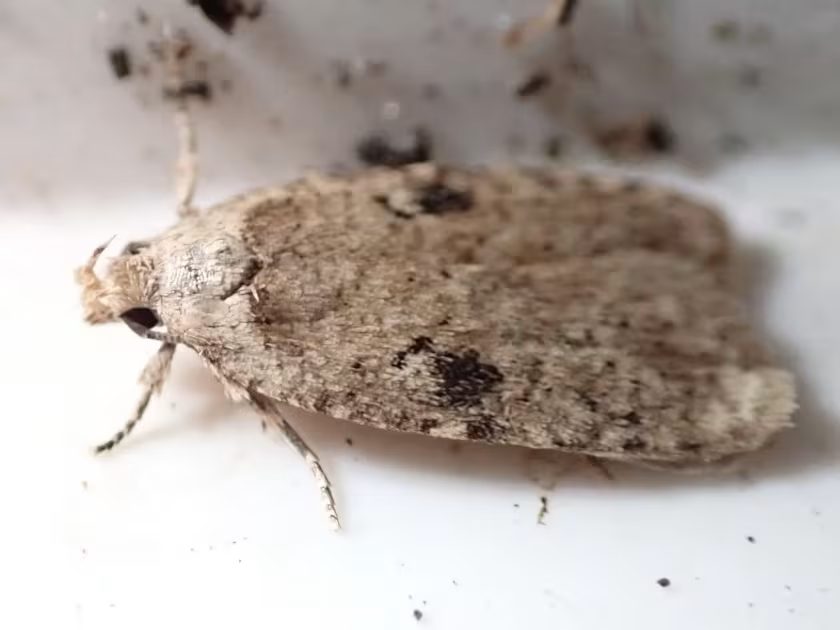
The flat moth (genus Agonopterix) belongs to the family Depressariidae. These small, slender moths are known for their distinctive flattened posture when at rest, which allows them to hide efficiently in narrow spaces like bark crevices or dried foliage.
Adult moths typically have a wingspan ranging from 15 to 25 mm. Their forewings are often mottled with various shades of brown, grey, or ochre, featuring dark streaks or spots that provide excellent camouflage against plant surfaces.
The larvae, or caterpillars, are highly mobile and characterized by a relatively flat, segmented body. Depending on the species, their coloration can range from pale green to brownish, often matching the host plant's tissues.
Their life cycle consists of four distinct stages: egg, larva, pupa, and adult. The majority of Agonopterix species overwinter as adults, seeking refuge in protected sites such as leaf litter, bark scales, or man-made structures.
Spring emergence is triggered by rising temperatures. Females then lay eggs on the leaves or flowers of suitable host plants, and the larvae begin feeding shortly after hatching, continuing through several molting stages before pupation.
What it damages
Agonopterix larvae are specialized feeders, and different species within the genus target specific host plants. They are frequently found on Apiaceae crops (carrots, celery, dill) and certain woody plants like willows and birch trees.
Caterpillars act as leaf rollers or skeletonizers. Early larval stages often mine the leaves, creating narrow channels, while older larvae consume larger areas of the leaf blade, often tying leaves together with silk webbing to create a protected feeding chamber.
Heavy infestations lead to significant leaf area loss, which reduces the plant's photosynthetic capacity. This stress causes stunted growth and, in severe cases, the death of young shoots or entire plants.
Beyond foliage, some species are known to feed on reproductive organs, specifically buds and flowers. This results in poor fruit set and reduced yields, which is particularly devastating for seed-producing crops.
The feeding activities cause physical tissue damage that compromises the plant's integrity, making the remaining tissues more susceptible to secondary fungal and bacterial pathogens.
Signs of infestation
The most common sign of infestation is the presence of rolled or curled leaves, bound together by fine silk webbing. These structures often contain the larvae or their fresh excrement.
Visible feeding damage typically begins as thin, winding translucent lines on the leaf surface, representing the larval mining phase. As the caterpillar grows, these patterns evolve into irregular patches of tissue consumption.
The presence of dark, granular fecal pellets (frass) accumulated within the webbed leaves is a clear indicator of active feeding and the presence of the pest.
When infestation affects the apical meristem or flower heads, they may appear withered, deformed, or prematurely brown, indicating that the larvae have disrupted the growth points.
Periodic monitoring during the spring and summer will reveal the presence of adult moths resting on the underside of leaves or nearby objects, signaling that egg-laying is likely in progress.
Control measures
Integrated pest management is crucial for controlling Agonopterix. Cultural practices, such as deep tilling and the removal of plant debris after harvest, effectively destroy the overwintering sites of the adults.
For chemical control, systemic or contact insecticides should be applied during the early larval development stages when the caterpillars are most vulnerable and before they build significant protective webs.
Biological control options include the use of Bacillus thuringiensis (Bt) based formulations, which are highly effective against lepidopteran larvae and offer a more environmentally friendly alternative to traditional pesticides.
Maintaining crop health through balanced fertilization and proper irrigation helps plants withstand minor damage, while crop rotation prevents the buildup of the pest population in the same field over successive years.
- Monitor for adults using light or pheromone traps to time insecticide applications accurately.
- Hand-pick larvae and destroy infested webbed clusters in small-scale gardens.
- Manage weed hosts, especially wild Apiaceae species that serve as alternate food sources for the moth.
Taxonomy
- Latin name
- Agonopterix
- Order
- Lepidoptera (butterflies)
- Family
- Depressariidae
- EPPO code
- AGOXSP
Discussion
No discussions yet — be the first.