
Double-banded longhorn beetle
Semanotus bifasciatus
Description
How to identify
The double-banded longhorn beetle (Semanotus bifasciatus) belongs to the order Coleoptera and the family Cerambycidae, commonly known as longhorned beetles.
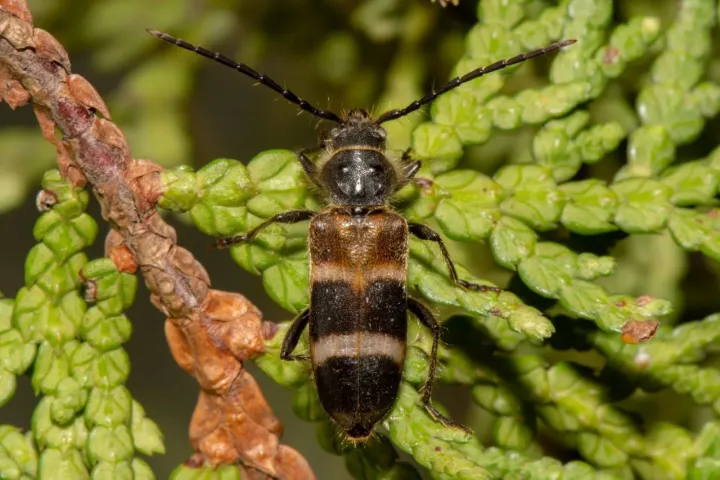
These beetles are typically 10 to 18 mm in length, possessing a dark, elongated body with two distinct orange or yellowish bands across the elytra.
The larvae are legless, white, and fleshy, featuring strong mandibles designed for boring through the hard woody tissues of host plants.
The pupal stage occurs within the wood, where the larva creates a chamber to transform into an adult, which later emerges through a characteristic exit hole.
Identification often relies on observing both the adult beetle’s distinct markings and the specific damage patterns left on host trees.
What it damages
This pest primarily infests coniferous tree species, showing a strong preference for members of the Cupressaceae family, such as cypress, thuja, and juniper.
The beetles typically target weakened or stressed trees, often those suffering from drought, poor soil conditions, or recent transplant shock.
Larvae feed under the bark and within the sapwood, creating serpentine tunnels that disrupt the flow of nutrients and water throughout the plant.
Severe infestations can result in the browning and dieback of branches, and if left untreated, the entire tree may eventually succumb to the damage.
The cumulative effect of larval feeding destroys the cambium layer, which is vital for the growth and survival of the tree.
When it appears
Adult beetles typically emerge in the spring, usually between April and June, depending on local temperature conditions and climate.
During the flight season, mating occurs, and females lay eggs in bark crevices or near mechanical wounds on the stems of suitable host trees.
The life cycle can vary in duration, typically taking one to two years to complete, depending on the tree's physiological state and environmental factors.
Overwintering occurs primarily at the larval stage within the wood, providing the insect with protection against adverse weather conditions.
Upon reaching maturity in the spring, the pupae transform into adults, which bore out of the tree to restart the reproductive cycle.
Signs of infestation
A primary sign of infestation is the presence of small, oval-shaped exit holes on the bark, created when the adult beetle emerges.
Wood dust, or frass, accumulating at the base of the tree or within bark cracks, is a strong indicator of larval feeding activity inside the wood.
Visible yellowing or browning of needles on specific branches often suggests that the internal tunnels have severed the tree's nutrient transport system.
Patches of loose or peeling bark may appear over the areas where larvae are most active, often accompanied by resin flow from the damaged spots.
The overall health of the tree declines, showing reduced vigor, sparse foliage, and potential branch dieback compared to healthy neighboring trees.
Control measures
Integrated Pest Management (IPM) is essential for controlling the double-banded longhorn beetle, starting with preventive care and tree health maintenance.
Regular monitoring for early signs of infestation is crucial, combined with the immediate removal and destruction of heavily infested branches or trees.
Maintaining optimal tree vigor through proper watering, fertilizing, and avoiding mechanical damage reduces the tree's susceptibility to pest attacks.
- Applying systemic insecticides during the adult flight season to deter egg-laying.
- Using pheromone traps for monitoring and reducing the population of adult beetles in the area.
- Sanitation pruning to remove dead or infested wood, ensuring proper disposal away from the garden.
In cases of light infestation, targeted insecticide injections into the larval tunnels, followed by sealing the holes, may help save the plant.
Taxonomy
- Latin name
- Semanotus bifasciatus
- Order
- Coleoptera (beetles)
- Family
- Cerambycidae
- EPPO code
- SEMABI
Discussion
No discussions yet — be the first.