
Sciapus platypterus
Sciapus platypterus
Description
How to identify
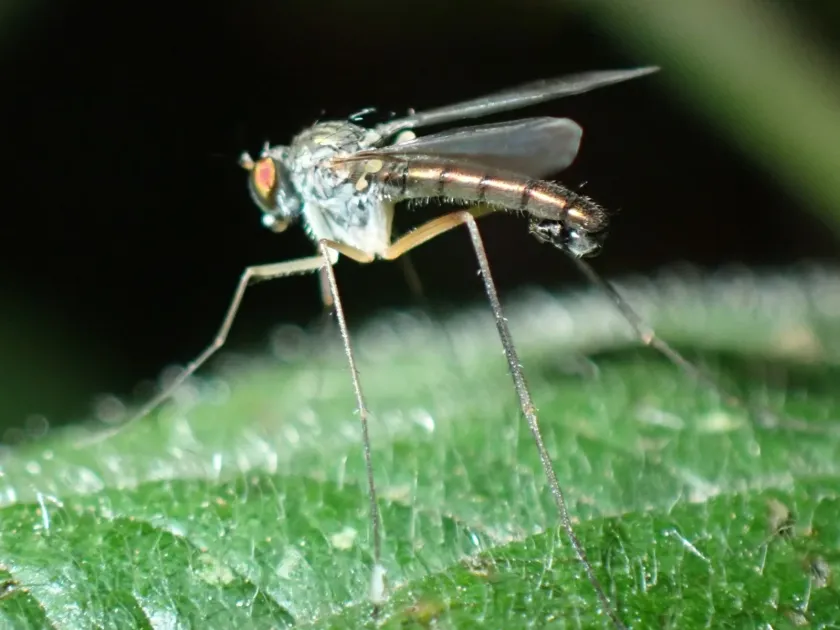
Sciapus platypterus belongs to the family Dolichopodidae, or long-legged flies, within the order Diptera. These flies are easily recognized by their distinct metallic green or golden-green appearance and elongated legs.
Adult flies typically measure between 5 to 7 millimeters in length. They have clear wings, often featuring a small dark spot at the apex, which aids in field identification among agricultural professionals.
The larval stage consists of small, whitish, legless maggots that inhabit moist soil or decaying vegetable matter. Their body structure is adapted for navigating through organic debris and soil layers.
These insects prefer high-humidity environments, making them common in shaded garden areas, irrigated fields, or along riverbanks where the soil moisture remains consistently high.
While the adult flies are predatory and often beneficial, the larval stage can pose threats to agricultural crops when their population densities reach critical thresholds in favorable habitats.
##damage##The primary damage is caused by the larvae, which live underground. In the absence of sufficient organic matter or their natural prey, larvae can attack the root systems of young vegetable or cereal crop plants.
By gnawing on roots and stems of young seedlings, the larvae disrupt nutrient and water uptake, leading to visible wilting, stunted growth, and in severe cases, plant mortality.
These underground feeding activities often create entry points for secondary soil-borne pathogens, complicating the diagnosis and often leading farmers to suspect root rot instead of insect activity.
Adult flies are active predators of smaller insects, including aphids and mites. However, their presence indicates a stable breeding ground in the soil, which correlates with potential larval pressure on sensitive crops.
Significant infestations can lead to patchy crop stands, reducing the overall yield and requiring careful evaluation to distinguish them from other soil-dwelling pests like wireworms.
##season##The peak activity period for Sciapus platypterus adults occurs during the early to mid-summer months, particularly in June and July, when temperatures and moisture levels are ideal for development.
The life cycle undergoes complete metamorphosis, including egg, larval, pupal, and adult stages. Females typically oviposit in moist soil, allowing the emerging larvae to start feeding immediately.
Depending on the climatic conditions, one or two generations can occur within a single growing season. Pupation occurs within the soil, providing a protective environment for the insect during transition.
During the autumn, late-generation larvae migrate deeper into the soil profile to enter diapause, surviving the winter months and emerging as adults when soil temperatures rise in the following spring.
Effective population monitoring relies on the use of yellow sticky traps placed near the canopy or soil level to track flight patterns and determine the necessity of intervention strategies.
##signs##The most reliable sign of an infestation is the sudden wilting of young seedlings during the heat of the day, which persists despite adequate soil moisture levels.
Upon inspecting the root zones of wilted plants, one may find physical damage or scarring caused by larval feeding, or potentially the larvae themselves within the soil substrate.
A dense population of iridescent green adult flies observed on leaves or low-lying vegetation is a clear indicator that the insect is successfully breeding in the vicinity of the crop.
Weakened, yellowing crops that lag behind in development compared to neighboring plants often suggest that root systems are compromised by underground larval pressure.
It is crucial to examine the soil profile closely when uneven growth patches appear, as these larvae can be easily overlooked compared to more common agricultural pests.
##control##Managing Sciapus platypterus involves cultural practices focused on soil health and moisture management to reduce the attractiveness of the site for egg-laying females.
- Implementation of balanced crop rotation cycles;
- Maintaining proper soil drainage to avoid excessive water accumulation;
- Deep plowing following harvest to expose larvae to natural predators;
- Targeted use of biological controls, such as entomopathogenic nematodes.
Chemical intervention should be treated as a last resort, as the predatory nature of adult flies means that broad-spectrum insecticides may eliminate beneficial natural enemies of other crop pests.
Integrated Pest Management (IPM) strategies, including encouraging natural predators like spiders and ground beetles, remain the most sustainable approach to keeping this population under control.
Taxonomy
- Latin name
- Sciapus platypterus
- Order
- Diptera (flies)
- Family
- Dolichopodidae
- EPPO code
- SPUSPL
Discussion
No discussions yet — be the first.