
Saperda
Saperda
Description
How to identify
The genus Saperda belongs to the family Cerambycidae, commonly known as longhorn beetles, which are significant wood-boring pests in forests and orchards.
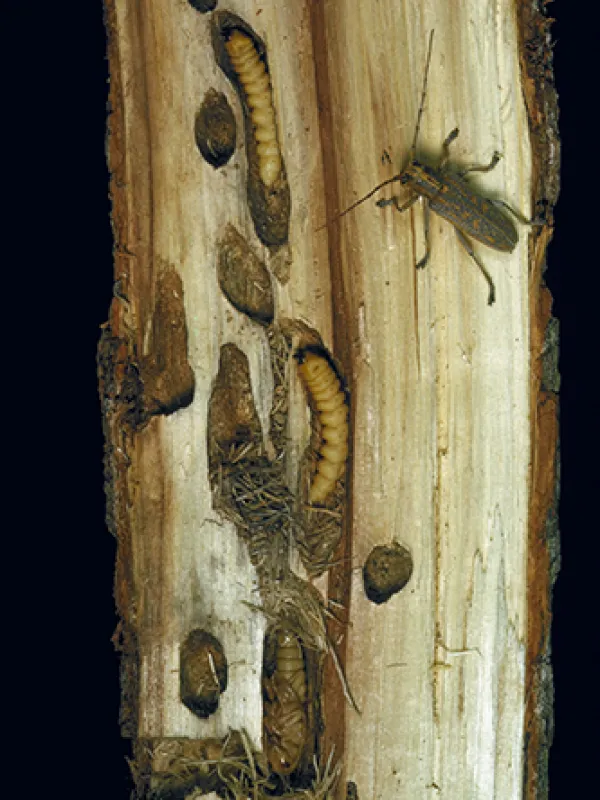
Adult beetles are characterized by their elongated bodies, often featuring distinct color patterns, and long, prominent antennae that act as sensory organs.
These insects derive their common name from the squeaking sound they produce when disturbed, a result of rubbing parts of their thorax together.
The life cycle undergoes complete metamorphosis, consisting of the egg, larva, pupa, and adult stages, with the larvae spending most of their life inside the wood.
Morphologically, these beetles are well-adapted for life on trees, with strong mandibles in the larval stage designed to penetrate tough woody fibers.
What it damages
Saperda species infest a wide variety of deciduous trees, including apple, pear, willow, poplar, and linden, causing extensive internal damage.
The larvae tunnel deep into the cambium and xylem, disrupting the tree's vascular system and preventing the flow of essential water and nutrients.
Severe infestations weaken the structural integrity of the tree, making it susceptible to windthrow and leading to stunted growth or eventual death.
Young saplings are particularly at risk, as a few larval tunnels can effectively girdle or hollow out the trunk, leading to immediate collapse.
Forest stands and nurseries can suffer economic losses as infestation centers expand from weakened trees to neighboring healthy plants.
When it appears
Adult beetles typically emerge in late spring and are active throughout the early summer months, which is their primary mating season.
Females deposit eggs by cutting small niches in the bark or twigs, providing a safe environment for the emerging larvae to start their feeding.
The duration of the larval stage can vary from one to two years, during which time the larvae feed continuously and grow within the host tree.
Pupation usually occurs in a specialized chamber near the bark surface, allowing the new generation of beetles to emerge easily upon reaching maturity.
Warm and stable climate conditions generally accelerate the development rate, leading to higher populations and increased frequency of outbreaks.
Signs of infestation
The presence of Saperda is often indicated by small entry holes in the bark, accompanied by wood shavings or sawdust piled at the base of the trunk.
Sap bleeding from the trunk or branches is a common symptom, particularly during the early stages of larval feeding beneath the bark.
Dieback of branches, premature yellowing of leaves, and an overall decrease in tree vigor are clear signals of internal vascular damage.
- Sawdust-like debris (frass) expelled from larval tunnels.
- Withered or deformed twigs appearing in the upper canopy.
- Distinctive scarring or slits in the bark from female egg-laying activities.
When investigating, peeling back small sections of bark may reveal winding larval tunnels filled with brownish waste material typical of these wood-borers.
Control measures
The most effective strategy involves regular monitoring to identify and remove infested branches or entire trees before the adult beetles emerge.
Applying contact insecticides to the tree trunk during the emergence window can effectively reduce the population by eliminating adults before egg-laying.
Maintaining vigorous tree health through adequate irrigation, nutrition, and proper pruning reduces the tree's susceptibility to borer colonization.
Physical control methods, such as probing tunnels with wires or using targeted insecticide injections, can be employed for high-value ornamental trees.
Promoting a balanced ecosystem by encouraging birds and predatory insects can help provide natural biological control against longhorn beetle populations.
Taxonomy
- Latin name
- Saperda
- Order
- Coleoptera (beetles)
- Family
- Cerambycidae
- EPPO code
- SAPESP
Discussion
No discussions yet — be the first.