
Saiga
Saiga
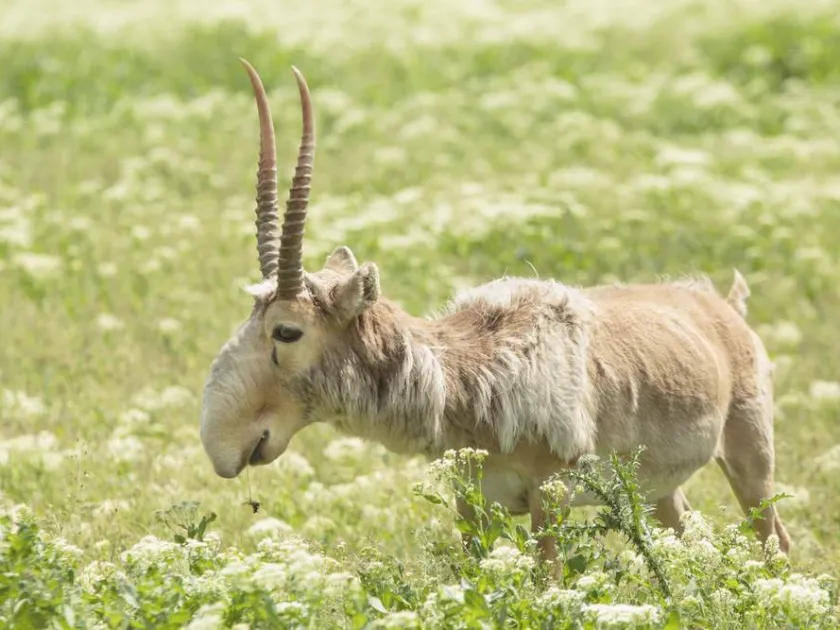
Description
How to identify
The Saiga (Saiga tatarica) is a large hoofed mammal belonging to the Bovidae family and the order Artiodactyla. It is easily identified by its unique nose, which features a flexible, drooping snout that acts as an air filter for the dusty steppe environment.
Adult saigas stand about 80 cm at the shoulder and weigh between 30 and 50 kg. Their coat color shifts with the seasons: it is a light ochre in summer and becomes thick, grey, and dense in winter to protect against the harsh climate of their habitat.
The primary sign of saiga presence is their herd behavior. They travel in massive groups, which can include thousands of individuals during migration, making their appearance highly visible across open agricultural landscapes.
Their physical traces are also specific. Hoof prints are elongated and oval in shape, while their droppings are dense, dark pellets. These signs clearly indicate the recent passage of a large herbivore group through the field.
Behaviorally, saigas are shy and cautious animals. They can run at speeds of up to 80 km/h. In agricultural ecosystems, they tend to frequent fields bordering open pastures where they feel safe and have quick escape routes.
What it damages
Saigas cause significant damage to various agricultural crops, particularly during early growth stages. Crops like wheat, barley, and millet are highly susceptible during their vegetative phase, as saigas consume the green biomass for essential nutrients.
The most severe damage occurs during the tillering and stem elongation phases. By consuming the green stems and destroying the growing point, saigas can cause the death of the entire plant or severely reduce the potential grain yield per hectare.
In addition to feeding, saigas cause massive mechanical damage. When a herd passes through a field, the soil becomes severely compacted, and young sprouts are trampled under thousands of hooves, often leaving the ground bare and destroying the crop stand.
Forage crops, such as alfalfa, are also frequently targeted. Intensive grazing by saigas reduces the biomass available for hay production, which negatively impacts the fodder supply for livestock and the overall economic viability of the farm.
The extent of the damage is directly linked to population size and the proximity of migration routes to fields. In years of high population, losses on individual farms can be catastrophic, potentially threatening the harvest of entire fields.
When it appears
Saiga presence in fields is closely tied to their seasonal migration patterns. In spring, as snow melts, they migrate in search of fresh green growth, which coincides with the planting season and the early development of winter cereals.
During the summer, as natural steppe vegetation dries up due to heat, saigas often move closer to agricultural lands in search of water and succulent greens. They may graze on both зернові and technical crops during this vulnerable period.
In autumn, as herds migrate toward wintering grounds, they may stop in fields with late-harvest crops. While the damage is generally less severe than in spring, it still represents a loss of harvest for crops like sunflower or corn.
During the winter, saigas typically avoid tilled fields, preferring regions with thinner snow cover. However, during mild winters, they may forage on winter crops, digging through thin snow layers to reach the green shoots underneath.
The dynamic of their appearance depends on annual weather conditions. Drought years often trigger more frequent incursions into agricultural zones, as natural food sources in the wild become scarce and animals seek alternatives.
Signs of infestation
The main indicator of saiga activity is the presence of heavily grazed patches with characteristic bite marks. Unlike rodents, which leave clean cuts, saigas tear the vegetation, leaving ragged, uneven edges on the leaves and stems.
- numerous hoof prints spread across the field;
- pellet-like droppings scattered along the herd's path;
- large trampled areas where the crop is completely destroyed;
- missing tops of the plants over vast swathes of land;
- signs of restlessness in nearby livestock due to wild herd presence.
Initial damage might be mistaken for smaller pests, but the scale of saiga impact is significantly larger. Inspecting the field edges near open spaces allows agronomists to spot signs of approaching herds well in advance.
A distinct musky odor often lingers after a large herd has passed. This scent can persist for several days in cool or damp weather, serving as a reliable indicator for farm staff to assess the scale of the intrusion and act accordingly.
Regular visual monitoring of the fields during dawn and dusk is the most effective way to detect herds. Using camera traps or drone surveillance near migration corridors allows farmers to predict potential incursions before major damage occurs.
Control measures
The primary control strategy involves non-lethal deterrents designed to divert herds away from crops. Visual deterrents such as bright ribbons, reflective elements, or scarecrows should be rotated frequently to prevent the animals from becoming accustomed to them.
Acoustic deterrents, such as gas cannons or alarm sound broadcasting, are effective if the frequency and type of sounds are varied. It is crucial that the noise profile is constantly changed so the animals do not interpret it as a permanent, harmless sound.
Temporary fencing can be economically viable for high-value seed plots. Electric fences or lightweight nets can serve as a strong deterrent, preventing access to the most vulnerable crops during critical stages of their development.
Agronomical methods include the creation of buffer zones or strips planted with less palatable crops surrounding the primary fields. This creates a natural barrier that helps distract the saigas from the highly attractive commercial grains.
Because the saiga is a protected species, all protection measures must be humane and strictly compliant with local wildlife protection laws. Collaboration with environmental agencies is essential to ensure that crop protection does not harm the animals.
Taxonomy
- Latin name
- Saiga
- Family
- Bovidae
- EPPO code
- SAIGSP
Discussion
No discussions yet — be the first.