
Sabulodes
Sabulodes
Description
How to identify
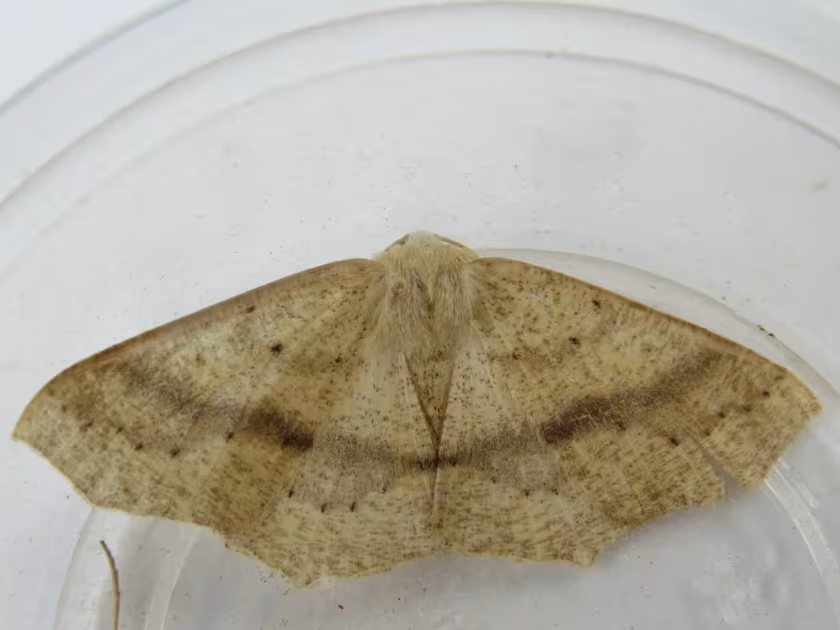
Sabulodes is a genus of moths belonging to the Geometridae family. The most well-known species is Sabulodes aegrotata, commonly referred to as the omnivorous looper.
Adult moths have a wingspan of about 40-50 mm, with an ochre or brownish coloration featuring distinct dark lines across their wings.
The caterpillars exhibit the typical movement of loopers (inchworms): they possess only three pairs of thoracic legs and two pairs of prolegs, which causes them to move by arching their bodies.
Caterpillar coloration ranges from green to brownish, often with longitudinal stripes that provide excellent camouflage against tree branches and foliage.
The pupae are typically hidden within rolled leaves or silk webbing, possessing protective coloring that mimics tree bark or dried leaves.
What it damages
This pest is a polyphage, meaning it feeds on a wide range of plants, including fruit, ornamental, and forest trees.
The greatest economic impact is observed on avocados, citrus fruits, eucalyptus, grapes, and various landscape shrubbery.
Caterpillars feed on plant foliage, consuming the leaf tissue entirely or partially, often leaving only the major veins behind.
High populations of this pest cause massive defoliation, which severely weakens the tree, lowers its vigor, and leads to significant crop yield reductions.
Young shoots are also highly susceptible to attacks, disrupting the plant's photosynthetic capacity and hindering the development of nursery seedlings.
When it appears
The life cycle of Sabulodes depends on climatic conditions; in warmer regions, the pest can produce multiple generations throughout the year.
The peak feeding period for caterpillars coincides with the spring and summer months, during which plants undergo active vegetative growth.
The pest typically overwinters in the pupal stage, seeking shelter in bark crevices, leaf litter, or rolled-up dried leaves.
The emergence of first-generation moths often synchronizes with the blooming of host plants, allowing newly hatched caterpillars to immediately feed on tender tissues.
Weather conditions such as damp and moderately warm springs foster rapid population growth, frequently leading to outbreaks and mass infestations.
Signs of infestation
A primary sign of a Sabulodes infestation is the presence of skeletonized or eaten leaves, often bound together by silk webbing.
Accumulations of caterpillar frass, which appear as small dark pellets, can often be found on the foliage surface or under the tree canopy.
When inspecting branches, one may notice caterpillars resting in an elongated pose, mimicking a small twig to avoid detection by predators.
The presence of fine silk threads connecting leaves is a clear indicator of active larval feeding activity.
In cases of severe infestation, general plant decline, premature leaf drop, and visible "bald" patches in the canopy become apparent.
Control measures
Controlling Sabulodes requires an integrated approach, utilizing a combination of cultural, biological, and chemical methods.
An important early-season practice is the manual removal and destruction of rolled leaves that harbor developing larvae.
The use of biological pesticides, specifically those containing Bacillus thuringiensis, is highly effective against young larvae without disrupting local entomophage populations.
In commercial orchards, systemic or contact insecticides are used based on population monitoring via pheromone traps.
- Regular pruning and disposal of infested twigs and branches.
- Encouraging natural predators such as parasitic wasps, predatory bugs, and insectivorous birds.
- Timely application of insecticides during peak larval hatching windows.
Taxonomy
- Latin name
- Sabulodes
- Order
- Lepidoptera (butterflies)
- Family
- Geometridae
- EPPO code
- SABUSP
Discussion
No discussions yet — be the first.