
Ruspolia nitidula
Ruspolia nitidula
Description
How to identify
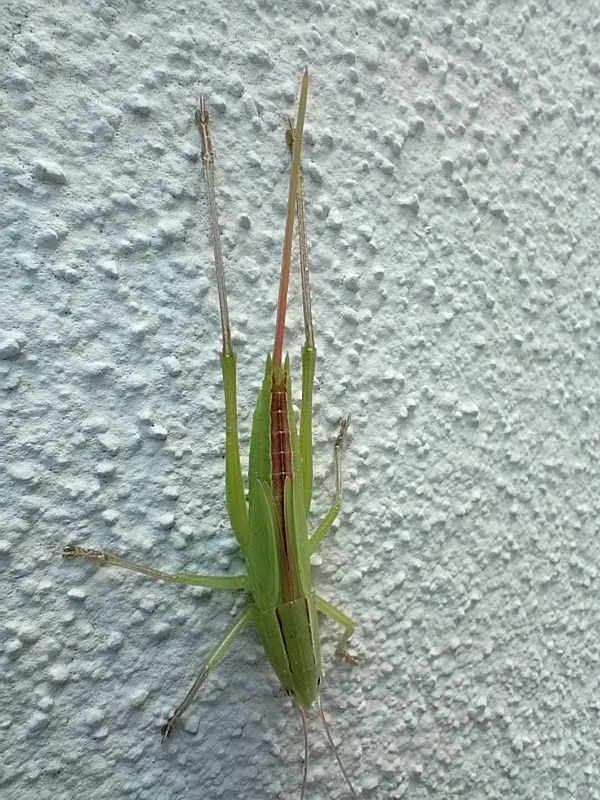
Ruspolia nitidula, known as the great green bush-cricket relative or meadow bush-cricket, belongs to the family Tettigoniidae. The adult insect has a slender, green or brownish body, enabling excellent camouflage within tall grasses.
Its head is distinctively conical with very long antennae that extend far beyond the body length. Females possess a long, slightly curved ovipositor that resembles a sword, which is a key morphological identifier for the species.
Adults typically measure between 25 and 30 mm in length. With well-developed wings, they are capable of active flight, allowing them to migrate between forage areas and fields.
The species prefers humid habitats, including riparian zones, tall grass meadows, and irrigated cereal fields, which provide both shelter and nutritional sources.
The life cycle involves incomplete metamorphosis. Eggs are laid in plant tissues or soil, where they overwinter, emerging as nymphs in the following spring once temperatures rise.
What it damages
This insect is a polyphagous feeder, but it causes the most significant economic damage to cereal crops, including wheat, millet, rice, and maize, during the grain-filling stage.
Both nymphs and adults feed on the generative organs of the plants. They typically gnaw on the developing ears, consuming the soft, milky grains inside the husk.
Damage to the spikes not only reduces total yield but also exposes the plant to fungal infections or secondary pest colonization through the damaged tissues.
Besides commercial crops, the insect thrives on various wild grasses, which act as a reservoir for the population, facilitating a continuous infestation cycle near agricultural land.
Outbreaks are more frequent in years with high humidity or increased rainfall during the summer, which significantly boosts the survival rate of the nymphs.
When it appears
Nymph development generally occurs from late spring through the early summer months, coinciding with the rapid vegetative growth of cereal crops.
Adults become most abundant from July through August, aligning with the period when grain heads begin to form and mature in the field.
These bush-crickets are primarily nocturnal. Their characteristic stridulation (chirping) becomes noticeable during warm summer nights as males signal to females.
As autumn temperatures drop, their activity diminishes. Females then seek suitable substrates to deposit their eggs for the upcoming winter season.
Monitoring for the presence of the pest is recommended during the peak of summer, particularly along field edges and areas bordered by tall, unmanaged vegetation.
Signs of infestation
The most evident sign of infestation is the appearance of gnawed grains within the ears, which often look like jagged, uneven cavities or completely hollow husks.
Field scouting during the evening hours allows for the visual identification of insects perched on the upper sections of the plants while they are actively feeding.
Accumulated frass (insect excrement) found on leaves directly below the infested ear provides clear evidence of the pest's recent feeding activity in that specific cluster.
Premature shattering or empty spikelets observed during inspections can also indicate significant feeding pressure from a localized population of Ruspolia nitidula.
Uneven ripening or ragged appearance of the grain heads at harvest time is a hallmark of damage caused by these insects during the milky-ripe phase.
Control measures
Effective agricultural management starts with timely harvesting, which significantly reduces the availability of food and disrupts the insect's late-season development.
Weed management, especially the removal of wild grasses surrounding the field, is crucial to eliminate the breeding reservoirs that harbor the pests.
Deep plowing of the soil after harvest is an effective mechanical method to destroy overwintering egg clusters, burying them deep enough to prevent successful hatching.
If population densities exceed economic thresholds, the use of targeted insecticides applied during evening hours is recommended to ensure direct contact with the pests.
- Implementation of crop rotation.
- Buffer strip maintenance around fields.
- Promotion of natural predators such as birds and parasitic wasps.
Taxonomy
- Latin name
- Ruspolia nitidula
- Order
- Orthoptera (locusts)
- Family
- Conocephalidae
- EPPO code
- CONCMA
Discussion
No discussions yet — be the first.