
Short-winged conehead
Conocephalus discolor
Description
How to identify
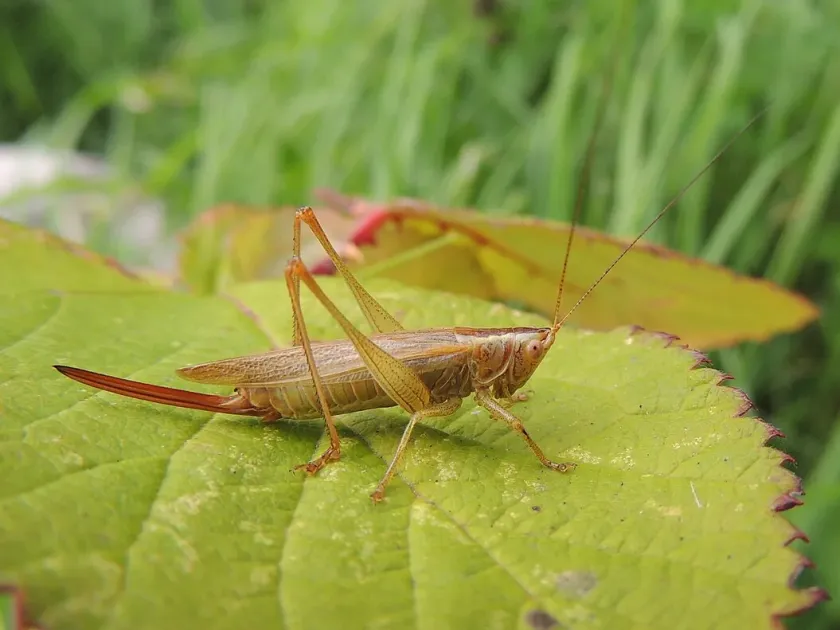
The short-winged conehead (Conocephalus discolor) is a species of bush-cricket belonging to the Tettigoniidae family. It is easily identified by its conical head shape and slender body.
These insects typically measure between 12 and 16 mm in length. Their coloration ranges from bright green to brownish, providing excellent camouflage within grasslands and cereal crops.
As the name suggests, their wings are relatively short and do not usually reach the end of the abdomen, which limits their flight capability compared to other grasshoppers.
Females possess a distinct, slightly curved ovipositor, which they use to insert eggs into the stems of grasses and cereal plants.
Nymphs resemble smaller, wingless versions of the adults and progress through several developmental stages before reaching maturity in mid-summer.
What it damages
The short-winged conehead primarily feeds on various cereal crops such as wheat, barley, and oats, as well as wild meadow grasses.
Both nymphs and adults cause damage by grazing on leaves, leaving longitudinal holes or jagged edges that can interfere with the plant's photosynthetic capacity.
During the grain-filling stage, the insects may target the ear of the cereal, feeding on the husks and developing kernels, which reduces crop yield and quality.
Severe infestations can lead to the weakening of stems, making plants more susceptible to lodging, especially during adverse weather conditions like heavy rain or wind.
Although typically considered a minor pest, in favorable years, their density can increase enough to cause noticeable economic losses in border rows of fields.
When it appears
This species completes one generation per year, surviving the winter in the egg stage deposited within plant tissue.
Nymphs emerge in late spring, typically around May, as temperatures rise, and immediately begin feeding on available vegetation.
Adult insects are present from July through August, which corresponds with the critical development stages of many cereal crops.
The insects are most active during the warmer parts of the day and in the evening, when they feed and mate within the crop canopy.
As autumn approaches, the adults lay their eggs for the following year and eventually die off with the first significant frosts.
Signs of infestation
The most common sign of infestation is ragged or chewed leaf margins on wheat and other cereals, often starting from the edges of the field.
A closer inspection of the plants in the morning often reveals the insects resting on the stems, where they tend to remain motionless to avoid detection.
Signs of grain damage include surface scarring on the husks of the ear, which may look like small, eroded patches where the insect has fed.
Frass (insect excrement) found at the base of the plant or on the leaves provides further evidence of active feeding by nymphs or adults.
In calm, warm weather, the stridulation (calling sound) of the males can be heard, providing an auditory cue to their presence in the field.
Control measures
Effective management begins with cultural practices, such as mowing field margins and removing grassy weeds that serve as breeding sites.
In cases of high infestation, localized application of insecticides may be necessary to protect the crop, focusing on the field edges where populations usually cluster.
Post-harvest tillage operations can help destroy eggs overwintering in crop stubble, significantly reducing the pest population for the next season.
Promoting natural biological control agents, such as predatory birds and insects, helps maintain the conehead population below harmful levels.
Maintaining a balanced crop rotation and ensuring rapid, uniform plant growth can help the crop withstand and recover from minor feeding damage.
Taxonomy
- Latin name
- Conocephalus discolor
- Order
- Orthoptera (locusts)
- Family
- Conocephalidae
- EPPO code
- CONCDI
Discussion
No discussions yet — be the first.