
Conocephalus
Conocephalus
Description
How to identify
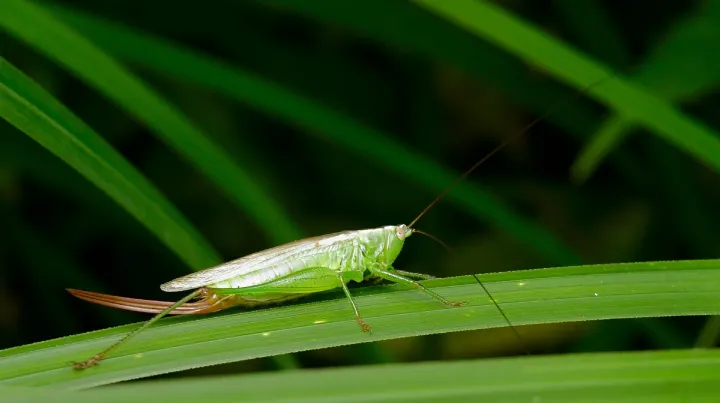
Conocephalus, commonly known as the conehead grasshopper, belongs to the family Tettigoniidae (katydids). They are easily recognized by their distinct conical head shape, which distinguishes them from other grasshopper species.
These insects are generally slender, measuring between 12 and 20 mm in length. Their coloration ranges from bright green to brownish, providing excellent camouflage within grasses and cereal crops.
The females are easily identified by their long, sword-like ovipositor used for inserting eggs into plant tissues. The antennae are exceptionally long, often extending well beyond the length of the body.
Wing development varies depending on the specific species, with some having short wings while others are fully macropterous (long-winged) and capable of flight. Their hind legs are robust and powerful, designed for jumping.
Nymphs resemble smaller, wingless versions of the adults. They undergo several molts as they grow, maintaining a similar slender shape and conical head structure throughout their development.
What it damages
Conehead grasshoppers primarily feed on plants within the family Poaceae (grasses). They are common pests in agricultural fields containing wheat, rye, barley, and oats.
In addition to cultivated grains, they thrive on wild grasses found in pastures and field margins. When populations are high, they may migrate into commercial crops, causing significant damage.
Both adults and nymphs feed on the vegetative parts of the plant, including leaves, stems, and developing grain heads. They chew on the edges of the leaves, resulting in an irregular, ragged appearance.
Damage to the grain heads during the milk or dough stage is particularly concerning, as it directly impacts yield and grain quality. Affected spikes may become partially empty or shriveled.
The feeding sites also serve as entry points for various fungal and bacterial pathogens. This can lead to secondary infections that further weaken the plant and reduce its overall vitality.
When it appears
The life cycle of Conocephalus is strongly linked to the summer season. Adult activity, including feeding and mating, typically peaks between June and August.
The species overwinters in the egg stage. Females insert their eggs into the stalks of grasses or under the leaf sheaths, protecting them from winter desiccation and cold temperatures.
In spring, as temperatures rise, the eggs hatch into nymphs. These nymphs feed and develop throughout the late spring and early summer, gradually increasing in size with each successive molt.
By mid-summer, the majority of the population reaches the adult stage. This period is critical for mating and egg-laying for the next generation, making them most visible at this time.
As autumn approaches and temperatures drop, adult populations decline and die off. They are univoltine, meaning they complete only one generation per year, limiting their impact to a single seasonal cycle.
Signs of infestation
The first signs of infestation are ragged, uneven edges on the leaves of cereal crops. These bite marks are characteristic of their chewing mouthparts.
- Ragged leaf margins on cereal stalks.
- Physical presence of the insects near the tops of the plants.
- High-pitched stridulation (singing) sounds in the field during dawn or dusk.
- Visible damage to the spikelets, reducing grain density.
- Occasional wilting of individual stems due to intensive feeding.
During the day, these insects are elusive and often jump to escape when disturbed. Early morning or late evening observations are most effective for identifying their presence.
If population numbers are high, the characteristic "song" of the males becomes audible even from a distance. Regular field scouting is necessary to determine if the population density justifies control measures.
Control measures
Cultural control is the first line of defense against Conocephalus. Keeping field margins clean and removing wild grasses reduces the primary habitats where these pests thrive.
Deep plowing in the autumn helps destroy eggs that have been laid in plant stubble. By burying the plant residues, the emergence of the next generation can be significantly suppressed.
If economic damage thresholds are reached, chemical intervention with registered insecticides is required. Products containing pyrethroids or organophosphates are generally effective against these insects.
Practicing diverse crop rotation disrupts the life cycle of the pest, making fields less attractive for colonization. This practice is essential for long-term population management.
Monitoring the fields using sweep nets is highly recommended to track population growth. Timely detection allows for localized applications rather than widespread spraying, minimizing the environmental impact.
Taxonomy
- Latin name
- Conocephalus
- Order
- Orthoptera (locusts)
- Family
- Conocephalidae
- EPPO code
- CONCSP
Discussion
No discussions yet — be the first.