
Conehead grasshopper
Homorocoryphus
Description
How to identify
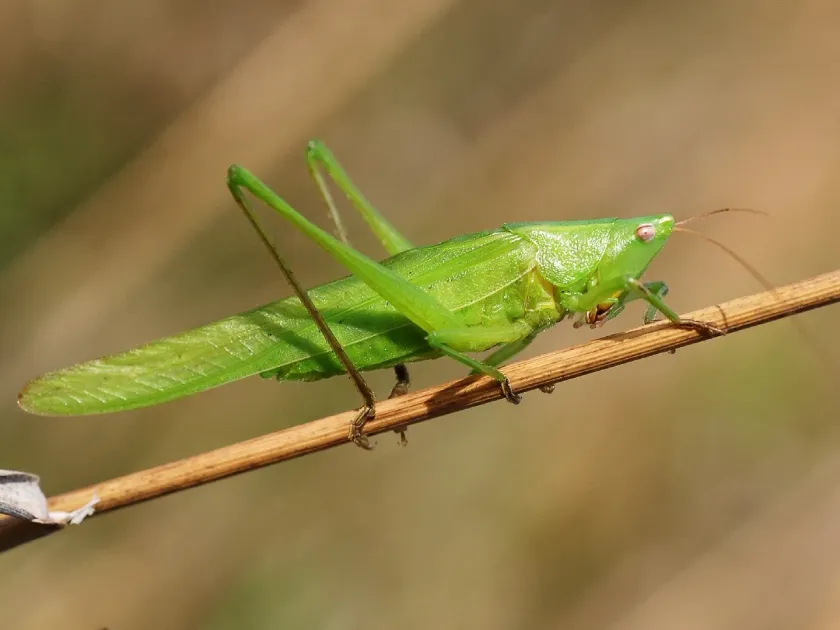
The Conehead grasshopper (Homorocoryphus nitidulus) belongs to the order Orthoptera, family Tettigoniidae. Its common name is derived from the distinctively elongated, conical shape of its head.
Adult insects typically measure 25–30 mm in length. Their body coloration ranges from vibrant green to light brown, serving as effective camouflage among stalks and dense vegetation.
The wings of the adults are well-developed and extend significantly beyond the abdomen, granting these grasshoppers the ability to fly long distances in search of suitable host plants.
They possess very long, thread-like antennae that often exceed the total body length. The pronotum features a clear ridge, and the female has a long, sword-shaped ovipositor for egg-laying.
Nymphs resemble smaller versions of the adults but lack full wings. They undergo incomplete metamorphosis, passing through several instar stages before reaching sexual maturity.
What it damages
The Conehead grasshopper is a significant pest for various cereal crops, including rice, wheat, and barley. It feeds on both vegetative tissues and developing reproductive parts.
The most severe damage occurs during the flowering and grain-filling stages. Grasshoppers feed on young kernels, leading to shriveled grain and decreased overall crop yield.
Beyond cereals, they may infest soybean and maize fields, particularly during hot and dry seasons when native forage grasses become depleted or less attractive.
In high-density outbreaks, damage can be substantial, resulting in yield losses of up to 10-15%. The feeding activity often leaves jagged edges on leaves and empty hulls on grain heads.
Mechanical damage caused by feeding often serves as an entry point for various plant pathogens, such as fungi, which can further reduce the quality and storability of the harvested crop.
When it appears
This species typically completes one generation per year. They overwinter in the egg stage, which are deposited inside plant stems or within the top layer of the soil near host plants.
Nymphs emerge in spring, typically in May or June, as temperatures consistently rise. They develop through several instars throughout the summer months.
Adult activity peaks during July and August. During this period, they are highly active, feeding aggressively and mating to ensure the survival of the next generation.
Reproductive activity continues until the first autumn frosts. After egg-laying, the adult population gradually declines and dies off before the onset of winter.
Population density is highly dependent on climatic conditions; warm and moderately humid summers provide ideal conditions for the survival and growth of the nymphal stages.
Signs of infestation
Visible signs of infestation include irregular, jagged feeding marks on leaves and visible depletion of kernels within the grain heads of affected plants.
The presence of the pest is often announced by the loud, rhythmic stridulation of males, especially noticeable during twilight and throughout the night.
During the day, adults can be found resting on stems. They are known for their defensive behavior of remaining perfectly still when threatened, making them hard to detect.
Presence of excrement on leaves and base stems is another indicator. Heavily infested fields may show clusters of empty or damaged spikelets that scatter under slight impact.
Severe infestations often manifest as patches of damaged crops where grain development appears stunted or incomplete due to repeated feeding by multiple grasshoppers.
Control measures
Effective control starts with agronomic practices, such as deep autumn plowing, which destroys overwintering eggs and disrupts the pest’s reproductive cycle.
Managing weed growth along field margins is essential, as these areas act as breeding grounds and reservoirs for the grasshopper population before they migrate into the main crop.
When the economic threshold is exceeded, chemical intervention using contact or systemic insecticides, such as pyrethroids, is recommended to reduce high population density.
- Implementing crop rotation to break the cycle of host availability.
- Encouraging natural predators such as birds, parasitic wasps, and predatory ground beetles.
- Regular field scouting during critical grain development phases for timely response.
Application of insecticides should be timed for early morning or late evening to minimize impacts on beneficial insects and pollinators while maximizing contact with the active pest.
Taxonomy
- Latin name
- Homorocoryphus
- Order
- Orthoptera (locusts)
- Family
- Conocephalidae
- EPPO code
- HOMRSP
Discussion
No discussions yet — be the first.