
Slender meadow katydid
Conocephalus fasciatus
Description
How to identify
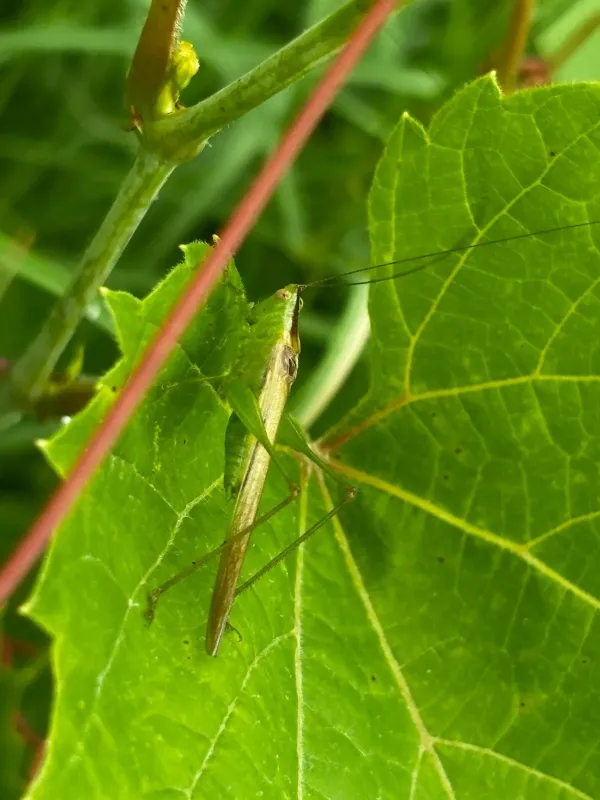
The slender meadow katydid (Conocephalus fasciatus) is a member of the family Tettigoniidae. These insects are characterized by their slender bodies, green or brownish coloration, and distinct dark stripes along the sides.
They are easily identified by their cone-shaped head and extremely long, thread-like antennae, which are significantly longer than their body, facilitating movement through dense vegetation.
Adults possess well-developed wings, allowing them to migrate between meadows and agricultural fields, which increases their potential as a field pest during warm seasons.
Nymphs resemble smaller, wingless versions of adults and undergo several developmental stages before reaching maturity, gradually adapting to the surrounding environment.
They are primarily found in moist habitats, including grasslands and marshes, but they frequently move into crop fields, especially cereal grains, during mid-summer when conditions in their primary habitats become unfavorable.
What it damages
This species is known to cause damage to various grain crops, including wheat, barley, and oats. They feed on leaves, leaving ragged edges and irregular holes, which stunts plant growth.
The most significant damage occurs during the grain-filling stages. Katydids feed on the developing kernels, leading to yield loss and reduced grain quality, which is particularly problematic for farmers.
In addition to cereals, they can affect other forage crops and vegetables by chewing on the foliage, creating entry points for secondary plant diseases and pathogens.
While often considered minor pests, in years of high population density, they can cause significant thinning of crops and measurable reductions in overall harvest volume.
The cumulative damage caused by feeding on both leaf tissues and reproductive parts makes them a relevant pest for integrated pest management programs in agricultural regions.
When it appears
The life cycle of the slender meadow katydid is tied to the growing season. They overwinter in the egg stage, with eggs deposited by females in plant tissues or soil.
Nymphs emerge in the spring, coinciding with the period when young host plants are growing rapidly and provide ample nutrition for the developing population.
Adult activity peaks during the summer months. This is when mating and feeding are at their highest, leading to potential damage to crops as the insects reach their maximum size and nutritional requirements.
Environmental factors such as moisture and temperature play a critical role in the survival of the population, with favorable conditions leading to larger infestations in agricultural zones.
By autumn, adult activity wanes as the insects prepare for the next generation, completing their annual cycle before the onset of cold weather dictates the cessation of feeding.
Signs of infestation
Evidence of infestation is usually found in the form of shredded leaf margins and jagged holes in the plant foliage caused by their chewing mouthparts.
Damaged grain heads, where individual kernels have been consumed or destroyed, serve as a primary indicator of their presence during the reproductive stage of the plant.
The audible chirping of males during evening hours is a reliable sign of their presence, often helping agronomists identify if a field is being colonized by these insects.
Small dark fecal pellets on the leaf surface are another sign of recent feeding activity, indicating that the katydids are currently active in the immediate vicinity.
Observing the insects themselves, especially early in the morning, hidden within the leaf sheaths or dense parts of the plant, confirms the presence of the infestation.
Control measures
Cultural control remains the most effective long-term strategy, primarily focusing on managing weeds and maintaining clean borders around crop fields to reduce breeding sites.
Post-harvest tillage and soil disturbance are effective methods for destroying eggs laid in the soil or crop residue, thereby preventing population spikes in the following season.
When the economic injury level is reached, the application of targeted insecticides is necessary to suppress large populations and protect the crop during critical growth phases.
Encouraging natural predators such as insectivorous birds and predatory arthropods helps keep the population levels in balance within the local ecosystem.
- Monitor fields frequently during the heading stage.
- Control weeds in field margins and near-field areas.
- Apply insecticides only when necessary based on economic thresholds.
Taxonomy
- Latin name
- Conocephalus fasciatus
- Order
- Orthoptera (locusts)
- Family
- Conocephalidae
- EPPO code
- CONCFA
Discussion
No discussions yet — be the first.