
Chamois
Rupicapra rupicapra
Description
How to identify
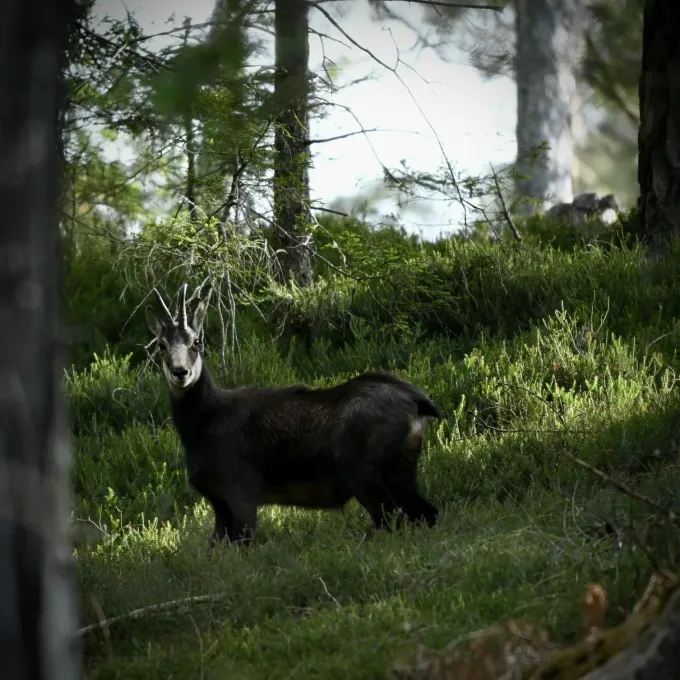
The chamois (Rupicapra rupicapra) is a species of goat-antelope belonging to the Bovidae family. It is known for its remarkable agility and is perfectly adapted to steep, mountainous terrains.
An adult chamois stands about 70–80 cm tall at the shoulder, with distinctive black, hook-shaped horns. Its coat color changes from reddish-brown in summer to a darker, thicker coat in winter.
They are primarily diurnal and live in small herds. Their biology is characterized by an extensive diet consisting of grasses, herbs, and shrubs found in high-altitude environments.
Due to their mobility, chamois can easily navigate between natural mountain habitats and lower-lying agricultural lands to exploit new food sources.
As the population density changes, chamois herds frequently expand their range, which brings them into direct conflict with local farming operations.
What it damages
The chamois causes damage by grazing on a variety of crops, including cereals, legumes, and vegetable gardens located near mountain slopes.
They consume young plant shoots, which hampers plant growth and significantly reduces crop yield. Additionally, they often browse on the bark of young fruit trees, leading to stunted growth or tree death.
Trampling by herds causes soil compaction and root damage, especially when moving across fields in wet weather conditions, which stresses the plants.
In forest nurseries and plantations, chamois can be destructive by damaging young seedlings, which poses a long-term risk to reforestation and commercial timber efforts.
High grazing pressure also leads to the degradation of pastures, forcing farmers to compete with wild animals for the limited grass resources available in mountainous regions.
When it appears
Early spring is a critical period when chamois descend to lower elevations to feed on fresh, nutritious grasses that emerge earlier than in their high-mountain range.
During dry summer periods, when alpine pastures dry out, chamois may move closer to cultivated fields seeking succulent green forage.
In autumn, chamois increase their food intake to build fat reserves, frequently raiding fields with winter cereals during this time.
Winter activity is usually limited by deep snow, but during harsh winters, they may move closer to agricultural structures or hay storage areas if natural food is scarce.
The movement patterns are highly dependent on seasonal weather conditions: extreme mountain winters force these animals to seek sustenance in lower agricultural zones.
Signs of infestation
The presence of chamois is indicated by distinctive cloven-hoof prints with sharp edges, often visible on soft or damp soil in the fields.
Visible feeding damage is characterized by ragged, unevenly bitten stems and leaves, distinct from the precision damage caused by insect pests.
Small, dark, pellet-like droppings scattered across the area are clear evidence that a herd has been foraging in the location.
Debarking on the lower trunks of young trees, particularly in orchard areas, serves as a significant marker of chamois activity in the vicinity.
Damage to perimeter fencing, especially mesh or wire types, is a common indicator that the animals are attempting to break into the cultivated area.
Control measures
Physical barriers are the most reliable control method; installing tall, reinforced fencing (at least 2.5 meters high) effectively prevents chamois entry.
Technological deterrents, such as motion-activated ultrasonic devices and strobe lights, can be used to scare animals away from vulnerable crop areas at night.
Repellents, including scents that mimic predator pheromones or specialized chemical treatments, can be applied along the field edges to discourage browsing.
Integrated land management involves planting less palatable buffer crops around the perimeter of high-value agricultural sections to reduce the incentive for grazing.
Collaboration with local wildlife authorities is recommended for long-term population management, including the establishment of managed feeding areas far from commercial fields.
Taxonomy
- Latin name
- Rupicapra rupicapra
- Family
- Bovidae
- EPPO code
- RPCPRU
Discussion
No discussions yet — be the first.