
Pyrenean chamois
Rupicapra pyrenaica
Description
How to identify
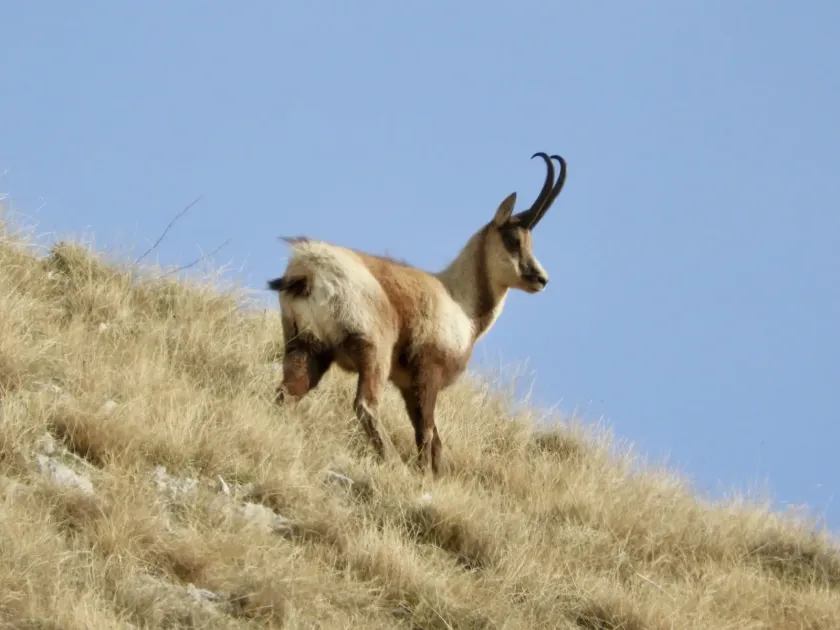
The Pyrenean chamois (Rupicapra pyrenaica) is a goat-antelope species found in the Pyrenees mountains. It is a medium-sized ungulate, weighing approximately 25 to 50 kilograms, characterized by its agile frame and distinctive horns that hook backward.
These animals are highly adapted to steep, rocky terrain. They belong to the family Bovidae and are known for their exceptional jumping ability, allowing them to navigate between high-altitude alpine meadows and lower valley agricultural fields with ease.
They are primarily diurnal, although they may change their activity patterns based on weather conditions and human disturbance. Their survival strategy relies on keen eyesight and hearing, which makes them difficult to monitor or approach in open agricultural settings.
The species is protected in many parts of its range, leading to a focus on non-lethal management rather than total eradication. However, their grazing habits pose significant challenges for farmers operating in mountainous regions.
Breeding usually occurs in late autumn, and the offspring are born in early summer. During these periods, the energy requirements of the females significantly increase, leading to intensified grazing pressure on nearby crop fields.
What it damages
The primary damage caused by the Pyrenean chamois involves the consumption of cereal crops, particularly wheat and barley sown on mountain plateaus. They can strip fields of their vegetative cover within a few days.
They are known to heavily graze on forage grasses, which impacts the hay yield for livestock farmers. By overgrazing and trampling, they can degrade the soil surface, leading to long-term reductions in pasture productivity.
In orchards and nurseries, chamois target young fruit trees, browsing on tender buds and leaves. This damages the structure of the tree, often preventing it from reaching a productive state, and can lead to the total loss of young plantings.
Root crops like potatoes are also susceptible, especially when the chamois pull the entire plant to reach the succulent tubers. This results in direct yield loss and damage to the soil structure around the base of the plant.
- Wheat, barley, and oat fields.
- Alfalfa and clover forage crops.
- Fruit tree saplings and nurseries.
- Vegetable gardens including potatoes and cabbage.
When it appears
The peak season for chamois interference with agriculture begins in late spring, following the snowmelt. During this time, the first flush of green vegetation on fields is highly attractive to the chamois, which are emerging from a long winter.
Summer is the most critical period, as the lactating females and growing kids require high-protein diets. This leads to frequent incursions into farmland located adjacent to their natural forest or mountain slope habitats.
In late summer and early autumn, chamois may visit harvested fields to graze on regrowth or leftover crop residues, which can interfere with the farmer's ability to prepare the field for winter tillage or subsequent crops.
During the winter, although activity on open fields decreases, they may descend into valleys if snow cover is extreme. In these cases, they prioritize feeding on tree bark and stored forage, which can be devastating for forestry plantations.
Overall, the vulnerability of crops is greatest during the periods of rapid plant growth (spring and early summer), making these the primary windows for implementing preventative management strategies.
Signs of infestation
One of the most obvious signs of a chamois presence is the pattern of their hoof prints. These are longer and more pointed than sheep tracks, with a distinct shape that is deep enough to be noticeable in soft soil.
Vegetation damage often appears as uneven "grazing lines" at the edges of fields. Unlike domestic livestock, they are highly selective, often removing only the most nutrient-rich parts of the plant and leaving the stalk behind.
In forest plots or orchards, bark stripping is a clear indicator. This damage typically occurs on young trees and shows ragged edges, confirming that the bark was gnawed off rather than scraped by machinery or domestic animals.
The presence of small, dark, oval-shaped droppings is a definitive sign. These are usually found in clusters near the forest edges or at the paths where the herd enters the field from the mountain slopes.
Torn or broken branches on young trees, particularly at a height of 0.5 to 1 meter, often indicate that the chamois has leaned against the saplings to browse on terminal buds or high-foliage areas.
Control measures
Physical fencing is the most reliable method for controlling chamois damage. High-tensile wire mesh fences, at least 2.5 meters tall, are recommended to physically prevent these agile climbers from jumping into protected crop areas.
Auditory deterrents, such as motion-activated sound emitters or sirens, can effectively discourage the chamois from approaching the fields. These devices are most effective when programmed with random intervals to prevent the animals from habituating.
Chemical repellents applied to the borders of fields or directly onto saplings in orchards can deter browsing. Modern biodegradable repellents are designed to be safe for the environment while creating an unpalatable taste or smell for the animals.
Strategic planting, or the use of "decoy crops" that are less preferred by the chamois, can act as a buffer between the natural habitat and the high-value agricultural crops, effectively diverting their grazing activity.
Collaboration with local wildlife authorities is essential. Monitoring the population density in surrounding areas allows farmers to receive early warnings, enabling the use of temporary protection measures before the primary grazing season begins.
Taxonomy
- Latin name
- Rupicapra pyrenaica
- Family
- Bovidae
- EPPO code
- RPCPPY
Discussion
No discussions yet — be the first.