
Alpine longhorn beetle
Rosalia alpina
Description
How to identify
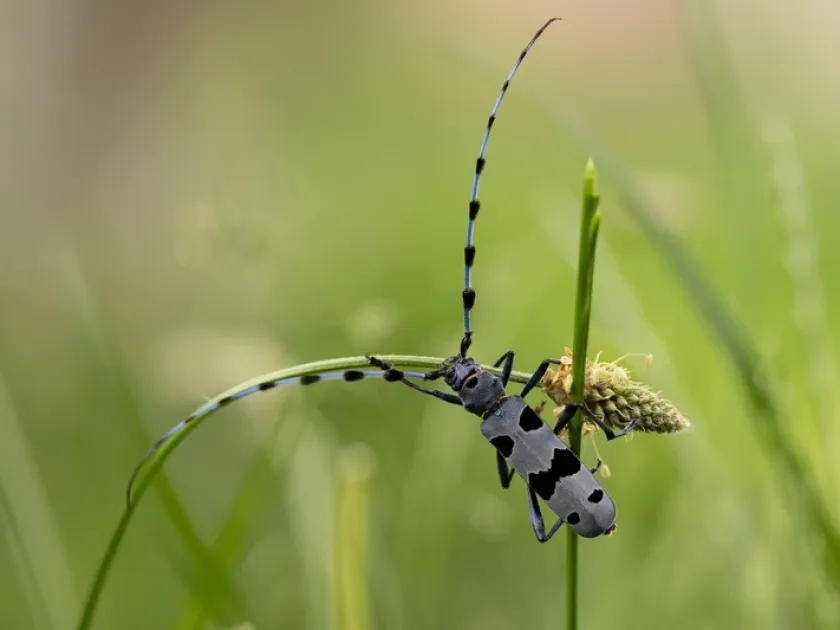
The Alpine longhorn beetle (Rosalia alpina) is a visually striking member of the Cerambycidae family. It is easily identified by its vibrant blue or grey-blue color, patterned with distinctive velvet-black spots on the elytra.
Adult beetles grow between 15 and 38 mm in length. They feature impressively long antennae, which are covered in fine, dense hairs. In males, these antennae are significantly longer than the body itself.
The larvae are creamy white, cylindrical, and equipped with strong, dark mandibles designed to tunnel through dense wood. Their body structure is typical for longhorn beetles, adapted for life inside woody tissues.
The beetle spends the majority of its life cycle as a larva inside the host tree. Depending on local environmental conditions and the quality of the wood, the development from egg to adult takes several years.
Due to its rarity and specific habitat requirements, this insect is legally protected in many European regions. Its presence is often an indicator of high ecological value in forest ecosystems.
What it damages
The larvae primarily feed on the wood of decaying or weakened broad-leaved trees. Beech is the most common host, but the beetle also infests elms, willows, walnuts, and old fruit trees like pears.
The Alpine longhorn beetle is not considered a primary pest of healthy, vigorous trees. Instead, it favors timber that has already been affected by wood-rotting fungi, which soften the wood and make it easier to consume.
The tunnels created by larvae disrupt the flow of nutrients and water within the tree, causing the dieback of branches and, eventually, the entire tree. This weakens the tree's overall structural stability.
In orchards and timber production, the damage manifests as a significant reduction in wood quality. The presence of larval galleries makes the wood commercially unusable and aesthetically unattractive.
Once a tree is heavily infested, it becomes susceptible to breakage during windstorms. Long-term larval activity inevitably leads to the premature death of the host tree.
When it appears
Adult beetles are active during the warm summer months, typically from June to August. This period is critical for mating and finding suitable trees for oviposition.
They are most frequently seen on sunny days when they emerge from the bark to bask in the sunlight on the trunks of host trees. This is the best time to observe the species in the field.
Larval development occurs continuously inside the trunk. While growth slows down during the winter, the larvae remain active and continue their slow process of wood consumption.
Pupation usually takes place in the spring. The larva constructs a special chamber deep within the wood, where it transforms into an adult beetle before chewing its way out.
The emergence of the adult leaves behind a distinctive exit hole, signaling the completion of the cycle and the start of a new generation of beetles searching for hosts.
Signs of infestation
The most reliable sign of an infestation is the presence of large, oval-shaped exit holes on the trunk of the tree. These holes are created by the emerging adults.
Accumulated frass, or wood dust mixed with larval excrement, near the base of the tree or in bark crevices is a clear indication of ongoing larval activity deep inside the wood.
The presence of wood-rotting fungi or fruiting bodies (such as bracket fungi) on the trunk serves as a lure for female beetles. They often lay eggs near these damaged areas.
Visible stress in the tree, including wilting branches and yellowing leaves during the growing season, may indicate a significant internal infestation that has compromised the tree's vascular system.
Sightings of adult beetles basking on sunlit bark during the summer months confirm their presence in the immediate area and suggest that host trees are nearby.
Control measures
Effective management focuses on maintaining tree health and proper forest hygiene. Removing dead or severely weakened trees reduces the availability of breeding grounds for the beetle.
It is important to avoid storing firewood or deadwood close to healthy orchards, as these are primary sites for the insect to establish and expand its local population.
- Conduct regular sanitary pruning to remove dead or diseased branches.
- Seal mechanical wounds on bark with tree wound paint to prevent egg-laying.
- Dispose of heavily infested logs through controlled means, adhering to local regulations.
Chemical control via contact insecticides is largely ineffective against larvae hidden deep within the wood. Treatments should be restricted to adult management during the flight season, if necessary.
Always verify the local conservation status of the Alpine longhorn beetle before implementing any control measures, as it is a protected species in many jurisdictions.
Taxonomy
- Latin name
- Rosalia alpina
- Order
- Coleoptera (beetles)
- Family
- Cerambycidae
- EPPO code
- ROSAAL
Discussion
No discussions yet — be the first.