
Brown-legged oak borer
Ropalopus femoratus
Description
How to identify
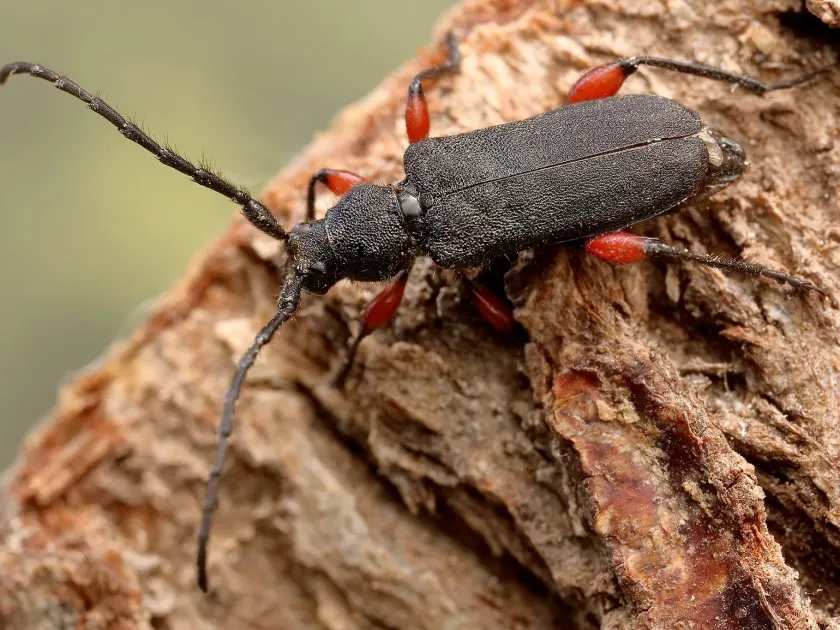
The brown-legged oak borer (Ropalopus femoratus) belongs to the longhorn beetle family (Cerambycidae), order Coleoptera. It is a medium-sized beetle known for its distinct physical features and impact on deciduous trees.
Adult beetles typically measure between 8 to 16 millimeters in length. Their bodies are black, while their legs and antennae often display a characteristic brownish or reddish-brown coloration.
The body of the beetle is slightly flattened and covered in fine hairs. Male specimens possess antennae that are approximately equal in length to their body, which is a common trait among longhorn beetles.
The larvae are typical of the family, appearing as pale, legless grubs with powerful mandibles. These mouthparts allow them to tunnel effectively through dense woody tissue during their developmental stage.
The pupal stage occurs inside a specialized chamber excavated within the wood. During this time, the insect undergoes metamorphosis, gradually developing the appendages and features of the adult form.
What it damages
The primary damage is caused by the larvae, which feed beneath the bark and within the sapwood. Common host plants include oak, beech, maple, hornbeam, and occasionally various fruit trees.
This pest preferentially targets stressed, weakened, dying, or recently felled trees. In orchard or forest settings, a high density of larvae can lead to severe structural damage or the rapid decline of the entire host tree.
Larval galleries interrupt the flow of nutrients and water within the tree's vascular system. When the infestation is severe enough to girdle the stem or branches, the affected parts quickly lose vitality.
The technical quality of the timber is significantly compromised by the larval tunnels. This renders the wood unsuitable for commercial use, including construction, woodworking, and furniture manufacturing.
Damaged wood is highly susceptible to secondary infestations by other pests and colonization by wood-decay fungi, which further accelerates the structural degradation of the tree.
When it appears
Adult flight activity typically occurs during late spring and summer, spanning from May through July. During this time, beetles emerge from the wood to mate and locate suitable host trees for egg-laying.
Females lay their eggs in bark crevices, often choosing areas where the tree has previously suffered mechanical damage or at the junctions of branches. A single female can deposit dozens of eggs.
Upon hatching, the larvae immediately penetrate the bark to begin feeding in the subcortical layer. Development continues throughout the summer and autumn, with the larvae overwintering deep within the wood.
Pupation takes place in the following spring within a pre-constructed chamber. This transition period is essential for the insect to emerge as an adult later in the season.
The entire life cycle is usually completed within one year, allowing the population to propagate steadily under favorable temperature and moisture conditions.
Signs of infestation
The most immediate sign of an infestation is the presence of frass (wood dust/boring waste) accumulating in bark folds or at the base of the tree. This indicates active larval feeding.
Exit holes left by emerging adults are often visible on the trunk surface. These holes are generally round or oval and may sometimes exhibit sap flow if the tree is still capable of an immune response.
Crown symptoms, such as premature leaf yellowing and the gradual drying of individual branches, serve as indicators of obstructed vascular systems caused by larval mining.
Exposing the wood by carefully removing a piece of bark will reveal broad, flattened galleries filled with dense frass. Larvae may be found deep within the sapwood during this inspection.
Chronic infestations lead to the death of large bark sections, which appear as depressed or dry patches on the main stem or thick branches, signaling severe long-term damage.
Control measures
Sanitation is the most effective management strategy. Regularly removing and destroying dead or dying trees prevents the pest from completing its life cycle and spreading to healthy vegetation.
It is crucial to avoid storing freshly cut wood near healthy stands, as it serves as a potent attractant for egg-laying females. Wood should be processed or disposed of promptly during the summer.
- Conducting regular pruning to remove weak or damaged branches.
- Maintaining tree vigor through appropriate irrigation and nutrient management.
- Cleaning the trunk surface to reduce potential oviposition sites.
- Encouraging natural predators and parasitoids in forest ecosystems to regulate populations.
Systemic insecticides may offer some protection if applied to the bark during the initial period of egg-laying, though effectiveness decreases once larvae bore into the wood.
When an individual tree is heavily infested, the most practical solution is to fell and destroy it, preferably by burning, to eliminate the reservoir of pests and protect surrounding healthy trees.
Taxonomy
- Latin name
- Ropalopus femoratus
- Order
- Coleoptera (beetles)
- Family
- Cerambycidae
- EPPO code
- RHOLFE
Discussion
No discussions yet — be the first.