
Common red soldier beetle
Rhagonycha fulva
Description
How to identify
The common red soldier beetle, scientifically known as Rhagonycha fulva, belongs to the family Cantharidae within the order Coleoptera.
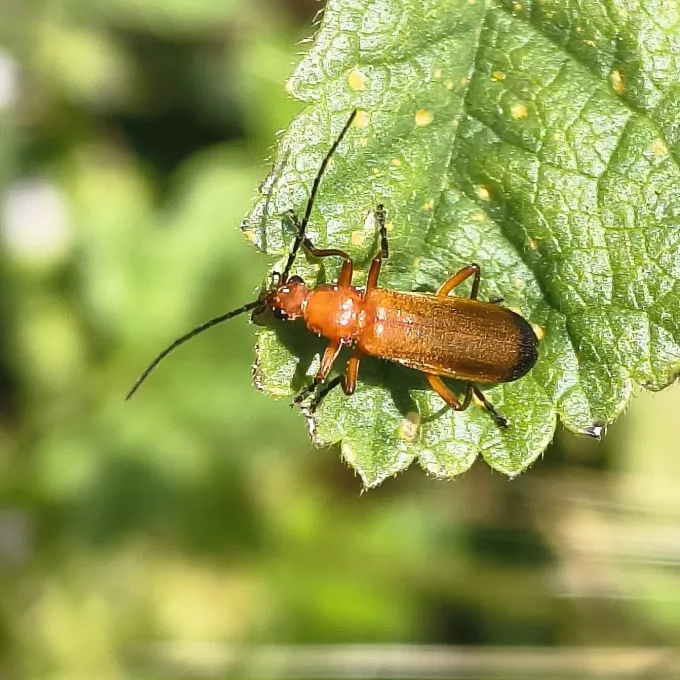
Adult beetles typically measure between 7 and 10 mm in length and are characterized by their soft, flexible elytra and orange-red to reddish-brown coloration.
The tip of the wing covers often features a distinctive dark patch, and the head and pronotum are generally darker than the rest of the body.
Larvae are dark, hairy, and robust, adapted to living in soil or dense vegetation where they act as active predators.
These beetles are frequently seen in pairs during the mating season, often found resting on the petals of open flowers during summer months.
What it damages
While often labeled as a potential pest, the common red soldier beetle is primarily recognized as a beneficial insect in gardens and agricultural settings.
Adults feed mainly on nectar and pollen, though they may occasionally cause minor damage to flower petals when their populations are extremely high.
The real value of these insects lies in their larval stage, where they feed on a variety of soil-dwelling pests, including small insects and larvae.
They are frequently found on umbelliferous and rosaceous plants, helping to pollinate them while simultaneously hunting for small prey.
In most agricultural contexts, the damage caused by this species is negligible and does not warrant chemical intervention.
When it appears
The life cycle of the red soldier beetle is closely tied to the seasonal changes, with adults appearing in late spring and early summer.
Peak activity for the beetles is usually observed in June and July, coinciding with the flowering period of many garden plants.
Larvae remain active throughout the winter in mild conditions and continue their development until pupation in the following spring.
The species requires moist, sheltered soil conditions to survive the larval stage, which explains their preference for gardens with mulch or organic debris.
As summer draws to a close, the adult population dies off, leaving the next generation of larvae to overwinter in the soil.
Signs of infestation
The presence of these beetles is easily identified by the appearance of numerous bright red-orange insects congregating on flower heads.
Observing small, irregular holes on the delicate edges of petals can indicate their feeding activity, especially during years with high beetle density.
On cloudy or wet days, beetles often aggregate on the undersides of leaves, making them clearly visible to anyone inspecting the foliage.
Finding dark, velvety-looking larvae while digging or turning over compost heaps is a clear sign of a healthy population inhabiting the area.
Lack of widespread plant damage confirms that their presence is generally benign and serves as a sign of a diverse garden ecosystem.
Control measures
Active control is rarely needed, as the red soldier beetle is a valuable predator that helps maintain the balance of the garden ecosystem.
If their numbers cause concern, physical removal by hand in the morning hours is the most eco-friendly way to manage local populations.
Avoid excessive pesticide use to protect these beneficial predators, which often help control more damaging pests like aphids or mites.
Maintaining a variety of garden habitats, including areas with leaf litter, will encourage them to remain in the garden to hunt pests naturally.
- Encourage natural predators in the garden.
- Minimize the use of broad-spectrum insecticides.
- Hand-pick if necessary to protect prize flowers.
- Maintain organic mulch to support larval development.
Taxonomy
- Latin name
- Rhagonycha fulva
- Order
- Coleoptera (beetles)
- Family
- Cantharidae
- EPPO code
- RHAOFU
Discussion
No discussions yet — be the first.