
Soldier beetle
Cantharis
Description
How to identify
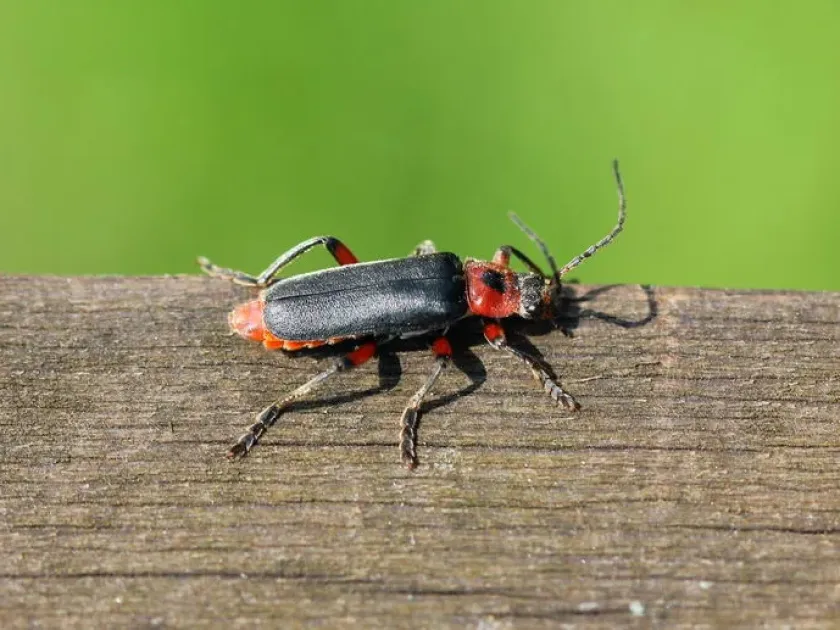
Soldier beetles belong to the family Cantharidae, order Coleoptera. They are commonly recognized by their elongated, soft bodies, which are typically between 5 and 15 mm in length.
Adult beetles often exhibit distinct color patterns, frequently featuring yellow, orange, or reddish markings combined with black or metallic wing covers (elytra). Their antennae are long and thread-like.
The larvae of the soldier beetle have a velvet-like appearance due to dense, dark bristles covering their bodies. They possess robust mouthparts adapted for hunting small soil-dwelling organisms.
These insects are frequently seen on flowers during the daytime, where they feed on nectar, pollen, and small soft-bodied insects like aphids, which makes them partially beneficial.
While often considered garden allies, certain species can become problematic when their population density increases, leading to incidental damage to garden plants.
What it damages
Direct damage occurs when adult beetles feed on the delicate petals of flowers and young buds, which may affect the aesthetic quality of ornamental plants and fruit-bearing potential.
Larvae, primarily carnivorous, may occasionally consume the roots or young shoots of seedlings when their primary prey is scarce, causing wilting or stunted growth.
Feeding marks appear as irregular holes in leaves or shredded petals, which can create entry points for secondary pathogens like fungi and bacteria, leading to tissue decay.
In intensive agricultural settings, excessive beetle activity can damage crops, resulting in reduced marketability of fresh produce and floral products.
However, the damage is rarely severe enough to cause total crop failure unless environmental conditions trigger a sudden population explosion.
When it appears
Soldier beetles are primarily active from late spring through the summer months, aligning with the flowering period of many host plants.
Adults emerge from the soil after completing their development and are frequently spotted in gardens during warm, sunny days in June and July.
The life cycle involves a single generation per year, with the larval stage spending the winter months in the soil or protected under decaying organic matter.
Pupation occurs in the spring in a soil chamber, leading to the emergence of adults that feed and mate to restart the cycle.
Seasonal management is most effective when targeted at the peak activity window, shortly after the adults emerge and begin foraging on the foliage.
Signs of infestation
Visible presence of adult beetles on the blossoms of flowers and foliage is the most reliable indicator of their activity in the garden.
Irregular, jagged edges on flower petals and small holes in leaves serve as strong diagnostic signs of feeding by adult soldier beetles.
Presence of velvet-like, dark larvae during soil cultivation in early spring suggests a high population density that may require monitoring.
Unexpected wilting of young vegetable transplants often points to root-zone feeding by larvae, especially in areas with high soil organic matter.
Observation of beetles clustering on plants after rainy weather is a common occurrence that indicates they are seeking food sources on the vegetation.
Control measures
Cultural control includes maintaining garden hygiene by removing excess weeds and debris that serve as overwintering sites for the larvae.
Chemical control should be used sparingly, applying registered insecticides only when damage thresholds are exceeded to avoid harming beneficial predators.
Biological control methods, such as utilizing soil-dwelling beneficial nematodes or entomopathogenic fungi, can effectively reduce larval populations in the soil.
Manual removal of beetles early in the morning, when they are sluggish, can significantly reduce pressure on small-scale garden beds.
Fall tillage is highly recommended as a preventative measure to disturb overwintering larvae and expose them to natural environmental stressors.
Taxonomy
- Latin name
- Cantharis
- Order
- Coleoptera (beetles)
- Family
- Cantharidae
- EPPO code
- CANTSP
Discussion
No discussions yet — be the first.