
Soldier beetle
Cantharis decipiens
Description
How to identify
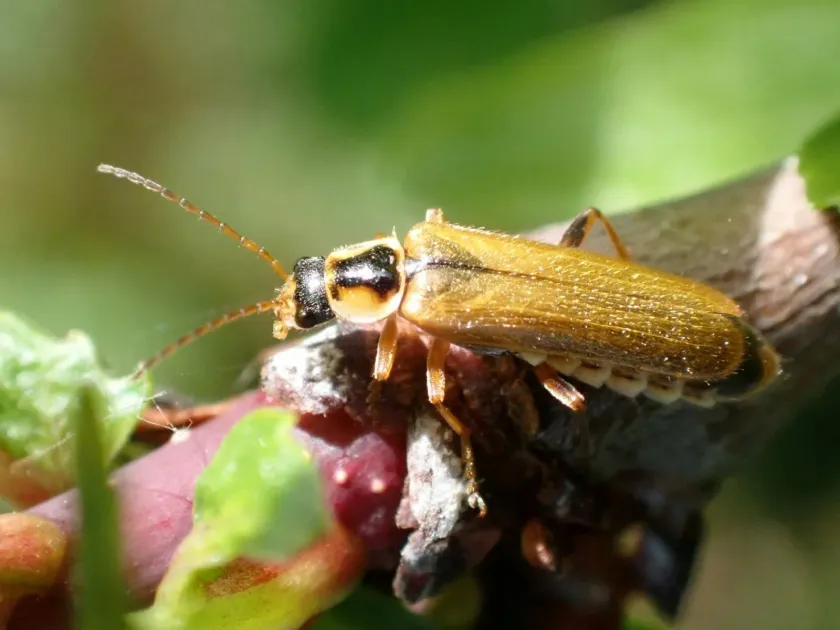
The soldier beetle (Cantharis decipiens) belongs to the order Coleoptera and the family Cantharidae. These insects are known for their soft, leathery elytra, which is the primary characteristic that gives the family its name.
Adult beetles are elongated with dark coloration and distinctive yellowish-red markings on the pronotum. Their antennae are thread-like and relatively long, which aids in identification compared to other common beetle species.
The larvae are covered in dense, fine hair, giving them a velvety appearance. They are generally dark-colored and possess well-developed mouthparts, adapted for hunting in soil or decaying organic matter.
The life cycle follows complete metamorphosis: egg, larva, pupa, and adult. In most agricultural regions, the species completes one generation per year, making the timing of monitoring crucial for control.
While often viewed as predators that feed on aphids and other small pests, they can occasionally behave as incidental pests when their primary food sources become scarce in the field.
What it damages
Damage caused by Cantharis decipiens occurs primarily when population densities are high and natural prey is limited. During these periods, adults may shift their diet to plant tissues.
Sensitive crops include various vegetables and berries, where adult beetles feed on flower petals, stamens, and young ovaries. This can lead to reduced fruit set and physical deformities in emerging fruit.
Larvae, residing in the soil, may feed on the tender roots or stems of seedlings. These injuries can leave the plant vulnerable to secondary infections from soil-borne fungi and bacteria.
The economic impact of this beetle is often balanced by its role as a beneficial predator. Agronomists should only consider intervention if the damage to reproductive plant organs becomes significant.
Proper field assessment is necessary to determine if the beetle is acting as a friend or foe, as their presence on plants does not always equate to economic loss for the grower.
When it appears
Adult Cantharis decipiens emergence typically occurs in late spring and early summer, strongly correlated with rising temperatures and the onset of the flowering phase for many crops.
Eggs are laid in moist soil or leaf litter, providing a stable environment for the developing larvae. Larvae remain active throughout the warm months, feeding and growing before wintering.
They overwinter as larvae deep within the soil profile, surviving harsh conditions until the following spring when they pupate. This timing aligns their emergence with the peak of crop growth.
Activity is highest during the early morning and late evening. During the heat of the day, adults seek shelter within dense foliage or shaded areas, making direct observation more difficult.
Monitoring should be intensified during the flowering stages, as this is the period when beetles are most attracted to fields and can potentially cause the most damage to crop yields.
Signs of infestation
The most obvious sign of Cantharis decipiens is the presence of adult beetles on the flowers or stems of the plants. Their distinctive coloration often makes them easy to spot during inspections.
Physical damage to plants appears as uneven, jagged margins on petals or chewed holes in developing flower buds. High levels of such damage indicate a large population density.
Larval activity may be inferred by observing stunted seedlings or localized damage to root systems during the spring. Digging in the soil near the root zone can confirm the presence of larvae.
Wilting of young plants without clear root-rot signs or stem borers might suggest subsurface feeding by soldier beetle larvae, especially in fields with high organic matter.
Utilizing yellow sticky traps can help assess the adult population levels in the field, allowing farmers to track the timing of the infestation and plan mitigation efforts accordingly.
Control measures
Management of Cantharis decipiens should focus on an integrated pest management (IPM) approach. Because they are often beneficial predators, total eradication is neither practical nor desirable.
Cultural control methods include maintaining clean fields by removing weed hosts and debris, and implementing proper soil tillage, which can disrupt the larval stages and reduce their survival rates.
Chemical intervention should be reserved for scenarios where economic thresholds are exceeded. Use selective insecticides that target the pest while minimizing harm to essential pollinators and other beneficial insects.
- Rotate crops to disrupt life cycles.
- Practice thorough soil cultivation in the off-season.
- Use biopesticides if monitoring shows high population spikes.
- Manual inspection and hand-picking for small-scale gardens.
Applications must be timed to avoid contact with pollinators. Always check local agricultural guidelines for product safety and usage instructions regarding the protection of beneficial species.
Taxonomy
- Latin name
- Cantharis decipiens
- Order
- Coleoptera (beetles)
- Family
- Cantharidae
- EPPO code
- CANTDE
Discussion
No discussions yet — be the first.