
Common soldier beetle
Cantharis livida
Description
How to identify
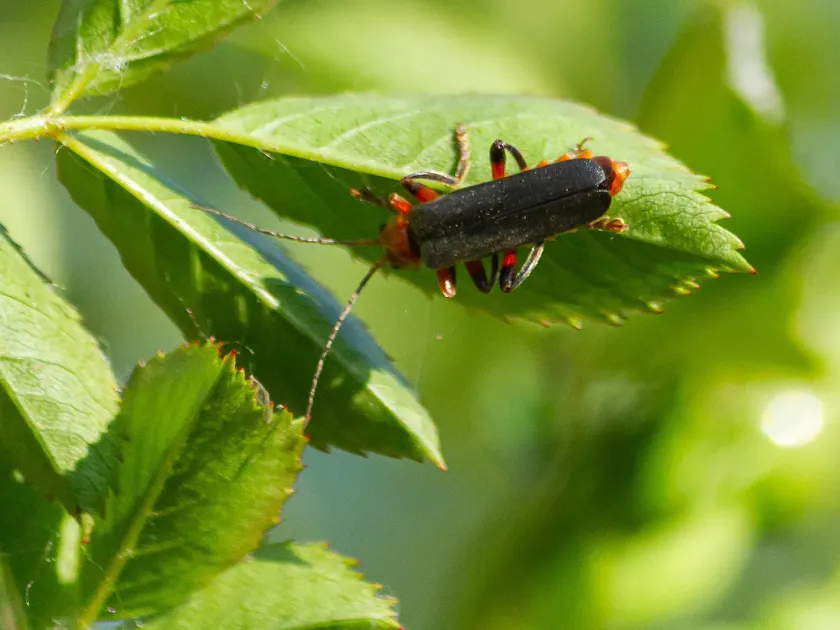
The common soldier beetle belongs to the Cantharidae family within the Coleoptera order. The adult beetle reaches a length of 10–15 mm and possesses long, soft wing covers that are typically brown or yellowish-brown.
The head and pronotum of the beetle often feature dark markings, which are characteristic of this species. Their antennae are long and filiform, enabling agile movement across vegetation while foraging.
Larvae of Cantharis livida are distinct, covered with dense, dark, velvety hairs. Their bodies are segmented, ranging in color from dark grey to nearly black, helping them blend into their surroundings.
The life cycle involves complete metamorphosis: egg, larva, pupa, and adult. They typically overwinter as larvae, hiding in the upper soil layers or under leaf litter to survive harsh winter conditions.
These beetles are well-adapted to varied environments, often found in fields, meadows, and gardens where prey such as aphids is abundant throughout the spring and early summer.
What it damages
The common soldier beetle is often considered a beneficial insect because adults feed on soft-bodied pests like aphids. However, under high population densities, they may feed on plant tissue.
Adults can sometimes consume flower petals, buds, and tender leaves of fruit trees and shrubs. This activity may lead to aesthetic damage or minor yield reductions in specific ornamental crops.
Although larvae are predatory, they occasionally cause damage to seedling roots or vegetable crops if natural prey is scarce, though this behavior is not their primary feeding strategy.
In most agricultural settings, the damage caused by these beetles is negligible compared to the benefits they provide by suppressing populations of major crop pests like aphids.
Overall, they are regarded as generalist predators. Management is usually only considered when their numbers become excessively high and actual crop loss is observed.
When it appears
The active period for adult soldier beetles typically begins in late spring, around May, and continues through June, which is their primary mating and egg-laying season.
Larvae are most active during the warmer months, beginning their feeding cycle in early spring as they emerge from their overwintering sites in the soil.
Development and population growth are highly dependent on temperature and soil moisture levels. A second or extended late-season generation can occur if environmental conditions remain favorable.
By autumn, the larvae prepare for winter by moving deeper into the soil or finding stable debris, marking the conclusion of their active development cycle for the year.
Monitoring for adults is most effective in June, as this is when they are most conspicuous on flowers and foliage during their peak reproductive activity.
Signs of infestation
The most obvious sign of presence is observing the adult beetles themselves, as they are frequently found on inflorescences and leaves during the late spring and early summer.
Damage to petals, characterized by ragged edges or small holes, can indicate the feeding activity of these beetles, especially when populations are dense during the flowering period.
Finding larvae during soil cultivation or while examining debris in the garden is a clear indicator of their presence and a sign of a healthy, functioning soil ecosystem.
A reduction in aphid populations in areas where these beetles are present serves as a positive sign that they are actively acting as natural biological control agents.
If visible damage to buds or leaves becomes frequent, it suggests a large population that may require management, though this is rare in balanced ecosystems.
Control measures
Chemical control is rarely recommended for the common soldier beetle, as they are valuable predatory insects that contribute to the natural suppression of agricultural pests.
The most effective management strategy is cultural: maintaining a clean garden, removing excessive weeds, and clearing heavy plant debris where larvae might congregate.
Deep soil cultivation in autumn is a recommended method to disturb and reduce overwintering larval populations, effectively lowering the beetle numbers for the following spring.
Integrated Pest Management (IPM) practices suggest avoiding broad-spectrum insecticides to protect these beneficial beetles, ensuring that their natural predation remains effective.
If management is absolutely necessary, use selective and low-toxicity methods to minimize the impact on the local population of beneficial predatory insects.
Taxonomy
- Latin name
- Cantharis livida
- Order
- Coleoptera (beetles)
- Family
- Cantharidae
- EPPO code
- CANTLD
Discussion
No discussions yet — be the first.