
Rhabditis strongyloides
Rhabditis strongyloides
Description
How to identify
Rhabditis strongyloides belongs to the phylum Nematoda, order Rhabditida, family Rhabditidae. These are primarily soil-dwelling saprobionts that feed on bacteria and decaying organic matter.
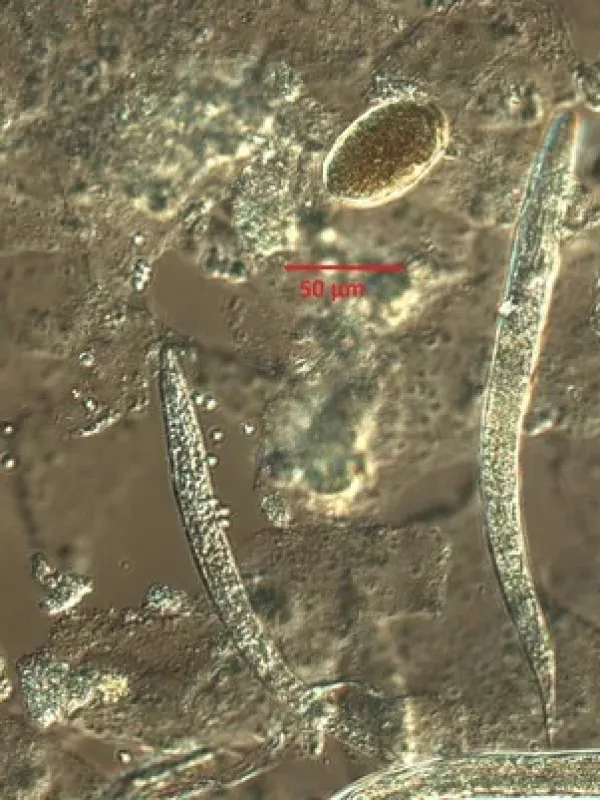
This species is characterized by its microscopic size, reaching approximately 1–1.5 mm in length. The nematode's body is transparent, cylindrical, and possesses a distinct rhabditoid esophagus structure.
Unlike highly specialized parasites, this species is a facultative parasite. It can transition from saprophytic feeding to invading plant tissues when they are already damaged or the host's immune system is weakened.
The life cycle includes several developmental stages: egg, four larval instars, and the adult stage. Optimal conditions for reproduction include high humidity and the presence of rotting organic debris.
An important biological feature is the larvae's ability to enter a state of anabiosis or form cysts under unfavorable environmental conditions, which contributes to their high survival rate.
What it damages
These nematodes frequently affect vegetable and ornamental crops planted in waterlogged soil rich in decomposing organic matter. Roots, tubers, and the root collar zone of stems are at risk.
The damage manifests as the colonization of tissues that have already begun to degrade or are compromised by fungal infections. They act as secondary colonizers, accelerating the decay process.
Under massive infestation, nematodes can attack healthy root tissues by penetrating through microcracks. This leads to the development of phytohelminthoses, which weaken the overall health of the plant.
They pose a particular danger in greenhouse conditions, where a microclimate with excessive humidity is maintained. In such environments, population growth occurs rapidly.
Crops grown in hydroponic systems with inadequate sterilization are also at risk, as nematodes spread quickly through the nutrient solution.
Signs of infestation
The main sign of infestation is stunted plant growth and yellowing of the lower leaves, caused by the dysfunction of the root system.
Visual inspection of the underground part reveals areas of softening or rotting tissues. Roots become dull or brownish, turning limp and easily separating from the stem.
Cross-sections of affected areas often show moist lesions that emit a characteristic putrid odor. This is the result of the activity of associated microflora introduced by the nematodes.
Wilting of plants during the day, despite adequate watering, is a characteristic signal that the roots are no longer effectively supplying moisture to the above-ground parts.
In severe cases, affected plants may detach from the soil entirely due to the complete destruction of the root collar, leading to significant yield losses in specific areas.
Control measures
The foundation of control lies in proper agronomic practices. It is crucial to avoid waterlogging the soil and ensure good drainage to prevent moisture stagnation and anaerobic conditions.
Quality soil cultivation and the application of only fully composted organic fertilizer are necessary. Fresh manure is an ideal environment for population outbreaks of these nematodes.
Using healthy planting material and performing regular disinfection of potting mixes before planting via thermal treatment (steaming) is highly effective.
- Regular loosening of inter-row spaces to allow oxygen circulation.
- Removal and destruction of heavily infected specimens along with their root ball.
- Adherence to crop rotation by including crops that are not hosts for these species.
In cases of mass infestation, the use of specialized nematicides may be permitted, though their application must be strictly regulated based on the type of crop grown.
Taxonomy
- Latin name
- Rhabditis strongyloides
- Order
- Nematodes
- Family
- Rhabditidae
- EPPO code
- RHATST
Discussion
No discussions yet — be the first.