
Agile frog
Rana dalmatina
Description
How to identify
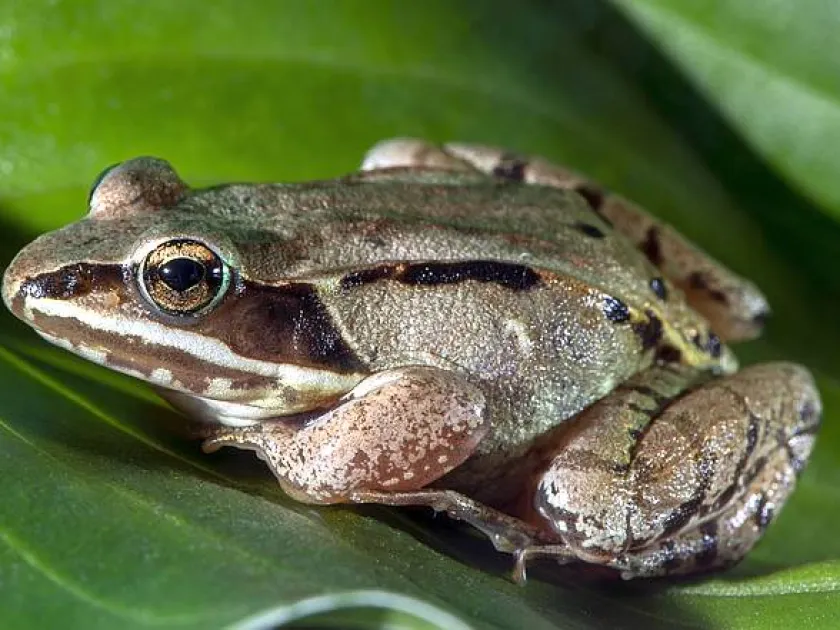
The agile frog (Rana dalmatina) is a member of the Ranidae family, distinguished by its slender body and exceptionally long, powerful hind legs.
The dorsal coloration ranges from light brown to reddish-brown, providing excellent camouflage against dry leaves in forest habitats and garden settings.
A definitive identification feature is the dark brown temporal spot covering the eardrum and the length of the hind limbs, which extend well beyond the tip of the snout.
The belly is typically uniform, whitish or yellowish, and the skin texture is smooth, lacking the rough tubercles found in toads.
Adults reach a size of 7 to 9 centimeters in length, with females being notably larger than males during the breeding season.
What it damages
The agile frog is not a plant pest. It is an insectivorous amphibian that exclusively hunts small invertebrates and has no interest in plant tissues.
It does not consume seeds, leaves, roots, or any part of agricultural crops, meaning it causes zero damage to farming operations.
Instead, these frogs serve as biological control agents by consuming large quantities of insects, many of which can be detrimental to commercial crops.
By preying on beetles, flies, and caterpillars, they naturally regulate pest populations in fields and orchards without requiring synthetic intervention.
Their presence on farmland is a positive ecological sign, indicating high levels of biodiversity and a healthy, self-regulating environment.
When it appears
This species is among the earliest to emerge from hibernation, often appearing near water bodies in late winter or early spring during the first thaw.
After the spring breeding period, they migrate away from water and spend the rest of the year in terrestrial habitats, such as deciduous forests and shaded gardens.
During summer, they are most active during moist, humid weather conditions, particularly at dawn and dusk, while seeking shade during the heat of the day.
As autumn temperatures drop, they search for frost-free refuges, such as abandoned burrows, rock piles, or dense piles of organic matter for overwintering.
They remain dormant throughout the winter until the soil temperatures rise sufficiently to trigger the start of the next reproductive cycle.
Control measures
There is no need for control measures against the agile frog, as it is a beneficial species and, in many parts of its range, a protected animal.
To discourage them from entering sensitive areas like seedbeds or greenhouses, simple physical barriers such as fine-mesh netting are sufficient.
Avoiding the unnecessary use of broad-spectrum pesticides is highly recommended to protect this natural ally from toxic exposure.
By providing habitat areas like log piles or damp ground cover, gardeners can encourage these frogs to stay and provide natural pest management.
Supporting amphibian populations is a cornerstone of sustainable and organic agricultural practices that prioritize ecological balance over chemical eradication.
Taxonomy
- Latin name
- Rana dalmatina
- Family
- Ranidae
- EPPO code
- RANSDA
Discussion
No discussions yet — be the first.