
Green frogs
Pelophylax
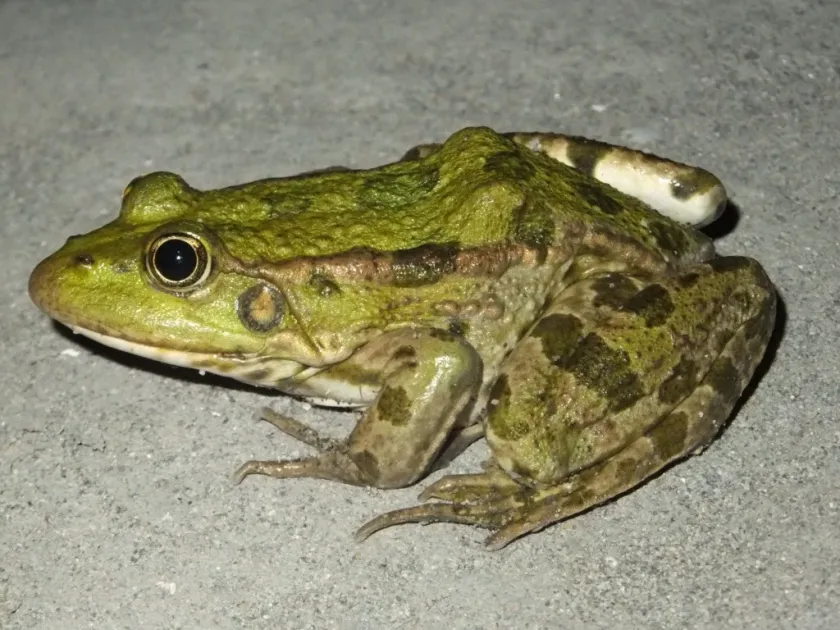
Description
How to identify
Green frogs (genus Pelophylax) belong to the order Anura, family Ranidae. These are amphibians with a distinctive bright green or olive color, often featuring dark spots on their back.
Adult individuals reach sizes from 6 to 12 centimeters. Their powerful hind legs allow them to make long jumps, which they use for hunting and escaping from predators.
The skin of green frogs is smooth and covered with mucus, which helps maintain necessary moisture levels. Their activity levels are highly dependent on ambient temperature.
They have large, high-set eyes that provide a wide field of view. During the day, they are often found basking in the sun near bodies of water.
Reproduction occurs in stagnant or slow-moving water bodies, where females lay thousands of eggs attached to aquatic vegetation.
What it damages
Despite their useful role in consuming insects, in specific agricultural settings like nurseries, these amphibians can cause indirect damage.
The main issue lies in their close connection to water, leading to excessive soil moisture near crops and promoting the development of fungal diseases.
Mechanical damage to young vegetable seedlings often occurs during the movement of frogs through garden beds at night or during the early morning hours.
A high population density of frogs can lead to the contamination of hydroponic systems or irrigation channels with their waste products.
The disruption of the microclimate due to the constant presence of moist trails left by amphibians creates an environment favorable for pathogen development on fragile plants.
When it appears
The activity of green frogs begins in early spring, when the temperature of the water in ponds rises above 10-12 degrees Celsius.
Peak activity and population density occur during summer months, coinciding with the active vegetation phase of vegetable and berry crops.
During periods of prolonged rain, frogs migrate over significant distances, often ending up in shaded garden beds with high soil moisture levels.
The end of the activity period occurs in the middle or late autumn, when the amphibians begin searching for wintering sites in mud or deep burrows.
The duration of the reproductive cycle is strongly dependent on regional climatic characteristics and the length of the warm season.
Signs of infestation
The presence of numerous characteristic tracks on moist soil between rows is the first sign of amphibian activity in the area.
Finding egg masses in drainage channels or artificial water containers is a direct indicator of their presence near the crops.
Damage to the epidermis of seedlings or young leaves, resembling punctures from jumping, indicates nocturnal animal visits.
A specific sharp odor, characteristic of amphibian activity in enclosed greenhouse spaces, serves as an indirect indicator of their infiltration.
The appearance of slippery trails on leaves of low-growing plants, causing tissue decay, often accompanies the presence of frogs in the garden bed.
Control measures
Restricting frog access to plots is achieved by creating protective barriers, such as fine-mesh fences around the perimeter of the beds.
Draining excessively wet areas and preventing water stagnation in rows reduces the attractiveness of the territory for these amphibians.
Regular cleaning of drainage systems and channels from aquatic vegetation deprives the amphibians of breeding sites and temporary shelter.
The use of physical repellents, such as ultrasonic devices, can provide a short-term effect when the population density is high.
As a final measure, moving individuals outside the agroecosystem to natural water bodies remains a humane method of population control.
Taxonomy
- Latin name
- Pelophylax
- Family
- Ranidae
- EPPO code
- PELXSP
Discussion
No discussions yet — be the first.