
Edible frog
Pelophylax esculentus
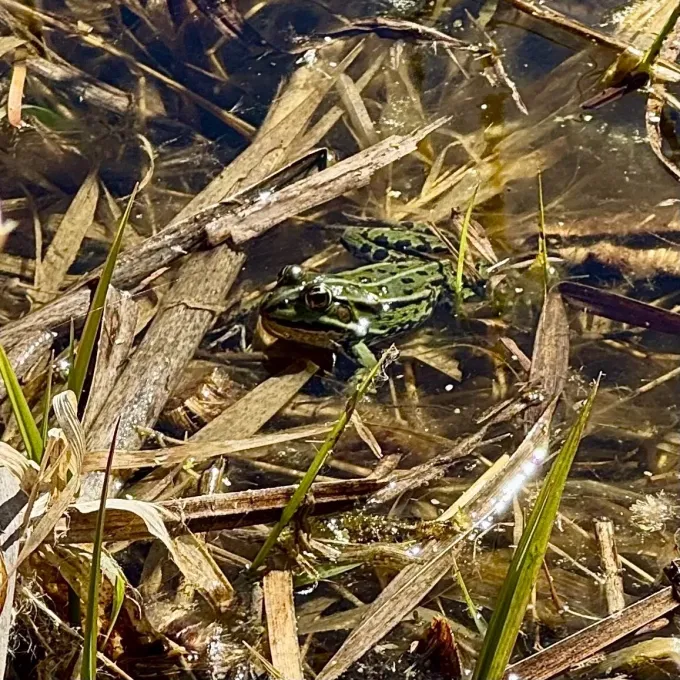
Description
How to identify
The edible frog (Pelophylax esculentus) is a common hybrid species widespread across European freshwater habitats.
Adult frogs typically range from 5 to 10 centimeters in length and exhibit a vibrant green or brownish dorsal coloration with darker, irregular spotting.
They possess long, powerful hind legs adapted for jumping and swimming, and their skin is generally smooth with large mucous glands.
The species is highly aquatic and can be identified by the distinct, pale-colored vocal sacs found in males, which become prominent during the breeding season.
They are primarily diurnal and are often seen basking on the banks of ponds, streams, or irrigation canals, ready to dive at the slightest disturbance.
What it damages
In the context of agriculture and specifically aquaculture, edible frogs are categorized as pests due to their predatory behavior in fish nurseries.
They actively hunt and consume fish fry and fingerlings, which directly reduces the yield of valuable commercial fish stocks.
Beyond direct predation, they compete intensely with fish for available food resources, primarily zooplankton and insect larvae, hindering fish growth.
The presence of large populations can also deteriorate water quality in small ponds and serve as vectors for various parasitic infections affecting fish.
Their habit of concentrating in small, nutrient-rich nursery ponds makes them a significant management challenge for aquaculture professionals.
When it appears
The active season begins in early spring when water temperatures reach approximately 10 degrees Celsius, prompting emergence from hibernation.
The breeding period peaks between May and June, which coincides with the timing of fish spawning, leading to increased pressure on juvenile fish.
Throughout the summer months, adult frogs engage in heavy feeding to accumulate energy reserves, causing maximum damage to fish stocks.
Activity gradually declines in late autumn as frogs seek deep, silt-rich areas of the pond bottom to enter hibernation for the winter.
The timing of their life cycle is highly dependent on environmental temperature and water depth, impacting their survival and population density.
Control measures
Management strategies focus on habitat modification to make the pond environment less hospitable for the frogs.
Regular maintenance, including cutting down dense riparian vegetation, removes the cover that frogs rely on for hunting and protection.
Physical exclusion, such as the use of fine-mesh netting installed around the perimeter of fry ponds, is highly effective at preventing entry.
Periodic drainage and cleaning of fish ponds are considered essential practices to eliminate breeding sites and reduce the overwintering population.
- Maintain short grass and clean pond edges.
- Install fine-mesh physical barriers.
- Implement scheduled pond drainage for cleaning.
- Manually remove egg masses during the breeding season.
- Reduce nutrient loading to limit the insect population.
Taxonomy
- Latin name
- Pelophylax esculentus
- Family
- Ranidae
- EPPO code
- RANSES
Discussion
No discussions yet — be the first.