
Water rail
Rallus aquaticus
Description
How to identify
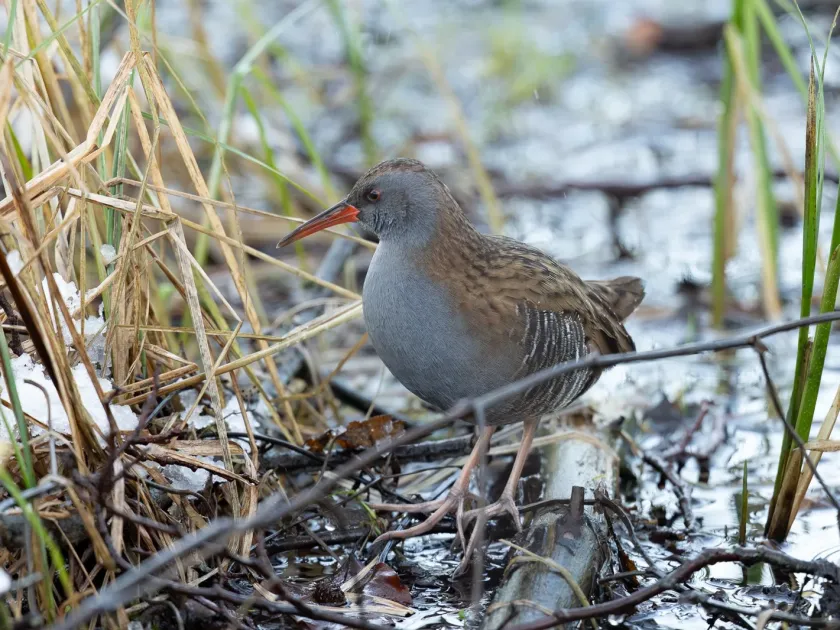
The Water Rail (Rallus aquaticus) is a semi-aquatic bird belonging to the Rallidae family, adapted for life in dense wetlands and marshy environments.
The bird has a laterally compressed body, which allows it to navigate through dense reeds and sedges with remarkable ease and speed.
Its plumage is primarily olive-brown with black streaks, providing perfect camouflage against the swampy backgrounds where it typically resides.
A distinctive feature of the Water Rail is its long, slightly decurved, reddish-colored bill, which is specialized for probing in mud and shallow water.
These birds are notoriously secretive and prefer to scurry along the ground, rarely taking flight unless they feel significantly threatened.
What it damages
While the Water Rail is not typically a major agricultural pest, it can cause localized damage to crops cultivated in or near wet, marshy fields.
The primary concern involves the consumption of sown seeds during the early planting stages, which leads to reduced crop density and yield losses.
In rice paddies, these birds may pull up young seedlings while foraging for insects, resulting in patchy areas across the field that require replanting.
During the ripening stage of cereal crops, Water Rails may damage standing grains, impacting the overall quality and quantity of the harvest.
The bird's tendency to probe the soil surface disrupts the seedbed and can contribute to soil moisture management issues in sensitive cultivation areas.
When it appears
The risk of Water Rail activity on agricultural land is highest during the spring and summer months, coinciding with the nesting and growing seasons.
In spring, foraging birds frequently visit newly planted fields, making this the most critical time for preventative measures against potential crop damage.
Throughout the summer, parents foraging for food for their chicks remain active in areas adjacent to their wetland habitats, often encroaching on crop fields.
In autumn, there is often a short spike in foraging activity as birds prepare for the winter, potentially impacting late-season crops near water sources.
Winter months generally see significantly less activity, as the birds congregate in smaller areas of open water or migrate to more suitable wintering grounds.
Signs of infestation
Identifying the presence of Water Rails involves looking for characteristic tracks in moist soil, which show long, distinct toes adapted for soft substrates.
Evidence of damage often includes uprooted seedlings with precise, small-diameter punctures in the stems or roots caused by their narrow bills.
Auditory evidence is a primary indicator; their presence is often signaled by distinct, piglet-like squeals heard during the twilight hours.
Small patches of flattened vegetation and disturbed soil in fields adjacent to irrigation ditches or marshes serve as clear signs of their foraging activities.
The presence of scat and remnants of aquatic mollusk shells near field edges can further confirm that the birds are utilizing the area for feeding.
Control measures
Managing the Water Rail as a pest requires a combination of deterrent strategies and habitat modification to discourage them from entering crop fields.
The use of acoustic deterrents, such as playing recordings of natural predators, can be highly effective during the vulnerable early-growth stage.
Habitat management, specifically thinning dense vegetation buffers between marshes and fields, makes the area less attractive for nesting and foraging.
Improving drainage in fields prone to water stagnation helps reduce the attractiveness of the environment to this specific water-dependent species.
Visual deterrents, such as reflective materials or scarecrows, can temporarily dissuade the birds from visiting critical areas of the plantation.
Taxonomy
- Latin name
- Rallus aquaticus
- Family
- Rallidae
- EPPO code
- RALLAQ
Discussion
No discussions yet — be the first.