
Water Rail
Rallus
Description
How to identify
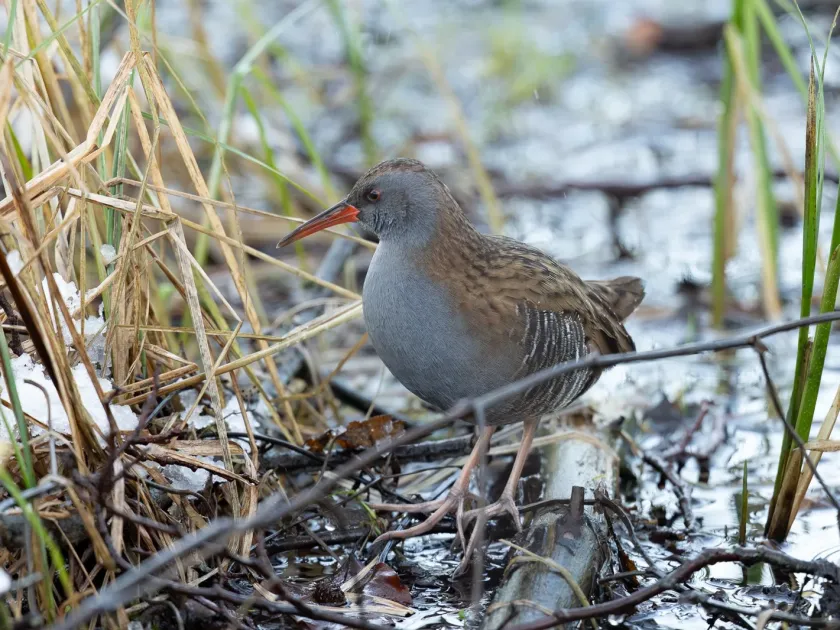
The water rail (lat. Rallus aquaticus) is a shy, elusive bird belonging to the Rallidae family, which can occasionally become a nuisance in agricultural environments near water bodies.
The bird is characterized by a laterally compressed body, allowing it to move effortlessly through dense reeds and wet crop fields, and a long, slightly decurved beak used for foraging.
Its plumage features brownish-black streaks on the back and a distinctive bluish-gray face and breast, which provides excellent camouflage in wetland and marshy agricultural habitats.
Measuring about 23–28 cm in length, the water rail prefers to remain hidden, making it a difficult pest to spot without specific knowledge of its behavioral patterns.
Agronomists should pay special attention to the boundaries of fields adjacent to irrigation ditches and drainage systems, as these are the preferred transit routes for this species.
What it damages
While the water rail primarily feeds on aquatic invertebrates and small amphibians, it may forage on young crops during periods of low natural food availability.
In rice cultivation, water rails can cause economic damage by trampling seedlings and foraging on emerging grains, creating gaps in the crop stand that impact overall yield.
Their feeding activity often involves digging into moist soil, which can disturb the root systems of young, sensitive plants, leading to weakened growth or plant death.
Mechanical damage is also associated with their movement near irrigation systems, as they can inadvertently disrupt sensitive sensors or micro-irrigation components.
The cumulative effect of trampling and direct consumption of vegetation can be significant when high densities of birds congregate in a single field.
When it appears
The risk of water rail interference is highest during the spring planting season, when newly emerged seedlings are most vulnerable to physical trampling and consumption.
The breeding season, occurring throughout May and June, makes the birds more territorially aggressive and likely to inhabit edges of irrigation channels near crop sites.
Late summer marks a period of increased mobility before migration, during which birds may frequent fields to forage on post-harvest grain remnants or moist soil areas.
Periods of extreme drought are critical, as these conditions force the birds to abandon their usual marshlands in favor of artificially irrigated agricultural land.
Monitoring should be most intensive during dawn and dusk, as these are the peak activity hours for water rails, regardless of the vegetation stage of the field.
Signs of infestation
The most reliable sign of presence is the discovery of long-toed footprints in the mud, which are distinct from those of typical farmland birds or small mammals.
Irregular patches of missing or damaged crops, especially those located near water sources, are a key indicator of activity that warrants further investigation.
The presence of unique, shrill, or pig-like squealing calls during early morning hours often alerts field managers to the presence of rails in the vicinity.
Evidence of broken or bypassed exclusionary fencing near drainage outlets suggests that the birds have established routes into the field interior.
Finding diagnostic droppings near feeding patches can help confirm the identification of the species and differentiate its damage from that caused by rodents.
Control measures
Acoustic deterrents that broadcast predator calls, such as those of raptors, can be highly effective in discouraging water rails from entering protected zones.
Installing fine-mesh physical barriers along the edges of irrigation channels is a proactive step to prevent birds from gaining easy access to young crops.
Cultural management techniques, including the regular mowing of tall vegetation along field margins, reduce the habitat suitability for rail nesting and foraging.
Water management strategies that avoid excessive flooding of field perimeters can help make the environment less attractive to these moisture-dependent birds.
The combined use of visual deterrents and habitat modification provides the most sustainable defense against water rail interference in commercial agriculture.
Taxonomy
- Latin name
- Rallus
- Family
- Rallidae
- EPPO code
- RALLSP
Discussion
No discussions yet — be the first.