
Corncrake
Crex
Description
How to identify
The corncrake (Crex crex) is a small bird belonging to the rail family, Rallidae, within the order Gruiformes. It is well-known for its elusive nature and its preference for dense, tall vegetation.
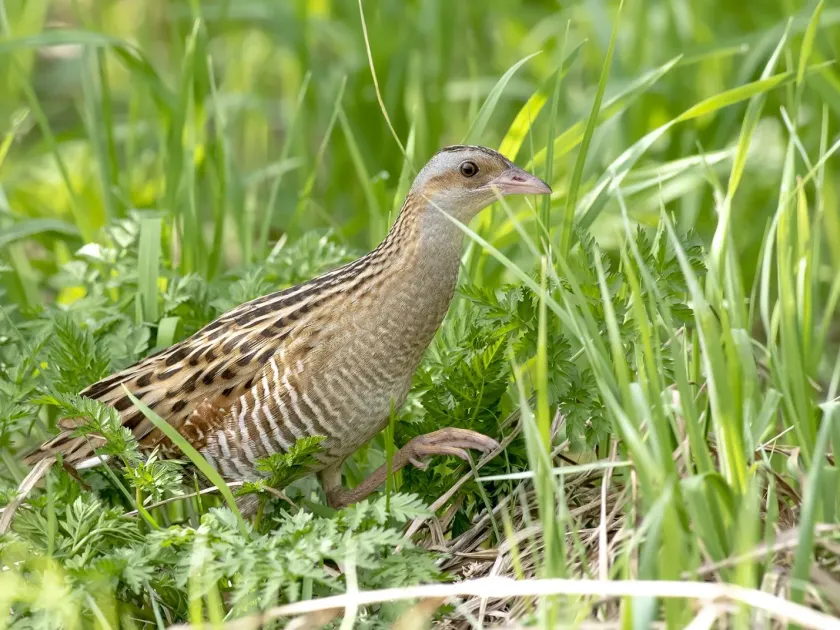
Adult corncrakes measure approximately 25–30 cm in length. They possess a compact body with a brown-streaked appearance, which provides excellent camouflage within meadows and cereal fields.
The species is most famous for the distinct, rasping call made by the males, which sounds like two pieces of hard material being rubbed together, traditionally transcribed as "crex-crex".
The bird is native to Europe and western Asia, primarily inhabiting moist grasslands, hay meadows, and sometimes agricultural crops like wheat or barley.
It is predominantly a ground-dwelling bird, relying on running rather than flying, which makes it highly sensitive to changes in its habitat structure.
What it damages
The corncrake is not considered a pest in the agricultural sense as it does not consume crops. Its diet consists of insects, earthworms, slugs, and other small invertebrates.
The interaction between corncrakes and agriculture is primarily focused on the potential conflict between harvesting schedules and the bird's breeding season.
Minor physical damage to crops may occur when birds construct nests, but this is statistically insignificant compared to the overall yield of a field.
The primary concern is the accidental destruction of nests or chicks by agricultural machinery during hay cutting or harvest, leading to population decline.
In modern agronomy, the corncrake is treated as a sensitive species, and farmers are often encouraged to adopt sustainable practices to maintain ecological balance.
When it appears
Corncrakes are migratory birds, returning to their breeding grounds in northern regions starting in late April or early May.
The breeding season, characterized by intense calling and nesting, takes place throughout June, which is the most sensitive period for the species.
By late July and August, the chicks are fledged, and the adults begin to prepare for their long-distance migration to Africa.
Agricultural operations, specifically the first cut of grass, often clash with the peak nesting activity, necessitating careful timing of field work.
By the end of the summer, the corncrake population departs, leaving the agricultural landscapes empty until the following spring.
Signs of infestation
The most reliable sign of the presence of a corncrake is the rasping call of the male, which is particularly audible at night and during dusk.
Visual identification is extremely difficult due to the bird's cryptic coloration and its habit of staying deep within the tall vegetation.
Small trails or paths through dense grass may indicate the bird's movement, but these are often indistinguishable from those made by small mammals.
The species rarely takes flight unless directly threatened, preferring to scurry through the base of the vegetation, which makes visual spotting during fieldwork unlikely.
Specialized acoustic monitoring conducted by environmental agencies is often the preferred method for assessing the bird's population density on farm land.
Control measures
Management strategies for corncrakes focus on conservation rather than elimination, aiming to protect the species within working agricultural landscapes.
Implementing a "center-out" mowing pattern—starting from the middle of the field and working outwards—allows the birds to move into adjacent cover rather than being trapped in the center.
Farmers are encouraged to delay mowing until after the breeding season or to leave patches of tall grass as refuge areas for the birds.
- Utilizing low-speed machinery to minimize the impact on nests.
- Leaving uncut strips or field margins to provide essential habitat.
- Participating in agri-environment schemes that provide incentives for wildlife-friendly farming.
Integrating these management techniques helps ensure that agricultural productivity does not come at the cost of the local corncrake population.
Taxonomy
- Latin name
- Crex
- Family
- Rallidae
- EPPO code
- CREXSP
Discussion
No discussions yet — be the first.