
Common moorhen
Gallinula
Description
How to identify
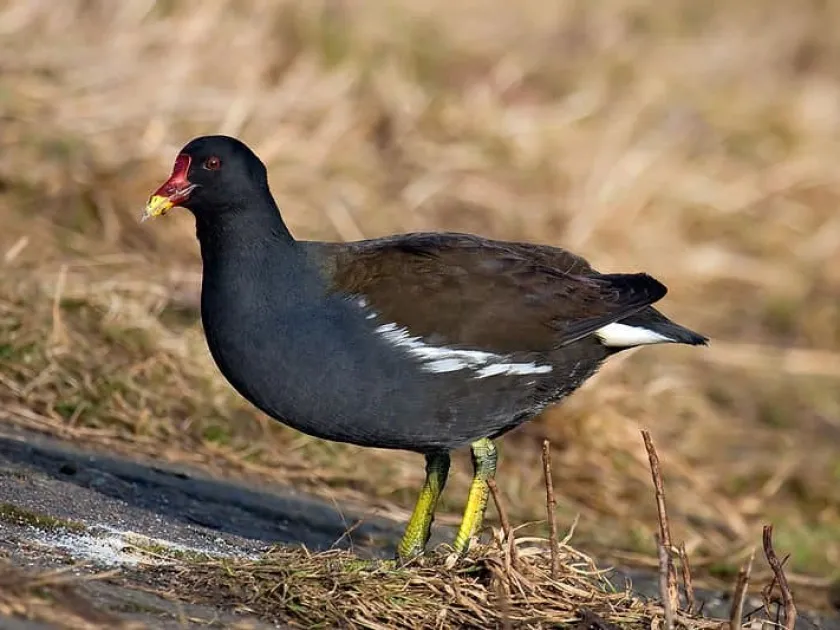
The Common moorhen (Gallinula chloropus) is a medium-sized waterbird belonging to the Rallidae family, easily recognized by its distinctive features.
The adult plumage is dark grey or black, with a prominent white streak along the flanks and white markings under the tail that flash when the bird swims.
Its most striking features are the bright red frontal shield on the forehead and the red bill with a yellow tip, which contrast sharply with the dark body.
The legs are long, with long toes that are not webbed, allowing the bird to walk easily on floating vegetation or soft mud in aquatic environments.
Juveniles are significantly browner and lack the vibrant red frontal shield, often blending into the marshy environment, which makes them less conspicuous to observers.
What it damages
The moorhen primarily causes damage to rice crops by feeding on freshly sown seeds, which leads to sparse emergence and uneven crop establishment.
They are particularly destructive during the sprouting stage, as they pull out tender rice seedlings, often forcing farmers to perform costly replanting.
Beyond rice, moorhens can feed on the shoots of various young vegetables or cereals if the fields are situated near riparian zones or irrigation networks.
Trampling is another significant issue; as the birds forage in groups, they physically crush the young crop, creating barren patches throughout the field.
The economic impact is highest when environmental conditions force a large population of moorhens into proximity with newly planted agricultural fields.
When it appears
The peak period of damage occurs during the early spring, which coincides with the sowing season and the initial emergence of seedlings in many crops.
As the growing season progresses, the birds' reliance on agricultural crops often decreases, but they remain potential threats if they reside in adjacent irrigation ditches.
Seasonal migration patterns can cause temporary spikes in moorhen activity, leading to unpredictable pressure on farming areas located along flyways.
Extreme weather events, such as droughts that reduce the availability of natural wetlands, can drive birds into irrigated fields, significantly increasing the risk of crop loss.
Continuous monitoring during the germination phase is essential to identify the arrival of birds before they reach a population density that causes widespread damage.
Control measures
Effective management requires integrated deterrent strategies, combining visual and acoustic signals to prevent birds from establishing themselves on the property.
Acoustic deterrents, such as devices that emit distress calls or predator sounds, are highly effective when used intermittently to prevent the birds from habituating.
Cultural control measures include regular maintenance of irrigation channels, such as removing dense reeds and vegetation that provide nesting and cover for the birds.
Visual deterrents like reflective tape, balloons, or scarecrows can be placed strategically at the edges of fields to create an environment that the birds perceive as threatening.
In high-risk areas, physical barriers like netting can be used to protect small-scale or highly valuable crops from bird intrusion during the vulnerable early growth stages.
Taxonomy
- Latin name
- Gallinula
- Family
- Rallidae
- EPPO code
- GLLNSP
Discussion
No discussions yet — be the first.