
Common moorhen
Gallinula chloropus
Description
How to identify
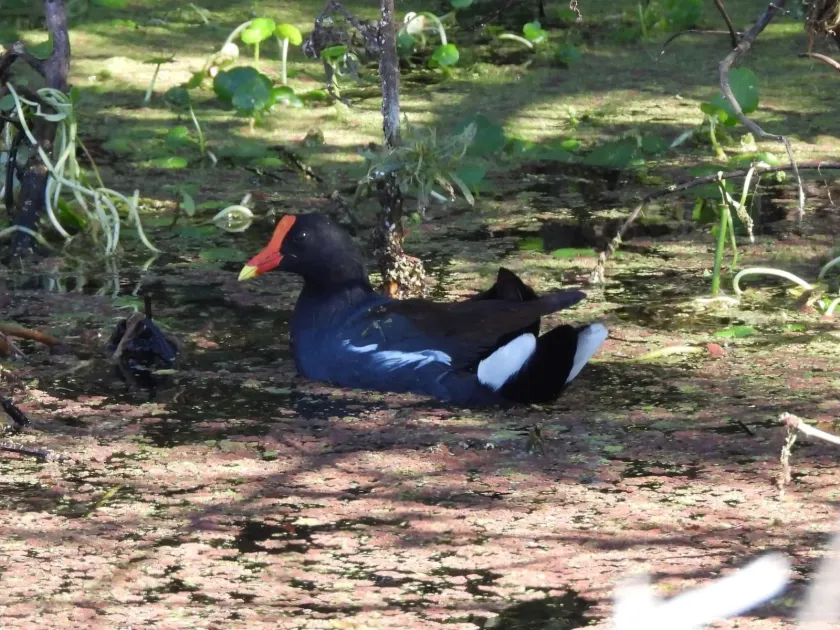
The Common moorhen (Gallinula chloropus) is a bird species belonging to the rail family, Rallidae. It is easily identified by its distinctive red beak with a yellow tip and a red frontal shield on its forehead.
The plumage is predominantly dark grey or blackish-brown, with a notable white stripe along the flanks that makes the bird easily recognizable in its habitat.
They are shy, secretive birds that typically inhabit wetlands, marshes, and ponds with dense vegetation, often venturing into adjacent agricultural fields to forage.
Moorhens are medium-sized birds, reaching up to 35 cm in length, equipped with long, strong toes that enable them to walk across soft, muddy terrain and swim efficiently.
The species exhibits strong territorial behavior during the breeding season, but outside of this period, they often forage in small groups, increasing the pressure on nearby crops.
What it damages
The primary agricultural damage caused by the Common moorhen involves the destruction of young seedlings, particularly in irrigated agricultural areas and riparian zones.
These birds actively consume seeds of rice, corn, and millet during the germination phase and frequently feed on the tender stems of vegetables planted near water bodies.
By moving in groups, they can trample significant areas of crops, resulting in sparse stands and a direct reduction in potential yield during the early growth stages.
In addition to foraging, they may damage irrigation infrastructure and monitoring equipment if such installations are located within their nesting or feeding ranges.
Farms situated in close proximity to wetlands, marshes, or canals are most vulnerable to recurring damage from these opportunistic foragers.
When it appears
Moorhen activity in agricultural settings peaks during the spring when sowing and transplanting occur, as young seedlings are the most susceptible to avian grazing.
Throughout the summer, during the chick-rearing period, the nutritional demands of the population increase, leading to more frequent and intense feeding incursions into fields.
During the autumn migration or harvest period, they may feed on leftover grain, which is generally considered harmless to the economic outcome of the harvest.
The duration of their impact is closely linked to water levels; high water levels in wetlands may force birds to seek food sources further inland on agricultural plots.
In regions with milder climates, sedentary populations may cause damage throughout the entire growing season, from March through October.
Signs of infestation
The primary sign of moorhen presence is the appearance of distinct footprints on damp soil, characterized by long, widely spaced toes designed for walking on mud.
Visual identification of feeding activity is often confirmed by finding bitten seeds, uprooted seedlings, or missing young plants along the edge of the field bordering water.
Presence of droppings and feathers in vegetation along the water's edge often suggests that the area is being used as a staging ground for field foraging.
- Uprooted seedlings with clear beak marks on the stems.
- Flattened paths or trails within crop rows near water bodies.
- Localized patches of missing vegetation appearing overnight.
Auditory signs, such as their characteristic call during dawn or dusk, often indicate that the birds are active in the vicinity and preparing to forage.
Control measures
Visual deterrents, such as reflective tapes, predator decoys, or motion-activated lights, are effective in discouraging moorhens from settling in or foraging on agricultural plots.
Acoustic deterrent systems that broadcast distress calls or predator sounds are useful in creating an unfavorable environment for the birds during the vulnerable germination phase.
Clearing dense reeds and tall grasses along the banks of canals and ponds adjacent to fields significantly reduces the area's attractiveness for nesting and cover.
Installing fine-mesh physical barriers along the perimeter of the field bordering the water is the most reliable way to prevent direct access to young seedlings.
Treating seed stocks with non-toxic chemical repellents can discourage feeding without causing long-term harm to the local bird population or the ecosystem.
Taxonomy
- Latin name
- Gallinula chloropus
- Family
- Rallidae
- EPPO code
- GLLNCH
Discussion
No discussions yet — be the first.