
Eurasian coot
Fulica atra
Description
How to identify
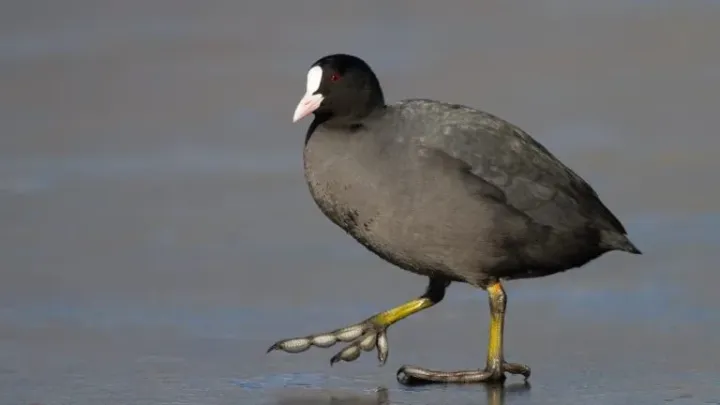
The Eurasian coot (Fulica atra) is a member of the Rallidae family. It is a distinctive aquatic bird characterized by its slate-black plumage and a prominent white shield on its forehead.
Adults typically weigh between 600 and 1000 grams. Their sharp, whitish beak is adapted for both aquatic foraging and grazing on terrestrial vegetation near water bodies.
Although they prefer water, they are highly mobile on land and often congregate in large numbers on agricultural fields adjacent to wetlands or irrigation channels.
Their feet are unique, featuring lobed membranes rather than webbed toes, which provide efficient movement across muddy surfaces and cultivated fields.
Nesting sites are usually situated in dense reed beds, placing them in close proximity to rice paddies and riverside vegetable crops.
What it damages
The Eurasian coot poses a significant threat to young cereal crops, including wheat and barley, by consuming early-stage seedlings and shoots.
In rice production, the damage is particularly severe, as coots uproot young plants and feed on emerging grains, often leading to total loss in coastal sections.
Mechanical damage occurs due to heavy trampling, as large flocks of coots consolidate on fields, compacting the soil and breaking the stalks of maturing plants.
Besides seedling consumption, coots may feed on mature crops if they can reach the grain heads, causing localized but intense economic losses.
The intensity of the damage often depends on the availability of natural aquatic flora; when natural food sources are scarce, their impact on cultivated land increases significantly.
When it appears
The peak risk period for agricultural fields is during the early spring, when crops are emerging and the tender shoots offer high nutritional value.
A secondary peak occurs in late summer and early autumn when juvenile coots become independent, and flocks become more aggregated ahead of migration.
The birds are most active in the fields during the early morning and at dusk, frequently moving between water bodies and cultivated areas in organized groups.
Drought conditions or low water levels in local lakes force these birds to move further inland to find food, increasing the probability of field infestations.
Monitoring should be most intense during the first two weeks after germination, which is the window of maximum vulnerability for most cereal crops.
Signs of infestation
The presence of coots is easily identified by their distinct footprints, which show clear impressions of the lobed toes on wet soil or mud.
Observation of clear patches in fields, where seedlings have been cleanly plucked or eaten to the soil level, is a primary indicator of their activity.
The accumulation of bird droppings on the field edges near water is a strong signal that a colony has established a feeding pattern in the vicinity.
Plants damaged by coots often exhibit shredded or uneven edges where the birds have used their sharp beaks to tear the green matter.
- patchy destruction of seedling rows;
- distinctive lobed footprints on damp ground;
- excessive bird activity along the field margins.
Control measures
Acoustic deterrents that broadcast distress calls or predator sounds are highly effective in breaking the feeding cycle of coot flocks.
Visual aids such as reflective streamers, scarecrows, and motion-activated lights can create an unwelcoming environment for the birds.
Maintaining a vegetation buffer strip between water bodies and sensitive crop areas can help deflect the birds' attention from high-value seedlings.
Field patrol and human presence during the early morning hours are simple but effective measures to discourage persistent feeding behavior.
For high-value crops, the use of temporary fencing or specialized netting can prevent the physical access of coots to the vulnerable growing stages.
Taxonomy
- Latin name
- Fulica atra
- Family
- Rallidae
- EPPO code
- FULCAT
Discussion
No discussions yet — be the first.