
Pond snail
Radix
Description
How to identify
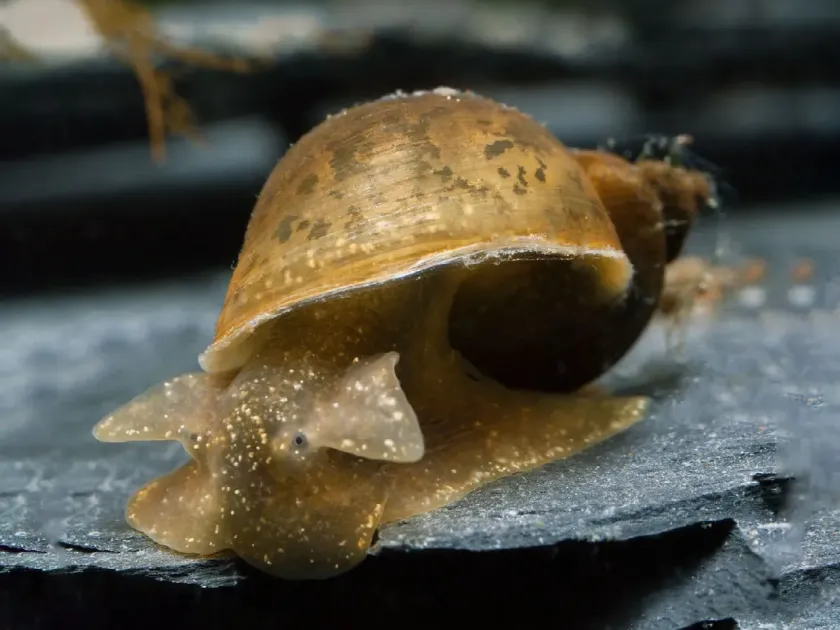
Pond snails of the genus Radix belong to the order of pulmonate gastropods, family Lymnaeidae. These freshwater snails possess a spirally coiled shell, which is typically thin-walled and inflated in this genus.
Adult specimens reach sizes ranging from 1 to 3 centimeters, depending on the species and environmental conditions. Their body is usually grey or yellowish, featuring two triangular tentacles with eyes located at their base.
These snails require stagnant or slow-moving water to thrive. Being hermaphroditic, they demonstrate a high reproductive rate, which allows their populations to expand rapidly when food sources are abundant.
They are capable of utilizing atmospheric oxygen by rising to the water surface, which allows them to survive in water bodies with low dissolved oxygen levels, a significant survival adaptation.
Young snails often congregate near the water surface, whereas adults may descend to greater depths, feeding on various submerged plant parts and organic matter.
What it damages
Pond snails are polyphagous and can cause significant damage to crops grown in hydroponic systems, rice paddies, or decorative ponds.
Their primary food sources include young leaves, shoots, and roots. In rice farming, they can destroy rice seedlings, significantly reducing plant density during early developmental stages.
In ornamental gardening, these mollusks damage aquatic plants such as water lilies and lotus flowers by consuming leaf blades entirely, which can lead to plant death or aesthetic loss.
Beyond direct tissue damage, pond snails facilitate the development of rot. In areas where they graze on the epidermis, secondary bacterial and fungal infections often take hold.
In intensive vegetable production, pond snails can infiltrate irrigation systems, clogging filters and causing mechanical damage to seedlings that come into contact with untreated water.
When it appears
Pond snail activity begins in early spring as soon as water temperatures rise above 8–10 degrees Celsius. During this time, they emerge from the dormancy state maintained on the bottom of the pond.
The peak reproductive period occurs between late spring and early summer. During this timeframe, females actively deposit jelly-like egg masses on plant stems and hard surfaces.
A pond snail can produce multiple generations within a single season if water temperatures remain consistently warm, which is typical for the summer months.
In autumn, as water temperatures drop and day length decreases, snails undergo metabolic slowdown, preparing for hibernation within the silt or on underwater vegetation.
The pest's life cycle is closely tied to the hydrological regime of the water body; drying out ponds during hot periods can lead to mass population die-offs if snails fail to burrow into the substrate.
Signs of infestation
The primary sign of a pond snail infestation is the presence of characteristic holes in leaves of aquatic plants, resembling traces of rasping.
Slime trails can often be observed on the leaf surface or along the edges of the pond, which are left by the snails during their nocturnal movements.
The discovery of egg masses—transparent, gelatinous capsules attached to the underside of leaves or stems—is a definitive indicator of a growing pest population.
Yellowing and premature decay of leaf blades, in the absence of other visible pests like aphids, often points to snail activity beneath the water surface.
- Damage to young succulent stems.
- Presence of slime on coastal vegetation.
- Reduced growth rates of aquatic crops.
- Skeletonization of leaves, leaving only main veins intact.
Control measures
Mechanical removal of snails from plant surfaces is effective in small areas, such as decorative ponds, but is labor-intensive for larger-scale operations.
Biological control methods include introducing natural predators of the pond snail, such as fish (carp or crucian carp), which actively feed on these gastropods.
Agrotechnical measures involve draining ponds during the off-season. Drying out the soil leads to the death of both eggs and adult snails, effectively eliminating their habitat.
Chemical control must be approached with caution due to the toxicity of many products to aquatic ecosystems. Specialized molluscicides that are legally approved for use may be applied.
Regular maintenance, such as cleaning ponds of excess vegetation and bottom sediment, removes the pest's food source and egg-laying sites, preventing population outbreaks.
Taxonomy
- Latin name
- Radix
- Order
- Molluscs
- Family
- Lymnaeidae
- EPPO code
- RADXSP
Discussion
No discussions yet — be the first.