
Purple Hairstreak
Quercusia quercus
Description
How to identify
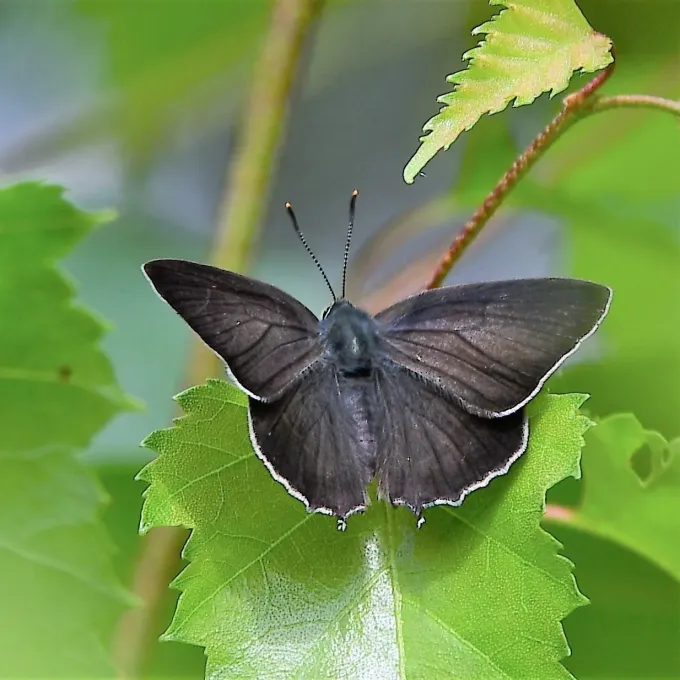
The Purple Hairstreak (Quercusia quercus) is a small butterfly belonging to the Lycaenidae family. Adult butterflies have a wingspan of approximately 30–35 mm, with a dark brown or black upper side that displays a distinctive iridescent purple or blue sheen, particularly in males.
The underside of the wings is a soft greyish-brown colour with a thin white streak crossing both fore and hind wings. A small, delicate 'tail' at the base of the hind wing is a diagnostic feature of the species.
The larvae are slug-shaped, typically green with oblique lighter markings, making them highly camouflaged against the oak leaves they feed upon.
Pupation occurs in a reddish-brown pupa, which is often found hidden in crevices or attached to the underside of leaves or twigs, secured by a silken girdle.
Adults are notoriously elusive, as they spend most of their time in the high canopy of oak trees, feeding on honeydew and seldom descending to the ground level.
What it damages
The primary host for this species is the oak tree, particularly Quercus robur. The larvae are specialists, feeding almost exclusively on oak foliage throughout their development.
Damage is caused by larvae consuming the buds during early spring, which can stunt the growth of new shoots. As the larvae mature, they feed on the young leaves, creating irregular holes and consuming leaf tissue.
In cases of high infestation, the cumulative defoliation can reduce the vitality of younger trees, although established mature oaks usually withstand the damage without long-term issues.
The reduction in leaf surface area can hinder the tree's photosynthetic capability, potentially making the host more susceptible to secondary environmental stresses or pathogens.
While often considered a beautiful component of woodland biodiversity, in nurseries or young plantations, their feeding activity may require management to ensure optimal tree growth.
When it appears
This species is univoltine, meaning it completes one generation per year. The winter is spent in the egg stage, with eggs laid singly or in small groups on the bark at the base of oak buds.
Larval emergence occurs in spring, perfectly synchronised with the bud-burst of oak trees. This timing ensures the larvae have immediate access to high-quality nutrition.
Larval development takes about 4–6 weeks. Following pupation, the adult butterflies emerge in mid-summer, typically from July to August, which constitutes their main flight period.
Mating and oviposition occur throughout the late summer period. Once the eggs are laid on the host tree branches, the adults die, and the species enters its diapause phase.
This lifecycle strategy is highly adapted to the seasonal dynamics of temperate oak forests, ensuring survival through the winter dormant period.
Signs of infestation
Signs of infestation include 'shothole' damage on young leaves during late spring. Because the larvae are small and well-hidden, damage is often detected before the insect itself is spotted.
Inspecting the foliage for signs of leaf tissue removal is the most reliable way to monitor the presence of larvae in the upper canopy layers.
The presence of adult butterflies is best monitored during sunny, warm days in July, when they can be seen flying around the tops of oak trees, especially near the canopy edges.
Droppings (frass) may accumulate on the leaves or branches below where the larvae are feeding, providing a clear indication of their presence in the tree crown.
Severe defoliation or stunted, deformed buds in early spring can also serve as an indicator of an active population of Quercusia quercus in the area.
Control measures
In most natural forest settings, the Purple Hairstreak is not considered a major pest and control is rarely necessary. However, in nurseries, management may be required.
Chemical control, if necessary, involves applying insecticides early in the season to target young larvae as they emerge and begin feeding on buds.
Biological control methods are preferred, including the promotion of natural predators such as birds and parasitic wasps that help keep population levels in balance.
Maintaining high tree health through proper irrigation and soil management helps trees recover quickly from any minor defoliation caused by the larvae.
- Targeted application of insecticides for high-value saplings.
- Encouraging avian predators to nest in the area.
- Regular canopy monitoring during the early spring growth phase.
Taxonomy
- Latin name
- Quercusia quercus
- Order
- Lepidoptera (butterflies)
- Family
- Lycaenidae
- EPPO code
- THECQU
Discussion
No discussions yet — be the first.