
Purple Hairstreak
Quercusia
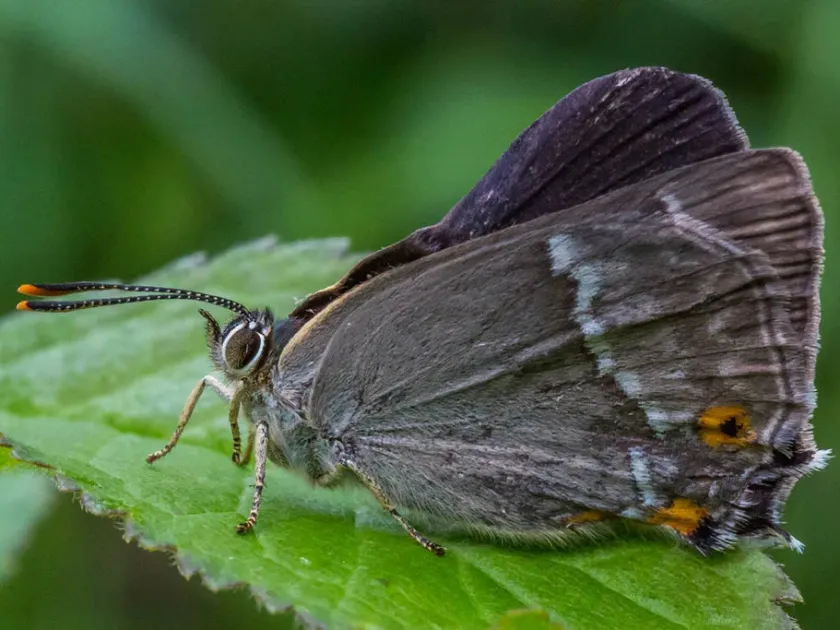
Description
How to identify
The Purple Hairstreak (Quercusia quercus) is a butterfly belonging to the Lycaenidae family. Adults typically have a wingspan of 30 to 35 mm and are easily distinguished by the small tail-like extensions on their hindwings.
Males display a distinctive purple-blue sheen on the upper side of their wings with a dark border, whereas females are generally darker brown with some blue scaling. The underside is greyish-brown with a thin white line running across the wings.
The larvae, or caterpillars, have a unique woodlouse-like shape and a green color that provides excellent camouflage against the oak foliage where they feed and reside throughout their development.
The eggs of the Purple Hairstreak are small, disc-shaped, and covered in intricate textures. They are laid singly or in small groups on the buds or twigs of the host tree, where they undergo overwintering until the spring.
Field identification is most effective when observing the adults in the canopy, as they tend to spend most of their time high in the oak trees, rarely descending to the ground level.
What it damages
The primary host plant for this species is the pedunculate oak (Quercus robur). The insect is closely associated with oak woodlands and ancient parklands where these trees are prevalent.
The larvae are the stage responsible for the damage. Upon hatching in the spring, they immediately seek out the developing buds of the oak trees, providing them with essential nutrients for their growth.
As the leaves unfurl, the caterpillars shift their feeding to the leaf tissue. This can cause partial skeletonization and ragged leaf edges, which is detrimental to the overall photosynthesis of the tree.
While mature trees are generally resilient to minor infestations, young saplings can suffer significant growth retardation if high numbers of larvae feed on their limited leaf area.
Increased feeding activity leads to a decrease in the tree's health, making it more susceptible to environmental stressors and other secondary pathogens that may follow such infestations.
When it appears
The life cycle of the Purple Hairstreak is univoltine, meaning that there is only one generation per year, and the timing is strictly aligned with the phenology of the oak trees.
The species overwinters in the egg stage. The hatching period in early spring is perfectly synchronized with the budburst of the host oak, ensuring that food is immediately available for the neonate larvae.
The larval stage lasts for several weeks, during which they grow rapidly. By late June or early July, the caterpillars are fully grown and ready to enter the pupal stage.
Pupation typically occurs in the crevices of the oak bark or hidden within the leaf litter beneath the host tree, where the insects transform into the adult butterfly form.
The adult flight period lasts throughout July and August. During this time, they engage in mating and egg-laying, ensuring the next generation is secured for the following spring.
Signs of infestation
Early symptoms of an infestation include damaged or hollowed-out buds in the spring, which are often the first sign that larvae have emerged and are feeding.
Visible trails of frass (caterpillar excrement) on the leaves or the presence of fine silken threads used to secure leaves are clear indicators of larval activity within the canopy.
As the season progresses, leaves with irregular, ragged edges or holes provide visual evidence of the feeding behavior characteristic of these caterpillars.
Stunted growth of new shoots on young oak trees is another observable sign, especially when multiple larvae congregate on the same branch during the initial growth flush.
Observation of adults flying around the tops of oak trees during calm, sunny afternoons in mid-summer is the most reliable way to monitor the presence and population density of the species.
Control measures
Management of the Purple Hairstreak is rarely necessary in healthy forest ecosystems as natural predators usually maintain balance, but specific control may be required in nurseries.
- Encouraging natural bird populations, such as tits and warblers, which are efficient predators of larvae during the nesting season.
- Applying selective biological control agents such as Bacillus thuringiensis, which target caterpillars while sparing other beneficial insect species.
- Implementing regular health assessments of young oak plantings to detect and address infestations before they reach levels that significantly damage growth.
- Maintaining high habitat diversity to support a wide range of parasitoids and predators that keep butterfly populations in check.
Chemical insecticides should be used as a last resort and only in cases of severe infestation in managed landscapes, ensuring they are applied according to safety guidelines for local flora and fauna.
Taxonomy
- Latin name
- Quercusia
- Order
- Lepidoptera (butterflies)
- Family
- Lycaenidae
- EPPO code
- QUERSP
Discussion
No discussions yet — be the first.