
Lanternfly
Pyrops
Description
How to identify
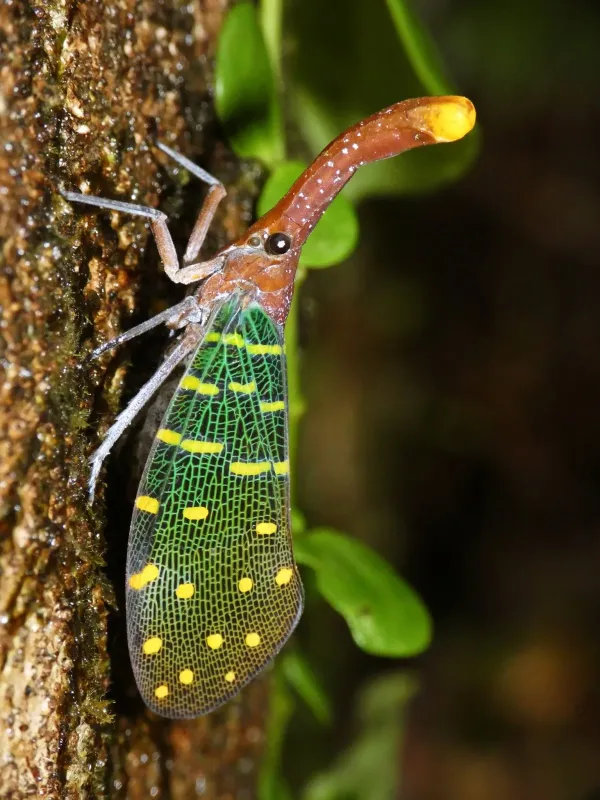
Lanternflies (genus Pyrops) are members of the order Hemiptera and the family Fulgoridae. These insects are easily distinguished by their prominent head projection, which often resembles a long, slender snout.
Adult insects are typically large with vibrant wing patterns, though their appearance is designed for camouflage against tree bark. They use this natural mimicry to avoid predators and detection while resting.
Equipped with specialized piercing-sucking mouthparts, lanternflies feed on the phloem of host plants. This physiological adaptation is key to their lifestyle and the damage they cause to woody species.
The life cycle involves multiple nymphal stages before reaching adulthood. Throughout these stages, nymphs are generally more mobile and may feed on various parts of the plant to support their rapid growth.
These insects are primarily adapted to tropical and subtropical climates, where environmental conditions remain relatively stable and support their high metabolic requirements.
What it damages
Lanternflies inflict damage by constantly feeding on the sap of trees and shrubs. This process diverts nutrients away from the plant, leading to significant physiological stress and growth inhibition.
Heavy infestations can weaken a tree's defense systems, making it more susceptible to secondary environmental stressors like drought, high heat, or frost damage.
The feeding sites often become entry points for fungal pathogens and bacteria. As the plant loses vitality, leaves may yellow, wilt, and eventually drop prematurely, severely affecting overall plant health.
In addition to direct feeding, the honeydew excreted by these insects promotes the growth of sooty mold, which coats the leaves and blocks sunlight, further reducing the plant's photosynthetic capacity.
Chronic infestation over several seasons can lead to dieback of branches and, in extreme cases, the total death of the host plant, resulting in significant agricultural and aesthetic losses.
When it appears
The seasonal activity of lanternflies is highly dependent on temperature and precipitation cycles within their native range. They are most active during the peak vegetative periods of host plants.
Adult populations often emerge during the transition between dry and wet seasons, aligning their reproduction with the period when host plants have the highest nutrient concentration in their sap.
Eggs are typically laid in protective clusters on tree trunks or branches. The duration of the embryonic and nymphal stages is dictated by local climatic variables, which influence the number of generations per year.
During the off-season, lanternflies may undergo a period of reduced metabolic activity, often remaining in dormant stages in sheltered areas to survive cooler temperatures or dry conditions.
Monitoring the population during the early stages of infestation is crucial, as the density of nymphs can increase rapidly under favorable environmental conditions, leading to widespread damage.
Signs of infestation
The presence of honeydew on the leaves and trunks is one of the most prominent signs of a lanternfly infestation. This sticky substance serves as a visual indicator of feeding activity.
Sooty mold growth is another reliable sign; it appears as a black, powdery coating on the surface of leaves and stems where honeydew has accumulated. This often attracts ants and other insects.
- Yellowing and wilting of foliage on infested branches.
- Presence of visible egg masses on tree bark or nearby structures.
- Increased ant activity on trunks, attracted by the nutrient-rich honeydew.
- Physical presence of the insects, often resting on branches during the day.
Closer inspection of the trunk may reveal dark, weeping spots where the insects have pierced the bark to access the nutrient-rich phloem.
Control measures
Effective management requires a combination of chemical and mechanical controls. Systemic insecticides are often used to target the insects as they feed on the plant's vascular system.
Mechanical removal of egg masses during the dormant season is a highly effective way to reduce the following year's population density. This should be done before the nymphs hatch.
Managing the canopy by pruning can improve air circulation and sunlight penetration, making the tree environment less hospitable for lanternflies and reducing the accumulation of honeydew.
Using sticky bands on the trunks of host trees acts as a physical barrier against nymphs, preventing them from climbing to reach fresh foliage and reducing the total number of insects on the tree.
Integrated Pest Management (IPM) practices, including the use of biological controls like parasitic wasps or pathogenic fungi, provide sustainable solutions for long-term population suppression.
Taxonomy
- Latin name
- Pyrops
- Order
- Hemiptera (bugs, aphids, leafhoppers)
- Family
- Fulgoridae
- EPPO code
- PYRSSP
Discussion
No discussions yet — be the first.