
Pyrgomorpha vignaudii
Pyrgomorpha vignaudii
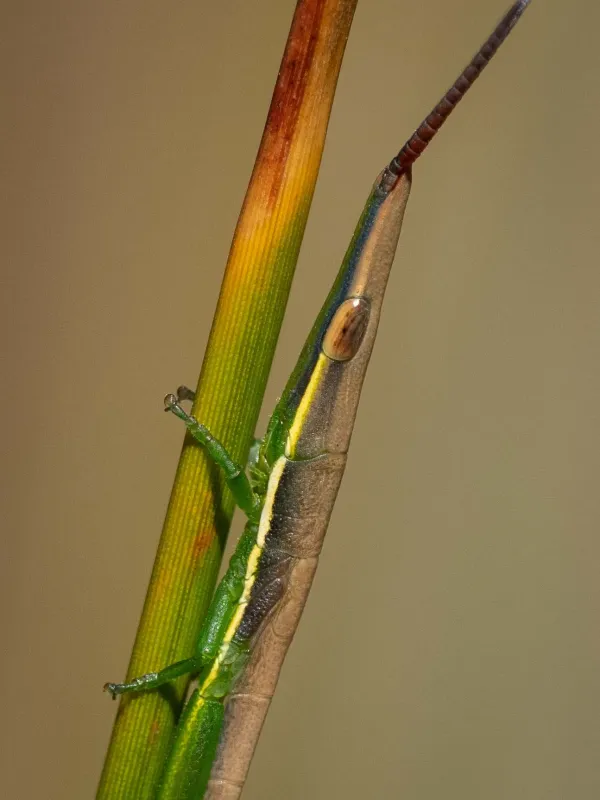
Description
How to identify
Pyrgomorpha vignaudii is a member of the order Orthoptera and belongs to the family Pyrgomorphidae.
This species is easily recognized by its elongated, conical head shape, which is a signature trait of the family.
The coloration of the insects varies significantly from bright green to brown and grey, providing excellent camouflage in grasslands.
Adults possess well-developed hind legs, which enable them to jump efficiently when disturbed or moving through vegetation.
The body structure is slim and adapted for living amongst grasses and herbaceous vegetation rather than dense forests.
What it damages
This pest is a generalist feeder (polyphagous), capable of consuming a wide variety of botanical species in its distribution range.
Primary agricultural damage is inflicted upon cereal crops, specifically sorghum, millet, and maize, causing significant leaf tissue loss.
Leguminous plants and various weeds are also frequently consumed, which maintains a stable population level throughout the season.
Damage often includes the destruction of the apical meristem in young plants, leading to stunted development or complete plant death.
During heavy outbreaks, the sheer number of feeding insects can lead to total crop failure, impacting local food security.
When it appears
The life cycle of Pyrgomorpha vignaudii is highly synchronized with environmental moisture availability and temperature patterns.
Seasonal activity peaks during the rainy seasons when lush vegetation provides optimal nutrition and breeding grounds for the population.
Females deposit their eggs in the soil, where they may remain in diapause until the onset of favorable moisture conditions.
Nymphal development proceeds through several instars, with the duration of each stage depending on the ambient climate and food quality.
Adults are typically most active during the daylight hours, when they maximize their foraging and reproductive efforts.
Signs of infestation
The initial signs of infestation are ragged, uneven edges on leaf blades where the insects have been feeding.
Visual inspection of fields often reveals the presence of adult insects, which are prominent due to their specific head shape.
Droppings left on leaves are a reliable indicator of the presence of grasshoppers, even if the insects themselves are momentarily hidden.
In cases of severe infestation, entire sections of the crop may show signs of defoliation and weakened, bending stems.
Sudden disturbance of the canopy often results in a flurry of movement and leaping, which is a clear sign of a high population density.
Control measures
Early detection through frequent field scouting is the most critical strategy to prevent significant economic damage to the crops.
Mechanical control through deep tillage is effective in disrupting the life cycle by destroying egg pods buried in the topsoil.
When populations exceed threshold levels, the use of insecticides targeting orthopteran pests is necessary to protect the yield.
Maintaining clean field borders by removing weeds reduces the host availability, making the main crop less attractive to the pests.
- Utilizing biological control agents, such as entomopathogenic fungi.
- Implementing crop rotation to disrupt insect breeding patterns.
- Monitoring weather patterns to predict peak emergence times for prophylactic action.
Taxonomy
- Latin name
- Pyrgomorpha vignaudii
- Order
- Orthoptera (locusts)
- Family
- Pyrgomorphidae
- EPPO code
- PYRMVI
Discussion
No discussions yet — be the first.