
Purpuricenus axillaris
Purpuricenus axillaris
Description
How to identify
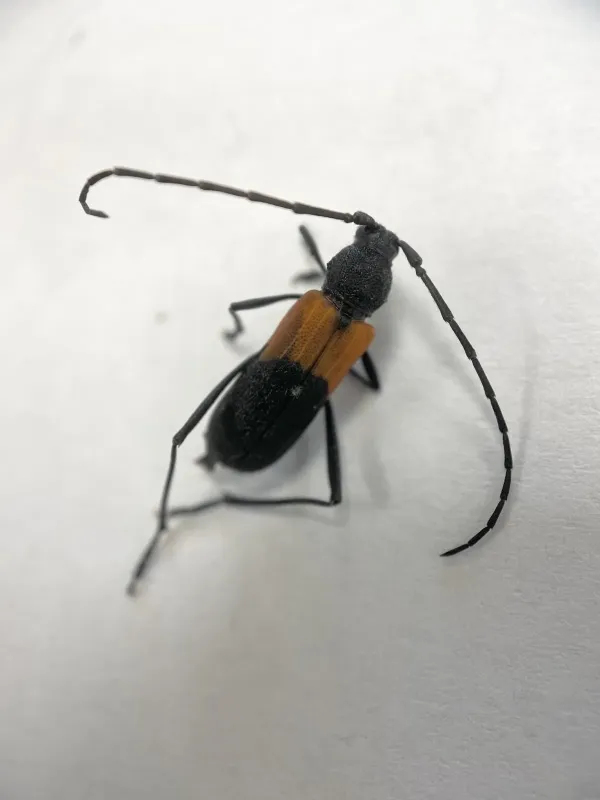
Purpuricenus axillaris is a species of longhorn beetle belonging to the family Cerambycidae. These beetles are characterized by their elongated body structure, typically measuring between 15 and 22 mm in length.
The visual appearance of the adult is quite distinctive, featuring a black body with a prominent purple-red or orange patch at the base of the elytra. The head and pronotum are black, often showing a rough or punctured surface texture.
Antennae in males are notably long, often extending beyond the length of the body, which aids in sensory perception during flight and mating. Females possess slightly shorter antennae but share the same overall body morphology.
The larvae are typically creamy-white, legless, and equipped with strong mandibles designed for boring through hard wood tissue. They remain hidden within the tree throughout their development phase.
These beetles are primarily diurnal, preferring to congregate on tree trunks or branches exposed to direct sunlight. Their life cycle is deeply integrated into the host tree's physiology, as they rely entirely on wood for nutrition during the larval stage.
What it damages
This beetle species primarily targets various deciduous tree species. It is recognized as a potential threat to orchard crops, causing significant damage to the structural integrity of the trees.
Common host plants include species from the Rosaceae family, such as apple, pear, plum, and apricot. Forest trees like oaks and various shrubs are also susceptible to infestations under specific conditions.
Larval activity involves creating deep galleries within the wood, which disrupts the transport of water and nutrients from the roots to the crown. This results in the progressive dieback of branches.
As the infestation progresses, the tree becomes structurally weakened. Heavy infestations can lead to massive branch failure during high winds or simply cause the tree to lose its vitality over time.
Economic losses in agriculture are driven by reduced fruit yields and the eventual necessity to remove and replace entire trees that can no longer recover from the internal damage caused by the larvae.
Signs of infestation
The presence of Purpuricenus axillaris is often indicated by small, oval-shaped exit holes on the surface of the bark. These holes are created by adults as they emerge from the wood after metamorphosis.
Accumulation of "frass" or boring dust at the base of the tree or within branch crotches is a classic sign of internal larval activity. This debris is often visible during the spring and early summer months.
Symptoms also include the yellowing and premature dropping of leaves on affected branches. Such branches may appear stunted, wither, and eventually turn completely brown due to the disruption of vascular tissues.
Observing adult beetles on the bark during sunny weather is a reliable sign of infestation. They are most active during the mating period, which coincides with the late spring and early summer season.
Inspecting the bark often reveals recessed or cracked areas where the tree has attempted to heal after the larvae created their internal tunnels. These areas are often soft and can be easily punctured to reveal the galleries beneath.
Control measures
Sanitary pruning remains the most critical control measure. Removing and burning all infested, dry, or damaged branches immediately prevents the emergence of the next generation of beetles.
Applying specialized white-wash coatings mixed with insecticide components on tree trunks can act as a deterrent for females attempting to lay eggs on the bark surface.
During the peak flight season, targeted insecticide applications can be effective. However, it is essential to ensure that such treatments comply with local agricultural safety regulations and timing.
Improving overall orchard health through optimal irrigation and balanced fertilization helps trees maintain their natural defenses, making them less attractive to boring insects.
- Regular orchard sanitation and branch removal.
- Burning infested wood material to kill larvae.
- Using contact insecticides during the adult flight period.
- Encouraging natural predators like woodpeckers in the orchard environment.
Taxonomy
- Latin name
- Purpuricenus axillaris
- Order
- Coleoptera (beetles)
- Family
- Cerambycidae
- EPPO code
- PURPAX
Discussion
No discussions yet — be the first.