
Pteronemobius
Pteronemobius
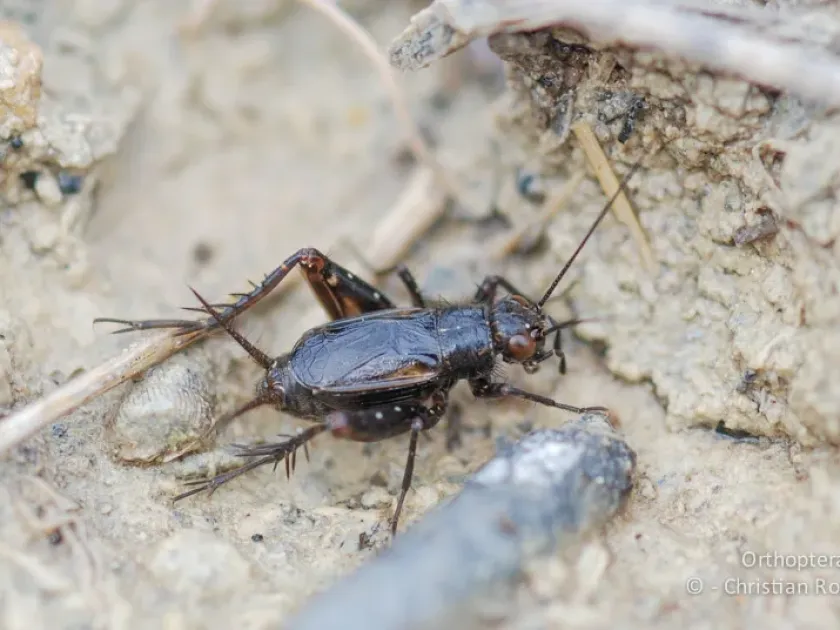
Description
How to identify
Pteronemobius is a genus of insects belonging to the family Gryllidae (crickets) within the order Orthoptera. These small crickets are well-adapted to humid environments, making them common inhabitants of wet agricultural landscapes, especially rice paddies.
Adult specimens typically measure between 5 and 10 millimeters in length. Their coloration ranges from light brown to dark brown, providing excellent camouflage against soil particles, plant debris, and moisture-rich ground surfaces.
The morphology of Pteronemobius includes well-developed hind legs adapted for jumping and, in many species, wings that may be fully functional or reduced. Females possess a specialized ovipositor, enabling them to lay eggs directly into moist soil or soft plant tissues.
Larvae look like miniature versions of the adults, although they lack wings and are significantly smaller in size. They undergo several molting stages, gradually developing into adult insects while increasing in body mass and complexity.
These insects are primarily nocturnal or crepuscular, spending the daylight hours hidden in soil cracks, under plant litter, or within thick aquatic vegetation where the humidity levels remain high enough to prevent desiccation.
What it damages
Pteronemobius causes significant economic damage to rice crops, particularly during the seed germination and seedling establishment phases. They feed on young sprouts, often chewing through the stems at the base, which causes the plants to collapse and die.
Beyond rice, these pests may consume tissues of various hygrophilous crops grown in waterlogged soils, including certain types of forage grasses. Their feeding activity can affect both aerial plant parts and root systems of seedlings, hindering normal growth.
Damage caused by these crickets weakens the overall plant health, leaving them susceptible to secondary infections by fungal and bacterial pathogens. This often manifests as yellowing, wilting, and thinning of crop stands in affected areas of the field.
In addition to direct mechanical feeding damage, the crickets act as potential vectors for plant pathogens. By moving between plants, they facilitate the spread of diseases, exacerbating the impact on overall agricultural yield.
The severity of damage is highest in fields where agronomic practices such as water level management and weed control are neglected, as weeds often serve as the primary refuge and food source for the pest population.
When it appears
The seasonal activity of Pteronemobius is heavily dependent on temperature and soil moisture. Large populations are typically observed from late spring through the summer, continuing until the onset of cooler autumn temperatures.
The lifecycle is intricately tied to the irrigation cycles of rice fields. When paddies are flooded, the crickets congregate around the young crops where the humidity levels are ideal for their development and feeding processes.
Overwintering usually occurs in the egg stage, laid in the soil or crop residues, or occasionally as late-stage larvae sheltered in protected niches. As temperatures rise in the spring, the population rapidly resumes development and reproductive cycles.
Depending on local climatic conditions, multiple generations can occur within a single growing season. These generations often overlap, leading to the concurrent presence of larvae of different ages and adults in the field at any given time.
The peak of pest pressure occurs during the initial seedling stage, as young plants are highly sensitive to stem damage. Rapid colonization by Pteronemobius during this timeframe can lead to severe thinning and the need for immediate intervention.
Control measures
The most effective strategy for managing Pteronemobius is strict adherence to agronomic practices, particularly water level control in rice paddies and the systematic removal of weeds along field margins, which serve as primary breeding sites.
Crop rotation is a highly recommended practice to disrupt the insect's lifecycle and food availability. Furthermore, deep plowing after the harvest helps destroy overwintering sites and reduces the number of eggs that survive until the following season.
If the pest population exceeds the economic threshold, chemical control becomes necessary. Contact and systemic insecticides approved for use on rice crops should be applied, ensuring all manufacturer guidelines regarding safety and application rates are followed.
Biological control methods include encouraging natural predators such as insectivorous birds, frogs, and predatory insects. Maintaining a healthy ecosystem around the fields helps keep the Pteronemobius population below the damage threshold naturally.
- Utilize high-vigor seeds to ensure rapid seedling establishment.
- Deploy light traps in the field to monitor population dynamics.
- Implement integrated pest management (IPM) to balance chemical and biological solutions.
Taxonomy
- Latin name
- Pteronemobius
- Order
- Orthoptera (locusts)
- Family
- Gryllidae
- EPPO code
- PTEESP
Discussion
No discussions yet — be the first.