
Psoroptic mange
Psoroptes cuniculi
Description
How to identify
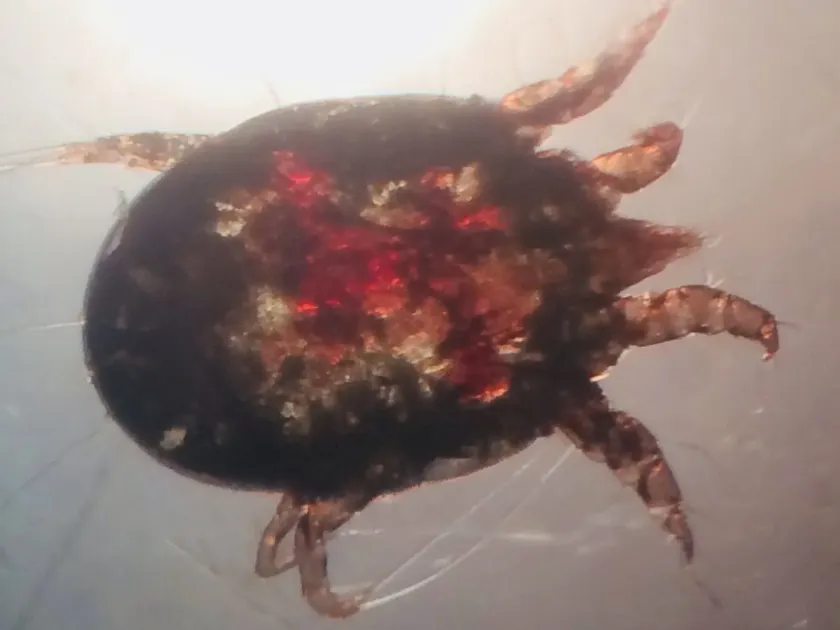
The causative agent of the disease is the mite Psoroptes cuniculi, belonging to the order Sarcoptiformes and the family Psoroptidae. This is a non-burrowing mite that thrives in the ear canal.
The adult mites are oval-shaped and pale yellow in color. They measure approximately 0.5 to 0.8 mm in length, making them difficult to detect without a microscope.
The entire life cycle occurs on the host animal and typically lasts between 15 and 20 days, involving stages from egg to larva, protonymph, deutonymph, and adult.
These parasites are highly resilient and can survive in the environment, such as in bedding or cage cracks, for up to 30 days under moderate humidity and temperature.
Transmission occurs through direct contact between infected and healthy rabbits or through contaminated equipment, brushes, and cage components.
What it damages
The parasite primarily infests domestic and wild rabbits. It colonizes the inner ear canal and the pinna, where it feeds on skin debris and tissue fluids.
In severe or neglected cases, the infestation may extend to the face, neck, and forelimbs, causing extensive crusting and severe discomfort for the animal.
The mites' feeding activity causes intense inflammation, leading to skin damage and the formation of serum-filled exudates that dry into hard, thick scabs.
The economic impact is significant due to the loss of body condition, retarded growth in young rabbits, and the risk of secondary infections that can lead to mortality.
If left untreated, the inflammation can spread to the middle and inner ear, potentially causing permanent neurological damage and vestibular imbalances.
Signs of infestation
The most common clinical sign is persistent head shaking and frequent scratching of the ears with the hind legs, indicating extreme irritation.
Physical inspection reveals a characteristic crusty, crumbly, dark brown to grayish material covering the internal surface of the ear canal.
The skin beneath the scabs is often red, swollen, and prone to bleeding due to the constant trauma caused by the rabbit's scratching.
An abnormal head tilt (torticollis) often appears in advanced stages of infestation as the infection begins to affect the balance center of the ear.
A foul, musty odor emanates from the ears, caused by the accumulation of mite waste, necrotic tissue, and secondary bacterial or yeast proliferation.
Control measures
Effective management requires a combination of systemic pharmacological treatments and stringent environmental sanitation to break the parasite's life cycle.
Veterinary-approved systemic injections of ivermectin or related compounds are highly effective for killing the mites throughout the animal's body.
Topical treatments, such as ear drops, can be used to soften the crusts and soothe the inflamed ear tissue, facilitating the recovery of the skin barrier.
Sanitizing cages and cleaning grooming equipment is essential, as mites can persist in the environment; heat treatment is often recommended for cleaning.
- Regular health monitoring.
- Isolation of infected individuals.
- Disinfection of enclosures.
- Quarantining new stock.
- Maintaining hygienic bedding.
Taxonomy
- Latin name
- Psoroptes cuniculi
- Order
- Mites
- Family
- Psoroptidae
- EPPO code
- PSORCU
Discussion
No discussions yet — be the first.