
Willow Sawfly
Pseudoclavellaria amerinae
Description
How to identify
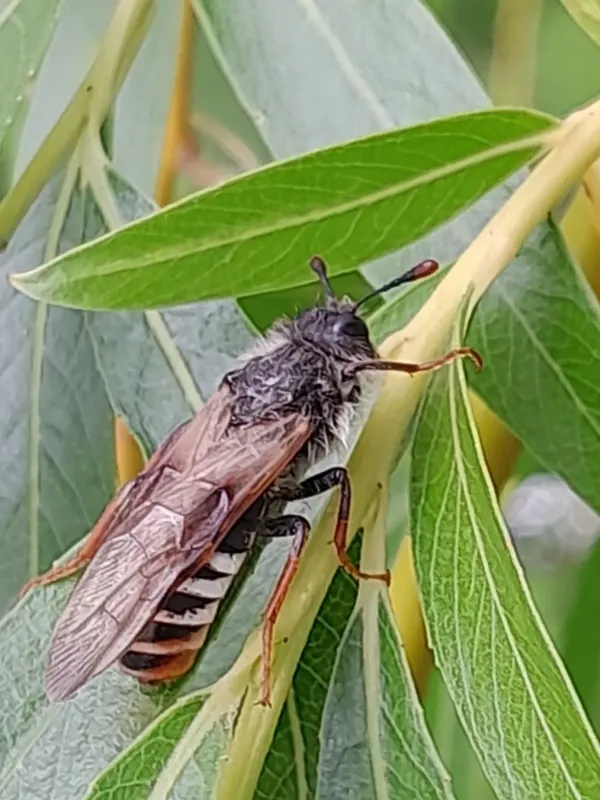
The Willow Sawfly, scientifically known as Pseudoclavellaria amerinae, belongs to the family Cimbicidae. These insects are characterized by their club-shaped antennae, which is a key diagnostic feature for identification.
Adult sawflies are robust insects with a body length ranging from 18 to 25 mm. They possess a dark coloration and well-developed wings, allowing them to fly effectively between host trees during the mating season.
The larvae, often referred to as false caterpillars, are the stage that causes the most visible damage. They have a cylindrical, segmented body that can grow up to 40 mm in length when mature.
Their color typically matches the host foliage, ranging from pale green to yellowish, which serves as a natural camouflage against predators. When disturbed, they instinctively curl into a spiral shape.
Adult females use a specialized saw-like ovipositor to insert eggs directly into the leaf tissue. This process creates small, often visible, scarring on the leaf surface where the eggs are deposited.
What it damages
This pest primarily targets trees within the Salicaceae family, most notably various species of willow (Salix) and poplar (Populus). It is a significant pest in both forestry and ornamental landscapes.
The larvae are voracious leaf-eaters, consuming large amounts of foliage. They typically begin by feeding on the edges of the leaf, moving toward the midrib, which can result in severe defoliation.
Constant feeding pressure leads to stunted tree growth and decreased vigor. In young trees, repeated infestations can cause significant stress, leaving them vulnerable to secondary diseases and pests.
In addition to leaf consumption, the oviposition process can damage young, tender shoots. While this damage is minor compared to larval feeding, it can affect the overall aesthetic shape of ornamental plants.
Severe infestations can lead to complete defoliation of entire branches or small trees, significantly reducing their photosynthetic capacity and overall health during the critical growing season.
When it appears
The life cycle of the Willow Sawfly is typically univoltine, meaning there is one generation per year. The insect overwinters as a prepupa inside a tough, papery cocoon located in the soil.
Adult emergence occurs in the spring, coinciding with the flushing of new leaves on host trees. This period is critical for the initial colonization and mating phase of the insect.
The larval stage is active during the early to mid-summer months, typically from June to July. This is the period when the most significant damage to the foliage occurs in the garden or forest.
After completing their development, larvae descend from the trees and burrow into the soil to pupate. They remain in the soil in a state of diapause throughout the fall and winter months.
Weather patterns significantly influence the timing of emergence and the success rate of the population. A cool, wet spring can delay the emergence, while favorable weather promotes rapid larval development.
Signs of infestation
The most prominent sign of infestation is the appearance of jagged leaf edges, as if portions of the leaf have been removed by scissors. This is the hallmark of larval feeding activity.
Observers may also notice skeletonized leaves, where only the tough veins remain. This happens when the larvae have consumed the softer leaf tissues entirely, leaving the structure bare.
The presence of frass (larval droppings) on the leaves and at the base of the tree is a strong indicator of an active infestation. These dark deposits are often easy to spot on the ground.
During the day, checking the underside of leaves or the edges of foliage usually reveals the larvae. They are often found in clusters when they are younger or individually as they mature.
- Noticeable loss of leaf surface area.
- Presence of curled larvae when disturbed.
- Yellowing and premature drop of foliage due to severe feeding.
Control measures
For small-scale infestations in home gardens, manual collection and destruction of the larvae is a highly effective and environmentally friendly control method.
Biological control agents, such as Bacillus thuringiensis (Bt), can be applied to target the larvae specifically without harming beneficial insects or other wildlife in the garden.
In large-scale nursery or forestry settings, systemic or contact insecticides may be necessary during peak larval activity to prevent significant tree growth reduction.
Autumn soil cultivation under the tree canopy helps disrupt the overwintering sites of the pupae, exposing them to freezing temperatures and natural predators like birds and ground beetles.
Encouraging the presence of natural enemies, such as parasitic wasps and predatory birds, provides a balanced ecosystem that helps regulate the population of the sawfly naturally over time.
Taxonomy
- Latin name
- Pseudoclavellaria amerinae
- Order
- Hymenoptera
- Family
- Cimbicidae
- EPPO code
- PSCVAM
Discussion
No discussions yet — be the first.