
Protonemura meyeri
Protonemura meyeri
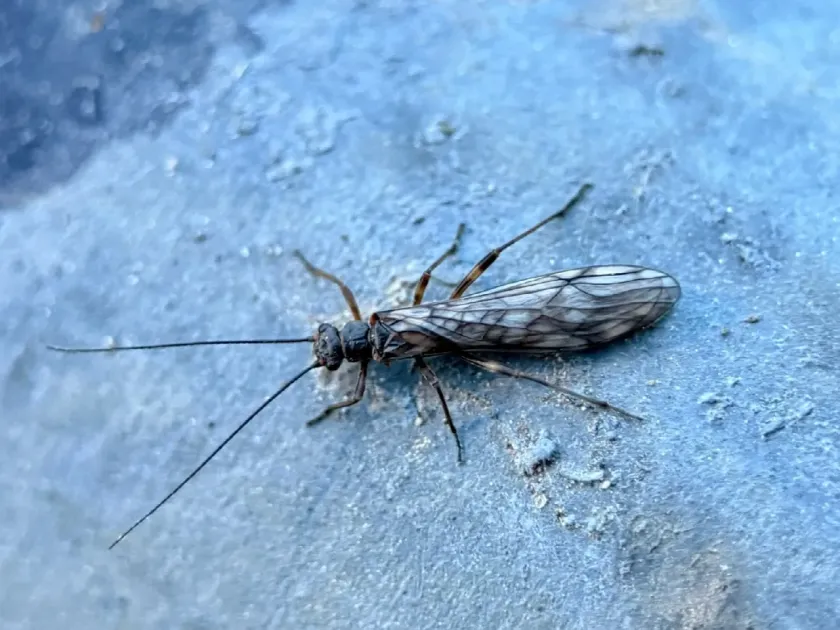
Description
How to identify
Protonemura meyeri belongs to the order Plecoptera (stoneflies) and the family Nemouridae. Adults are small insects with two pairs of membranous wings that fold flat over their abdomens when at rest.
The body color of the imago is typically dark brown or blackish, allowing it to blend in with bark or stones near aquatic habitats. They possess long, filiform antennae, which are a distinguishing feature of the family.
The larvae are aquatic and possess long, thread-like tails (cerci) and six strong legs. Their morphology is perfectly adapted for crawling on the substrate in clear, flowing streams.
Species identification often requires microscopic examination of the male genitalia, as external features can be very similar across different species within the Nemouridae family.
As hemimetabolous insects, they undergo a life cycle with incomplete metamorphosis, where the aquatic nymphal stage represents the majority of their lifespan.
What it damages
While stoneflies are not considered major pests, Protonemura meyeri can occasionally cause damage to fruit tree buds and young foliage during the spring emergence phase.
The damage occurs when large numbers of adults feed on succulent plant tissues, such as swelling buds, leading to stunted growth or reduced flower production in specific areas.
Plants located in close proximity to rivers or clear streams are most susceptible, as these are the primary sites where the insects originate.
The feeding patterns are usually irregular, characterized by nibbled edges on young leaves or damaged bud scales, which can create entry points for secondary pathogens.
Although the economic impact is rarely catastrophic, in high-density years, this activity can be detrimental to the vigor of young saplings in orchard fringes.
When it appears
The activity of adult Protonemura meyeri is strictly confined to the early spring period, aligning with the first warm days of the season.
The emergence of adults from water coincides with the crucial growth stages of deciduous trees, making the succulent buds an attractive food source for the insects.
Adult longevity is quite short, lasting only a few weeks, which is solely dedicated to mating and laying eggs back into the water to ensure the next generation.
Warmer weather in late winter can lead to an earlier emergence, which is a critical observation point for farmers monitoring local orchard health.
Typically, there is only one generation per year, limiting the duration of the insect's presence to a specific, short-term window during the early growing season.
Signs of infestation
The primary sign of their presence is the direct observation of adult insects resting on tree trunks or branches, especially in the early morning hours.
Damaged buds appear ragged or partially eaten, and in severe cases, the bud scales may drop prematurely before the leaves can fully expand.
Leaves that manage to open despite the damage may show small holes or marginal nibbling, which is indicative of earlier adult feeding activity.
Discarded larval skins (exuviae) found on rocks or near the waterline are a clear indicator of a local breeding population of stoneflies.
Orchards bordering streams that show uneven or reduced budding success during early spring should be inspected for the presence of these insects.
Control measures
General chemical intervention is rarely recommended for stoneflies as they are part of the riparian ecosystem and usually do not cause economic loss on a wide scale.
Effective management focuses on robust orchard maintenance and promoting plant vigor, which allows trees to withstand minor bud damage.
If significant damage is observed in sensitive crops, localized application of authorized contact insecticides at the bud-burst stage may be utilized.
- Monitoring of orchard areas adjacent to streams during the early spring.
- Using eco-friendly deterrents if adult populations become exceptionally high.
- Maintaining clean water sources to support natural predators of stonefly nymphs.
Careful timing is essential; insecticide usage should be avoided once pollinators and other beneficial insects begin to emerge in the spring.
Taxonomy
- Latin name
- Protonemura meyeri
- Family
- Nemouridae
- EPPO code
- PNMRME
Discussion
No discussions yet — be the first.