
Nemurella
Nemurella
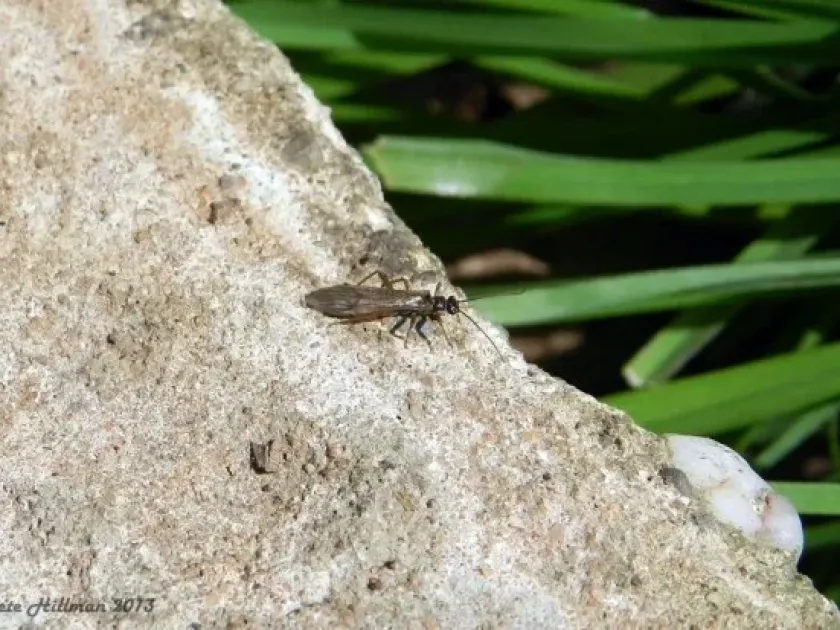
Description
How to identify
Nemurella belongs to the order Plecoptera and the family Nemouridae. Adult individuals are small insects with soft bodies and transparent wings that fold along the back when at rest.
Larvae of Nemurella are aquatic, developing in clean running water and moist soil near riverbanks. Their bodies have a characteristic flattened shape, allowing them to move efficiently in water currents.
A distinctive feature of the family is the presence of specialized gill filaments in larvae, which allow them to breathe dissolved oxygen in water for extended periods.
Imago of Nemurella are characterized by low flight activity and are often found on coastal vegetation, where mating and egg-laying occur.
The insect's development undergoes incomplete metamorphosis, meaning there is no pupal stage, with larvae appearing as a miniature copy of the adults.
What it damages
Although adult stoneflies are often considered harmless, mass aggregations of Nemurella can cause damage to coastal and lowland vegetable and cereal crops.
Damage is primarily caused during spring flooding, when insects migrate from breeding areas to agricultural lands located in low-lying areas.
Larvae living in moisture-saturated soil can damage the root systems of young plants, leading to slowed growth and general inhibition of vegetation.
The greatest damage occurs in the early spring period, when plants have a weakened immune system after winter and are unable to fully regenerate after damage.
Indirect damage manifests through the spread of various pathogens via mechanical plant tissue damage, which can trigger secondary fungal infections.
When it appears
The development cycle of Nemurella is closely linked to temperature and humidity, which determine the timing of the pest's appearance in the fields.
Mass emergence of imago usually occurs in early spring, coinciding with the period of active snowmelt and river flooding in the insect's distribution zones.
Larvae are most active at the end of winter and early spring, when water levels reach their maximum, allowing them to inhabit coastal soil areas.
In summer, there is a significant decline in pest activity associated with the drying of temporary water bodies and unfavorable conditions for development.
In autumn, eggs are laid, which overwinter in the soil or on plant debris, ensuring population survival during the cold season.
Signs of infestation
The first sign of Nemurella in the field is the detection of adults on plant stems during morning hours when the insects are still slow-moving.
When the root system is damaged, plants turn yellow, tops begin to wilt, and the overall density of the crop in lowland areas noticeably decreases.
On the surface of moist soil near the crops, one can notice traces of larval activity or empty exuviae left behind after molting.
Inspection of the root system reveals necrotic spots and specific gnaw marks, which indicate the presence of the pest in the root zone.
- Yellowing of lower seedling leaves
- Presence of adults on the underside of leaves
- Stunted growth in lowland zones
- Small tunnels in the basal part of the stem
Control measures
The main method for controlling Nemurella population is land reclamation and the organization of proper drainage on fields prone to flooding.
Agrotechnical measures, such as regular soil cultivation and the removal of weeds along riverbanks, significantly reduce the pest population.
The use of biological control agents, including preparations based on entomopathogenic fungi, allows for the containment of infestation outbreaks without ecosystem harm.
In cases of high population density, the use of contact-stomach insecticides authorized for regional use may be considered.
Maintaining crop rotation and avoiding the planting of sensitive crops in immediate proximity to permanent water bodies helps prevent mass crop damage.
Taxonomy
- Latin name
- Nemurella
- Family
- Nemouridae
- EPPO code
- NMRLSP
Discussion
No discussions yet — be the first.