
Amphinemura sulcicollis
Amphinemura sulcicollis
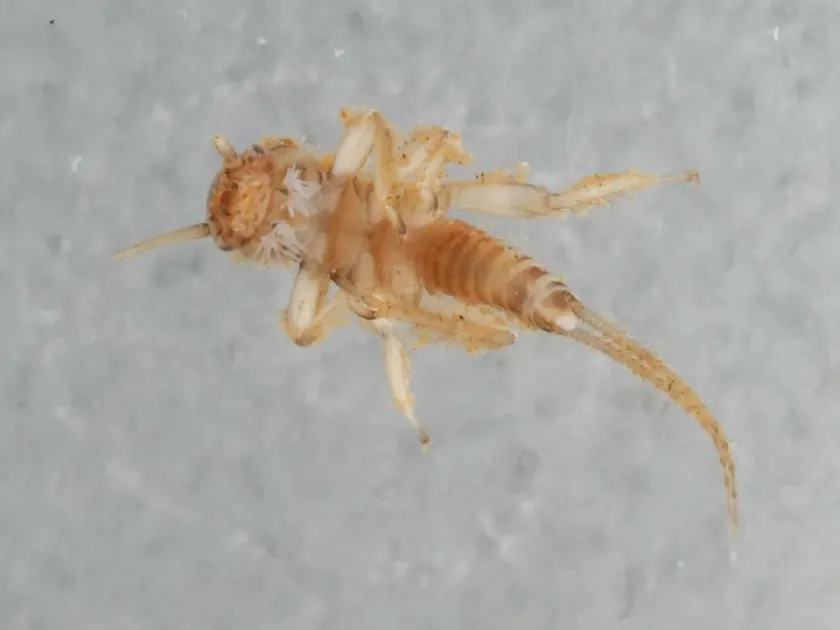
Description
How to identify
Amphinemura sulcicollis is a species of stonefly belonging to the order Plecoptera and the family Nemouridae. This insect is primarily recognized for its aquatic larval stage, which is characteristic of the entire order.
Adult insects have soft, flattened bodies with two pairs of membranous wings that lie flat over the abdomen when at rest. They are typically brown to dark brown, allowing them to blend into tree bark and foliage.
Larvae are aquatic and possess long, slender antennae and two cerci at the end of their abdomen. They are distinguished by thoracic gills that enable them to thrive in well-oxygenated, flowing water.
Identification at the species level usually requires microscopic examination of the male genitalia and the shape of the pronotum, which is unique for Amphinemura sulcicollis.
These insects are highly sensitive to water quality. Their presence is often used as a bio-indicator for clean, unpolluted running water in rural and forested environments.
What it damages
While stoneflies are not considered major agricultural pests, Amphinemura sulcicollis can occasionally cause minor damage to crops situated in immediate proximity to their aquatic breeding grounds.
Adults may feed on tender leaves, flower buds, and young shoots during the peak of their emergence, leaving behind irregular holes and notches in the leaf tissue.
The damage is typically localized and does not pose a systemic threat to large-scale agricultural operations, as the feeding behavior is limited to the adult stage.
Larvae are exclusively aquatic and feed on detritus, algae, and decaying organic matter on the stream bottom, meaning they do not interact with or damage terrestrial crops.
Economic losses associated with this species are negligible; however, in years with exceptionally high population density, aesthetic damage to orchard foliage may be observed.
When it appears
The lifecycle of Amphinemura sulcicollis is long and complex, with the larval stage spending one to two years developing in the water before maturation.
The emergence of adults typically occurs in the spring and early summer, spanning from April to June, depending on local water temperatures and climatic conditions.
After reaching the shore, adults become active in terrestrial environments, where they mate and females return to the water to oviposit eggs onto suitable substrates.
The embryonic development of eggs occurs in the water, leading to the hatching of first-instar larvae that settle into the stream bed to continue the life cycle.
Adult activity is highly temperature-dependent; they prefer humid, sheltered environments and are most active during warm, calm days, hiding during inclement weather.
Signs of infestation
Signs of infestation include the presence of adult insects gathered in clusters on the leaves of shrubs and trees located near streams, rivers, or irrigation canals.
Leaf damage appears as small, irregular holes or "windowing," where the epidermis is removed, resulting from the adult stoneflies feeding on the plant tissue.
The most reliable sign of a recent emergence is the discovery of shed larval skins (exuviae) left on rocks, bridge structures, or stems near the water's edge.
A noticeable increase in fluttering activity around the edges of fields near water sources often coincides with the peak emergence period of this species.
In cases of high density, droppings on the foliage and the physical presence of the insects may lead to slight discoloration or contamination of the affected plant surfaces.
Control measures
Control measures are rarely required for Amphinemura sulcicollis, as they are not primary pests and their impact is limited by their reliance on aquatic habitats.
For small-scale orchard or garden protection, physical removal (shaking branches early in the morning) is sufficient to reduce the number of adults feeding on foliage.
Cultural practices, such as maintaining clean stream banks and removing excessive debris that serves as adult shelter, can help discourage them from congregating near sensitive crops.
Chemical intervention is not recommended, as it is economically unjustified and may negatively impact the surrounding aquatic ecosystem and beneficial insect populations.
Preserving natural predators, such as birds and spiders near aquatic habitats, is the most effective way to manage and regulate the population of these insects naturally.
Taxonomy
- Latin name
- Amphinemura sulcicollis
- Family
- Nemouridae
- EPPO code
- AMNMSU
Discussion
No discussions yet — be the first.