
Nemoura cinerea
Nemoura cinerea
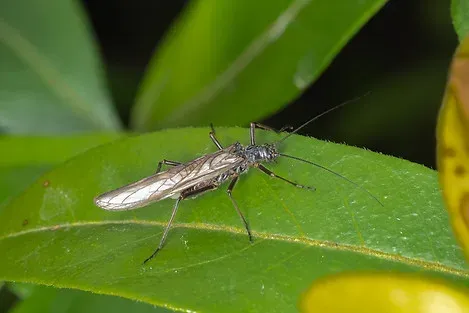
Description
How to identify
Nemoura cinerea is a species of stonefly belonging to the family Nemouridae. Adult insects are typically gray-brown with a body length of 10–15 mm.
They possess transparent wings with complex venation that are folded flat over the abdomen when at rest. Their antennae are long and filiform, serving as sensitive receptors.
The aquatic larvae are flattened to navigate successfully among stones and debris in flowing water. They have well-developed legs and specialized gills for respiration.
These larvae lack the bright coloration of many other insects, usually appearing brownish or yellowish to blend in with the aquatic substrate.
Distinguishing features include the presence of long cerci at the tip of the abdomen and tufts of gills located on the thorax, which are vital for underwater survival.
What it damages
While stonefly larvae are primarily detritivores, high populations can damage submerged or riparian vegetation, affecting the overall health of nearby plants.
Adult stoneflies occasionally feed on plant tissue, causing minor damage to buds and young leaves of sensitive crops, especially during massive emergence events.
Agricultural damage is often localized, primarily occurring in nurseries or greenhouses situated near natural streams where the stonefly life cycle takes place.
Feeding by adults can result in ragged leaf margins and weakened buds, which may serve as entry points for bacterial or fungal pathogens in moisture-rich environments.
In hydroponic setups, the presence of larvae in the water system can disturb root development, leading to stress and reduced vigor in commercial plant production.
When it appears
The life cycle of Nemoura cinerea is strictly tied to water temperature, with adult emergence starting in early spring just as ice melts.
The peak activity of adults usually occurs between April and May, during which they congregate on nearby vegetation for mating and oviposition.
Eggs are deposited directly into water, where the larval stage follows, which can last from one to two years depending on environmental conditions.
The emergence of adults is highly synchronized, leading to large swarms near water bodies that coincide with the early growth phase of many plant species.
Environmental factors such as water current speed and organic matter availability regulate the timing and density of the seasonal population cycle.
Signs of infestation
Presence can be detected by observing swarms of gray insects on trees or shrubs located immediately adjacent to water sources during the spring months.
Feeding signs on plants include uneven leaf damage and skeletonized areas, often accompanied by the presence of exuviae (cast-off skins) on plant stems.
In irrigation or hydroponic systems, the detection of mobile, flattened larvae in the water reservoir is a clear indicator of a pest infestation.
Wilting of young shoots or necrotic patches on leaves near the water source can be a secondary sign of damage caused by the feeding activity of these insects.
Increased activity of birds or spiders around riparian zones can also serve as a behavioral indicator of a high concentration of emerging stoneflies.
Control measures
The most effective management strategy involves maintaining clean water channels and removing excessive organic debris that serves as food for larvae.
During peak emergence, protective physical barriers such as fine mesh screens on greenhouse vents can prevent adult stoneflies from reaching sensitive crops.
Targeted use of insecticides may be necessary in extreme cases, focusing on perimeter treatments to protect high-value nursery plants from adult damage.
Monitoring programs using light traps can help determine the timing of the emergence, allowing for timely preventative actions before significant damage occurs.
- Removing leaf litter from canal banks to limit larval food.
- Installing physical insect barriers on greenhouse openings.
- Regular inspections of hydroponic nutrient solutions for larvae.
Taxonomy
- Latin name
- Nemoura cinerea
- Family
- Nemouridae
- EPPO code
- NEMOCI
Discussion
No discussions yet — be the first.