
Nemoura avicularis
Nemoura avicularis
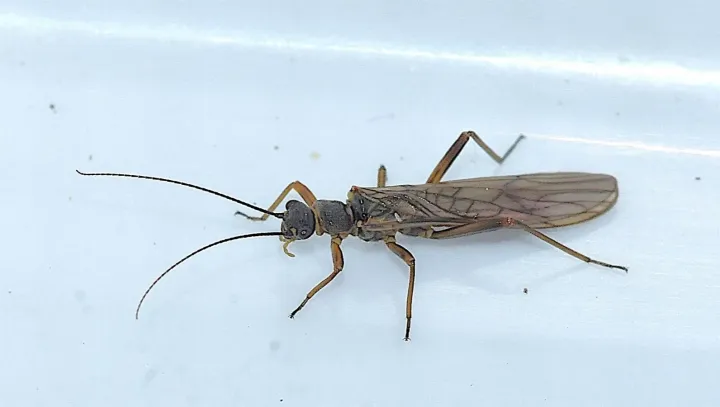
Description
How to identify
Nemoura avicularis belongs to the order Plecoptera, commonly known as stoneflies, and the family Nemouridae. These insects undergo incomplete metamorphosis and are characterized by a soft, brownish body.
Adult stoneflies have membranous wings with a distinct vein pattern, and they are generally weak fliers that tend to stay near their native water bodies during their short adult life.
The larval stage, or nymph, is entirely aquatic, possessing specialized external gills and long, thread-like cerci at the end of the abdomen to facilitate movement in stream beds.
These insects are highly sensitive to water quality and oxygen levels, making them excellent bioindicators for healthy, unpolluted aquatic environments.
Scientific identification of Nemoura avicularis is based on detailed examination of the male genitalia and specific morphological traits, which are distinct from other related species.
What it damages
Nemoura avicularis is not considered a crop pest. They do not feed on agricultural crops, and their impact on commercial farming is essentially non-existent in terms of direct damage.
Their presence is mostly relevant to water management in agricultural landscapes, as they require clean, well-oxygenated water which is essential for healthy irrigation systems.
The larvae primarily consume detritus and algal growth, helping to clean the aquatic ecosystem by breaking down organic matter that washes into streams and irrigation channels.
Mass reproduction of stoneflies is usually a sign of high organic content in the water, which can occasionally lead to minor clogging issues in delicate irrigation equipment.
Overall, they pose no threat to plant health and are generally regarded as beneficial components of the aquatic food web surrounding agricultural areas.
When it appears
The life cycle of Nemoura avicularis is strictly seasonal, with adult emergence typically occurring in spring, matching the phenology of many riparian insects.
Eggs are deposited into the water, where they develop into nymphs. This aquatic phase spans most of the year, involving multiple molts as the larvae grow larger.
Development is highly dependent on water temperature; cooler temperatures during autumn and winter facilitate the growth and maturation of the nymphs.
During the warmer summer months, growth rates may stabilize, or the insects may inhabit deeper, cooler parts of the water body to survive temperature fluctuations.
The synchronized emergence of adults is an evolutionary strategy to maximize mating success before the insects complete their relatively short lifespan on land.
Control measures
No chemical or biological control methods are required for Nemoura avicularis, as they are not pests of any agricultural crops or stored products.
To maintain the health of irrigation systems, ensure that water filtration and maintenance schedules are followed, preventing any buildup of debris.
Good agricultural practices that minimize nutrient runoff into local streams help sustain these insects as bioindicators of healthy water, which is vital for quality irrigation.
Avoid excessive use of broad-spectrum pesticides near water bodies, as stoneflies are highly susceptible to chemical contamination, which can disrupt the local ecosystem.
Monitor water quality regularly to ensure that environmental conditions remain optimal for both agriculture and the native aquatic fauna.
Taxonomy
- Latin name
- Nemoura avicularis
- Family
- Nemouridae
- EPPO code
- NEMOAV
Discussion
No discussions yet — be the first.