
Amphinemura standfussi
Amphinemura standfussi
Description
How to identify
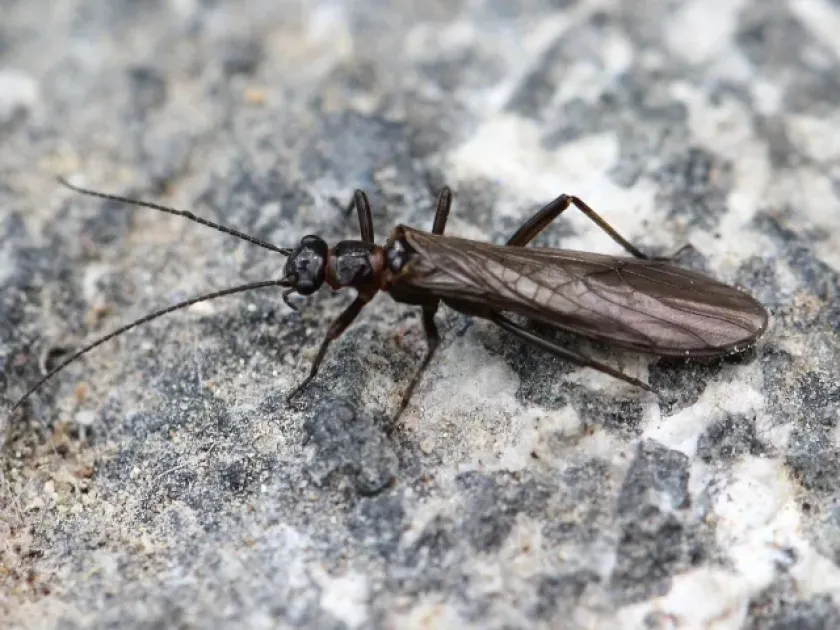
Amphinemura standfussi belongs to the order Plecoptera, known as stoneflies, and the family Nemouridae. Adults are characterized by soft bodies and delicate, transparent wings folded over the abdomen.
The larvae are aquatic and possess distinct cervical gills, a key feature for identifying this family, which helps them survive in well-oxygenated running water.
Adult stoneflies generally exhibit a dark brown or blackish color, providing effective camouflage against tree bark and vegetation located near riverbanks or streams.
The mouthparts of the adults are of the chewing type, though many individuals spend their short adult lives focusing on reproduction rather than feeding.
Typically, these insects are small, measuring between 7 to 10 mm in length, with females being notably larger than males, which is a common trait in this genus.
What it damages
While stoneflies are primarily regarded as indicators of water quality, the larvae of certain species like Amphinemura standfussi can occasionally cause damage to agricultural crops.
The primary concern arises in fields adjacent to water bodies where larvae may emerge and feed on the succulent parts of young plants during their transitional phase.
Damage often appears as skeletonized leaves or chewed edges, particularly in low-lying areas that are prone to seasonal flooding or water saturation.
Heavy infestations can significantly weaken seedlings, making them more susceptible to secondary pathogens and further environmental stress.
The economic impact is generally localized but can be significant for farms situated in floodplains where water levels are difficult to manage consistently.
When it appears
As suggested by the common name of the order, adults are most active during the spring, which is when they emerge to mate and lay eggs.
The larval stage, however, is much longer, with development occurring throughout the colder months within the aquatic environment of streams and drainage ditches.
Peak emergence of adults usually happens between April and May, often correlating with the early growth stages of surrounding agricultural crops.
The life cycle is heavily dependent on water temperature and flow; in cooler regions, it may span one to two years to complete a single generation.
By late spring or early summer, adult activity subsides, and the population shifts back into the aquatic developmental phase, reducing the direct threat to land crops.
Signs of infestation
Visible signs of infestation include irregular holes or ragged edges on the leaves of crops grown near irrigation canals or riparian zones.
Finding exuviae, the shed larval skins, on stems or nearby rocks is a strong indication that the stonefly population is active in the vicinity.
Adults can often be spotted in the early morning hours, resting under the leaves of host plants or on shaded structures near the water's edge.
A general decline in the vigor of crops located in water-logged areas can serve as a warning sign, even if the insects themselves are not immediately seen.
Monitoring the moisture levels of the soil near water sources can help identify zones where the larvae might congregate before emerging as adults.
Control measures
Effective management begins with soil moisture control and the maintenance of proper drainage systems to prevent water from stagnating around crop roots.
Regular maintenance of irrigation canals, including the removal of excess vegetation, helps disrupt the habitat where larvae develop and adults lay eggs.
In cases of significant damage, the use of biorational pesticides that are safe for aquatic ecosystems can be a viable strategy to manage adult populations.
Crop rotation and mechanical soil management can reduce the suitability of an area for larval development by drying out potential breeding sites.
- Optimize field drainage to prevent flooding.
- Clear riparian vegetation near water channels.
- Monitor adult emergence in early spring.
Taxonomy
- Latin name
- Amphinemura standfussi
- Family
- Nemouridae
- EPPO code
- AMNMST
Discussion
No discussions yet — be the first.