
Stonefly
Protonemura
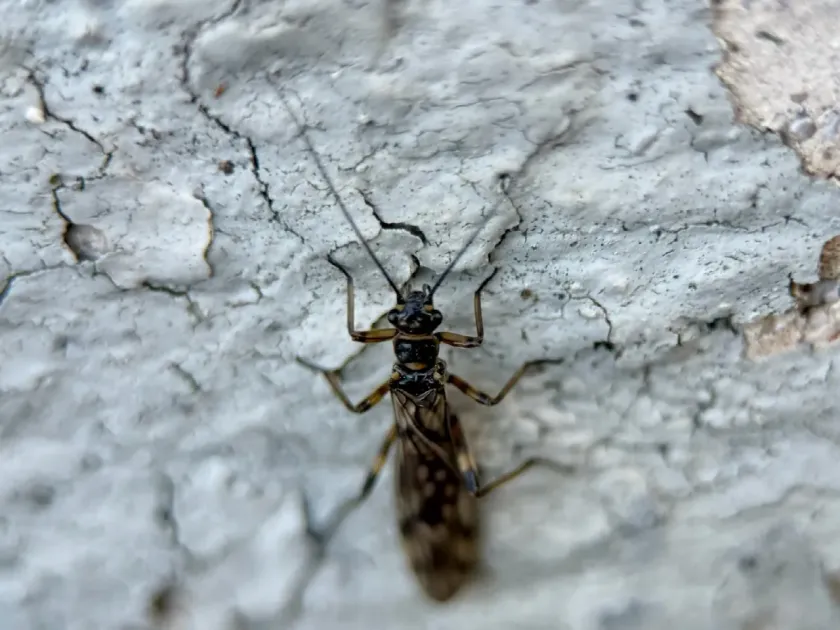
Description
How to identify
Stoneflies (Protonemura) belong to the order Plecoptera and the family Nemouridae. Adults typically feature an elongated body, soft integument, two pairs of membranous wings with distinct venation, and long antennae.
Their coloration ranges from brown to black, allowing them to camouflage effectively on tree bark or rocks near water sources. Adults have chewing mouthparts, although they feed quite infrequently.
Nymphs (larvae) live exclusively in aquatic environments, preferring flowing waters with high oxygen levels. They possess distinct cerci and two pairs of tracheal gills, which differentiate them from other insect larvae.
The development involves several nymphal stages, each requiring specific water purity conditions. Identification is challenging because most species are active during cooler seasons.
It is important to distinguish stoneflies from other similar insects, as they are rarely considered major agricultural pests compared to other insect orders.
What it damages
The damage caused by stoneflies is specific, as adults may feed on young buds and tender leaves of fruit trees during early spring. This occurs primarily near forest edges or natural water bodies.
While in the water, nymphs do not cause direct damage to plants; however, mass emergence of adults can negatively affect ornamental plants by nibbling the edges of leaf blades.
The highest risk of damage occurs in gardens located in lowlands or near streams, where conditions are most favorable for the emergence of imagos from the water.
Damage can reduce the overall vegetative activity of trees, which is critical during the budding stage, although significant economic losses are rare.
The impact is often sporadic and localized, depending on the proximity of hydrological sites favorable for nymph development.
When it appears
The life cycle of stoneflies is closely linked to seasonal water temperature fluctuations. Mass emergence of adults usually occurs in early spring, immediately after the ice melts.
The period of peak adult activity coincides with April and May, overlapping with the bud break of most garden crops.
Nymphs develop in water over a long period, often ranging from one to three years, depending on the species and environmental conditions.
Pupation does not occur because stoneflies undergo incomplete metamorphosis, with the imago emerging directly from the final nymphal stage after leaving the water.
Water temperature is the primary factor determining the timing of this pest's appearance in the garden.
Signs of infestation
Visual signs include the presence of the insects themselves on leaf surfaces or tree trunks during early morning hours when their activity is minimal.
Typical damage signs include unevenly nibbled leaf edges and partially damaged bud scales, which appear as the result of small chewing pests.
A large number of adult stoneflies on building walls or plant supports near water indicates the proximity of breeding sites.
Upon inspection, one may notice exuviae (cast-off nymph skins) on rocks or vegetation along the water's edge.
In cases of mass emergence, a characteristic fluttering of wings can be heard if the insects are disturbed within the tree canopy.
Control measures
Prevention involves removing excess vegetation near water bodies and clearing banks of rotting organic matter where adults may hide.
Using light traps at night can significantly reduce the number of adult stoneflies near orchards and nurseries.
The use of insecticides is advisable only when the damage threshold is exceeded, typically at the start of the growing season, using broad-spectrum contact pesticides.
- Spraying with contact insecticides during early morning hours.
- Installing sticky bands on tree trunks to restrict insect movement.
- Cleaning the channels of small water bodies of sediments to interrupt the life cycle.
Agrotechnical methods, such as timely pruning and fertilization, increase tree resilience against minor pest damage.
Taxonomy
- Latin name
- Protonemura
- Family
- Nemouridae
- EPPO code
- PNMRSP
Discussion
No discussions yet — be the first.