
Pomacea lineata
Pomacea lineata
Description
How to identify
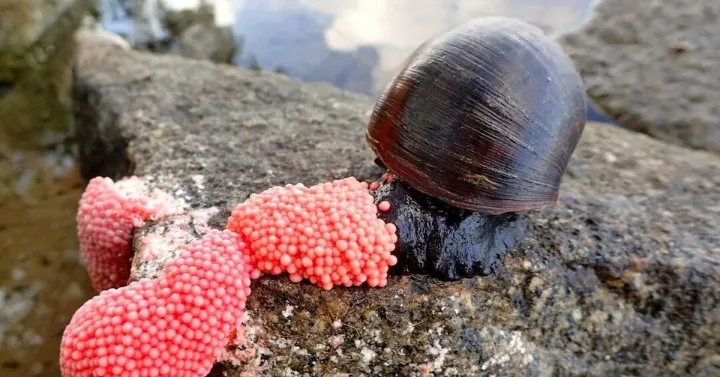
Pomacea lineata, commonly known as a type of apple snail, is a freshwater mollusk belonging to the Ampullariidae family. Adults are characterized by a large, globular shell that is typically yellowish to brown, often marked with distinct dark spiral bands.
A key diagnostic feature of this species is the operculum, a rigid trapdoor that allows the snail to seal its shell tightly when environmental conditions are unfavorable, such as during dry spells.
Females are easily identified by their egg-laying behavior. They deposit clutches of bright pink or reddish eggs on stalks, rocks, or any structure above the water line, making them highly visible.
The snail possesses a highly plastic biology, belonging to the order Architaenioglossa. It exhibits significant adaptability to various aquatic environments, which contributes to its status as a notorious invasive pest in agricultural systems.
Anatomically, Pomacea lineata is equipped with both gills and a lung, enabling it to breathe underwater and at the surface. This dual respiratory system allows it to thrive in oxygen-depleted waters where other organisms might struggle.
What it damages
The primary agricultural threat posed by Pomacea lineata is the destruction of young rice seedlings. They are most destructive during the early stages of plant growth, often consuming entire stands of newly emerged rice.
Beyond rice, this mollusk feeds on a wide range of aquatic and semi-aquatic plants, including water spinach and various ornamental flora. When population densities are high, they can devastate almost any soft plant tissue in their vicinity.
The feeding habit involves rasping plant tissue with a radula, leading to rapid tissue loss. In rice cultivation, this results in significant gaps in the field, necessitating expensive replanting and lowering total yields.
Snails may also damage the roots of seedlings, causing the plant to lose structural integrity and wither. In extreme cases, a dense population can destroy an entire paddy field in just a few days if left unmonitored.
Furthermore, their presence in irrigation channels can lead to the clogging of water systems with mucus and decaying plant matter, indirectly impacting the water quality needed for healthy crop development.
When it appears
The activity and reproduction of Pomacea lineata are heavily dependent on water temperature. They are most active during warmer months, typically when temperatures exceed 20°C to 25°C.
As the season progresses and conditions become optimal, snails emerge from aestivation (a state of dormancy) in the mud. This emergence often coincides with the rice planting season, creating an immediate conflict.
With a very short lifecycle, these snails can produce multiple generations in a single year under favorable tropical or subtropical conditions, leading to an exponential increase in population density.
Winter months or cooler periods are spent burrowing into the sediment of irrigation ditches or riverbanks. Once the weather warms, they migrate back into the fields, often carried by the flow of irrigation water.
The spread of the pest is closely linked to water management practices. Irrigation canals serve as the main highway for both adult snails and their egg-containing debris to infest new plots.
Signs of infestation
The most reliable sign of an infestation is the presence of the aforementioned bright pink egg clutches on stems or hard surfaces. Finding these is a clear indicator that immediate intervention is required.
In the field, visual signs include large, bare patches where rice plants have vanished. Upon close inspection, remaining leaves will show characteristic edges that appear rasped or cleanly cut.
- Accumulation of empty shells near water inlets after drainage.
- Mucus trails visible on wet soil or surrounding vegetation after nocturnal movement.
- Aggregation of adult snails at the bases of rice stools during the early morning.
The presence of active, striped snails floating or crawling in the water is proof of a well-established colony that is already causing damage to the crop.
Differentiating Pomacea lineata from native aquatic snails is important. P. lineata is generally larger, more voracious, and displays a more rapid pace of movement across the bottom of the paddy.
Control measures
Manual removal of egg clutches is a primary, low-cost control method. Regularly inspecting stems and removing pink egg masses can significantly reduce the potential population size before they hatch.
Cultural control involves proper field preparation, such as deep plowing to expose and kill dormant snails. Managing the water level to be shallow during the seedling stage can also make it harder for the snails to thrive.
Biological control, such as introducing ducks into the rice fields after the seedlings are established, is a highly effective traditional method, as ducks readily consume both young and adult snails.
Chemical control utilizing molluscicides can be employed when populations reach economic injury levels. However, caution is required to prevent the contamination of water sources and to avoid harming non-target aquatic life.
Integrated Pest Management (IPM) is the most sustainable approach. It combines monitoring, mechanical clearing, and habitat modification, ensuring that the impact of the snails is minimized while protecting the ecological health of the farm.
Taxonomy
- Latin name
- Pomacea lineata
- Order
- Molluscs
- Family
- Ampullariidae
- EPPO code
- POMALI
Discussion
No discussions yet — be the first.