
Common blue
Polyommatus icarus
Description
How to identify
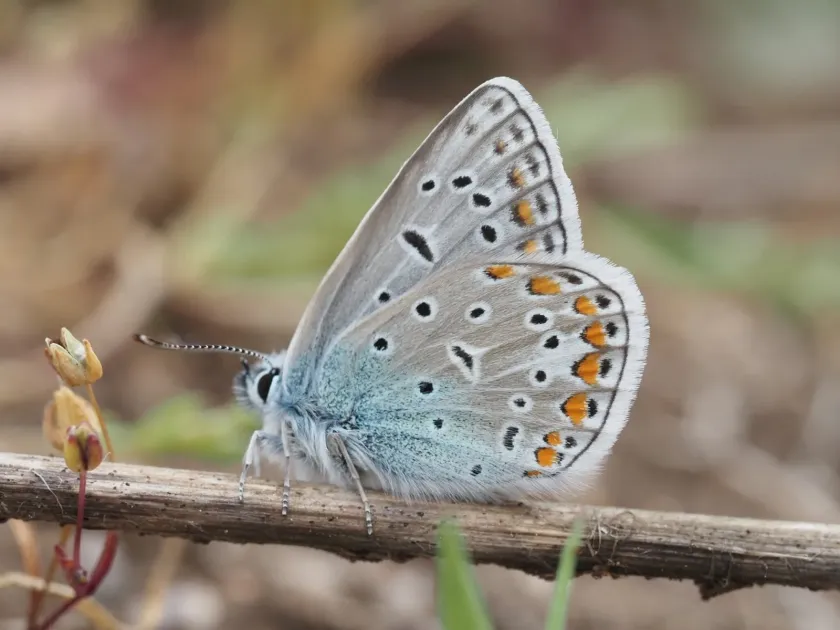
The common blue (Polyommatus icarus) is a butterfly in the family Lycaenidae, often found in meadows, pastures, and agricultural fields containing legumes.
The species exhibits sexual dimorphism, where males are a vibrant blue with a thin dark border, and females are typically brown with orange-red spots on the wing margins.
The larvae are slug-like in appearance, typically bright green with a darker green stripe along the back, which provides effective camouflage against host plants.
The pupae are often found in the soil at the base of host plants or amongst debris, showing a pale green or yellowish coloration that darkens before emergence.
These insects are relatively small, with a wingspan of approximately 30-35 mm, making them agile flyers during the warm daylight hours.
What it damages
The primary damage is caused by the larvae, which feed on the foliage, buds, and flowers of various legumes, potentially threatening crop yields.
Key crops affected include lucerne (alfalfa), clover, vetch, and sainfoin, which are essential forage plants in many agricultural regions.
By consuming leaf tissue and floral buds, larvae reduce the photosynthetic capacity and seed-bearing potential of the affected plants.
Under high population pressure, significant defoliation can occur, resulting in reduced biomass production and poor quality of hay harvest.
Feeding damage can also create entry points for secondary plant pathogens, further degrading the health and vigor of the leguminous crop.
When it appears
The common blue typically produces two or three generations per year, with the emergence timing heavily influenced by local climate and temperature.
Adult flight periods span from late spring through early autumn, typically peaking in mid-summer when environmental conditions are most favorable.
Overwintering occurs at the larval stage, with the caterpillars resting near the soil level among crop residues or weed cover to survive cold temperatures.
In spring, as temperatures rise, the larvae resume feeding on the fresh growth of leguminous crops, completing their development into pupae.
Optimal conditions for larval survival include mild, humid weather, whereas severe heat or drought may negatively impact the population dynamics.
Signs of infestation
Early detection is possible by inspecting foliage for characteristic small, ragged feeding holes or irregular edges caused by larval activity.
The presence of adult butterflies hovering over the field is a primary indicator of reproductive activity and potential egg-laying on host plants.
Larvae are often difficult to spot due to their green color matching the host plant, but they can be found by examining the undersides of leaves.
Stunted growth, sparse foliage, and lower flower production are typical signs of heavy infestation within a specific area of the field.
- Ragged feeding holes in legume leaves.
- Adult butterflies active in the field.
- Presence of green slug-like larvae on stems.
- General decline in crop biomass.
Control measures
Effective management begins with maintaining clean field borders by controlling wild legumes and weeds that act as reservoir hosts for the larvae.
Strategic harvesting of hay crops can effectively disrupt the life cycle of the common blue by removing the food source before larvae complete development.
When infestation levels exceed economic thresholds, the application of targeted insecticides is necessary to prevent significant yield losses.
Biological control options, including Bacillus thuringiensis-based products, provide an environmentally friendly alternative for controlling young larval populations.
Regular field scouting and pheromone monitoring are critical tools for timing interventions and ensuring the long-term sustainability of the pest management program.
Taxonomy
- Latin name
- Polyommatus icarus
- Order
- Lepidoptera (butterflies)
- Family
- Lycaenidae
- EPPO code
- PQLYIC
Discussion
No discussions yet — be the first.